
Heidi Name Meaning: Its Roots, Symbolism, and Lasting Identity

Heidi is one of those names that seems to arrive in a voice smaller than its inheritance. It sounds bright, alpine, affectionate, almost immediate, as though it belongs naturally to childhood and open air. But the idea under it is older and weightier than the sound first suggests. Heidi means noble, and that gives the name a different center of gravity. Nobility, in its oldest sense, is not glitter or rank alone. It is bearing, self-command, a certain inner height. So the name does something interesting from the very start: it dresses dignity in a friendly silhouette.
That is why Heidi has lasted longer than many names that share its cheerful clarity. Official data shows it still remains in active American use in 2024, though not at the overheated levels that can flatten a name into fashion. It feels familiar, but not overfamiliar. It feels human-sized, but not slight. The literary memory attached to it through Johanna Spyri’s Heidi helped fix one side of the name in public imagination—mountains, childhood, sincerity, health, and natural goodness. Yet beneath that beloved surface remains the name’s older Germanic line through Adelheid and Adelaide, where nobility is the true root. Heidi is therefore not just sweet. It is sweetness carrying old structure.
Heidi's U.S. popularity rank over time, 1929–2024
Popularity statistics are based on official data from the Social Security Administration baby name records.
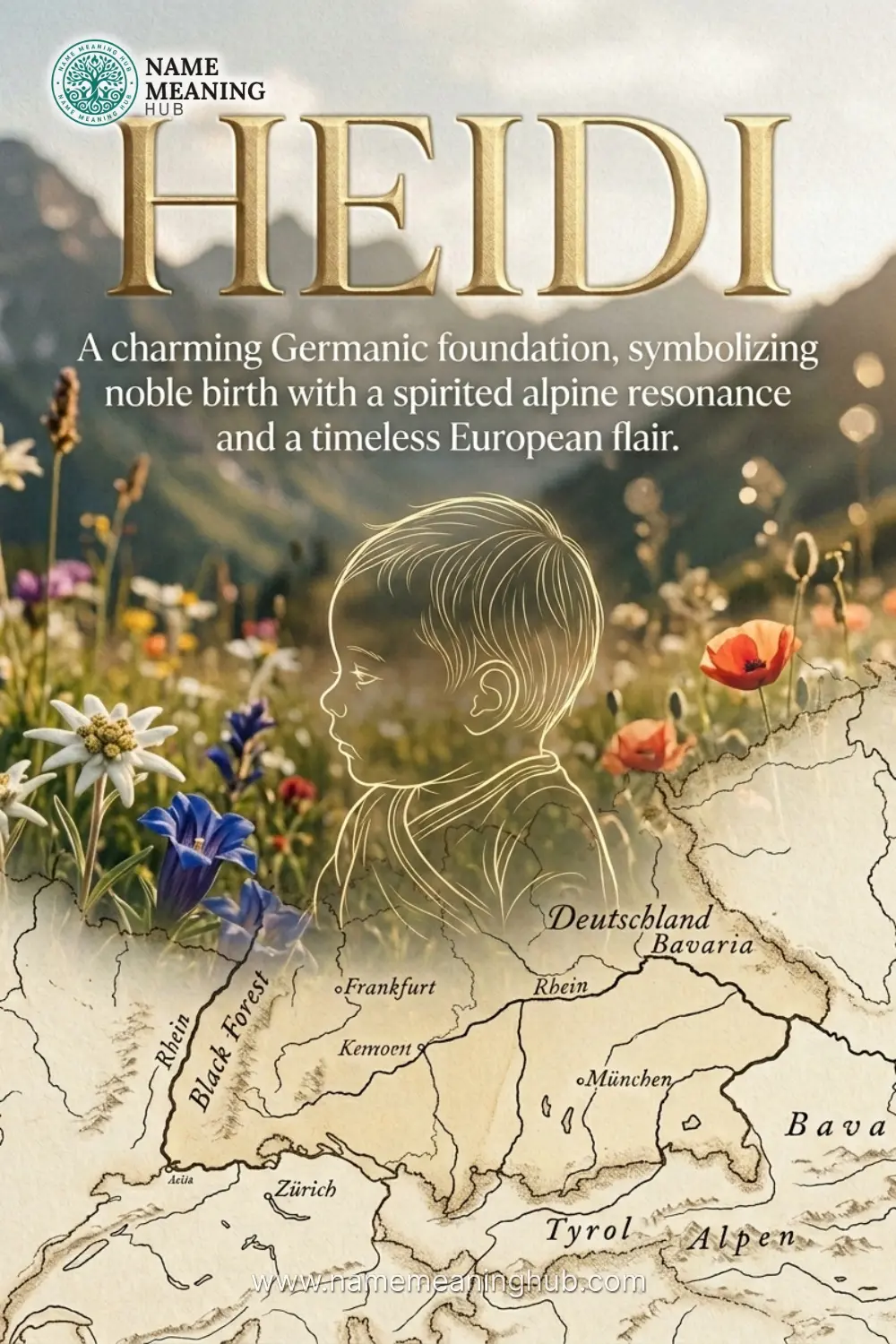
Heidi: A Charming and Noble Germanic Classic
Heidi reads as a name with one unmistakable center of gravity, where its visibility is concentrated almost entirely in its primary lane. Its current profile fits a broader naming-culture preference for “charming diminutives” that feel classic without being heavy .
The trace usage in the boys’ lane from decades past has largely faded, leaving a clearer present for feminine identity. Meaning “noble,” its simple two-syllable rhythm carries a sense of friendly familiarity and spirited character.
How Heidi carries more than charm
| Key Facts | Information | Quick Insight |
|---|---|---|
| Name | Heidi | The form feels light and familiar, but the name sits on a much older and more formal lineage than its sound alone suggests. |
| Primary Gender Usage | Female | Heidi reads clearly feminine in modern use, yet it avoids the ornamental softness that can make some girls’ names feel overly delicate. |
| Origin | Germanic | The Germanic root matters because it ties the name to a long tradition of strength and rank rather than to momentary style. |
| Core Meaning | Noble | This is the name’s hidden backbone: Heidi sounds approachable, but what it means is poise, dignity, and inherited strength. |
| Pronunciation | HY-dee | The lively first syllable gives the name lift, while the softer ending keeps it warm and personal. |
| Syllable Count | 2 | Two syllables make Heidi easy to carry in real life, which helps the older meaning feel lived rather than ceremonial. |
| U.S. girls’ rank (2024) | No. 345 | Heidi is visible enough to feel established, but uncommon enough now to sound chosen rather than expected. |
| Style Position | Literary, alpine, vintage-modern, quietly strong | Its appeal lies in the tension between bright friendliness and the older dignity carried underneath. |

Why Heidi makes nobility feel human-sized
The most important thing about Heidi is that its meaning does not sit on the surface in an obvious way. Many names meaning noble, royal, or exalted announce that fact through grandeur. They sound formal, polished, even slightly distant. Heidi does something subtler. It takes nobility and brings it into the scale of everyday affection. That is what makes the name so effective. It does not force dignity into a stiff pose. It makes dignity feel natural.
That matters because the idea of nobility can easily go wrong in naming. If treated shallowly, it becomes a costume—status without depth, elegance without humanity. But in stronger name traditions, noble means something closer to bearing: a person who carries herself with steadiness, a person whose inner tone is elevated rather than merely decorated. Heidi fits that older sense better than many grander names do. It sounds clear, bright, and kind, while still holding the idea of stature in reserve.
This balance makes Heidi particularly attractive in modern use. Parents often want a name for a daughter that does not sound meek or ornamental, but they also do not necessarily want something hard-edged or aggressively assertive. Heidi offers another path. It suggests self-possession without severity. A noble child in this naming sense is not a child of pomp. She is a child of inward quality. The name implies grace of conduct, a certain uprightness, the sense of someone who is not merely likable but well-formed.
There is also a social intelligence in the contrast itself. Because Heidi sounds warm and companionable, the meaning of noble does not create distance. Instead, it deepens the name. It makes the friendliness feel more grounded. That is one reason Heidi has aged better than many names that lean on sweetness alone. Sweetness without structure can fade. Heidi keeps its shape because nobility remains a durable aspiration.

How Heidi stepped out of Adelheid and became its own name
The project naming references are strikingly consistent about Heidi’s lineage. One name book describes Heidi as a Swiss pet form of Adelheid, the German form of Adelaide. Another calls it a short form of Adelaide and glosses that older form as noble. Additional entries list Heidi directly under Adelaide’s variants and diminutives, alongside Addie, Adelheid, and other related forms. Taken together, these references make the structure of the name unmistakable: Heidi began as an affectionate shortening, but it stands on a formal root with real historical mass.

Why the Adelheid line gives Heidi its backbone
Without Adelheid behind it, Heidi might sound merely pretty and alpine. With Adelheid behind it, the name gains architecture. Adelheid is an older Germanic form associated with nobility, and the project books repeatedly place Heidi under that umbrella. This matters because it explains why the lighter form never becomes empty. The affectionate surface is supported by a serious ancestral frame.
That is one reason Heidi feels stronger than many other diminutive-style names. It did not begin as a random clipping. It emerged through long usage from a form that already carried authority. A shortened name often retains something of the older name’s gravity even after becoming independent, and Heidi is a good example of that process done well.
Why Heidi no longer feels secondary
Modern parents rarely choose Heidi because they intend to use Adelheid formally and Heidi only at home. The shorter form has become fully self-sufficient. This is a common development in naming culture, where older pet forms leave the shadow of the formal name and become complete first names in their own right. Heidi has completed that transition so thoroughly that many listeners no longer think of it as a nickname at all.
That independence is part of its appeal. The name arrives already softened, already familiar, already easy to live with. Yet because its older line remains so clear, it does not feel slight. Heidi offers the emotional accessibility of an intimate name without sacrificing the credibility of a historical one.
Why the Germanic origin still shapes the mood of Heidi
Even when people do not consciously know the name’s route through Adelheid or Adelaide, they often hear something stable in Heidi. That stability comes partly from its Germanic bones. The name is brisk, clean, and sturdy in sound. It does not flutter. It steps. That suits the meaning well. Nobility here is not lace and formality; it is composure in motion. For more names connected to this tradition, see Germanic-origin names.
Project sources also describe Heidi as “noble” and in some places “noble, kind,” which helps explain why the name feels so well proportioned. Even while your fact packet governs the core meaning as noble, the broader project framing supports a reading of Heidi as a name whose dignity remains human, not severe. That is exactly how it behaves in real life.
Heidi in literature and memory: the mountain child who softened the name
One of the strongest cultural anchors for Heidi is literary. Project sources repeatedly note that Heidi is the title character of Johanna Spyri’s famous children’s story. That fact matters more than as simple trivia. It changed the emotional atmosphere around the name for generations. Through that novel, Heidi became associated with alpine landscapes, freshness, health, innocence, resilience, and a certain moral clarity tied to outdoor life. For many people, that story is still the first mental picture the name creates.
What is interesting is that the literary image does not cancel the older meaning of noble. It translates it. In Spyri’s world, nobility is not presented as courtly distance. It appears in sincerity, courage, and emotional generosity. The mountain setting strips away ornament and leaves character. That is why the literary Heidi continues to matter. She made the name vivid without making it shallow.
This also helps explain why Heidi can feel so wholesome without becoming bland. The book’s legacy attached the name to open air, recovery, and a kind of elemental goodness, but the name’s older roots kept it from sounding only childish. A literary association can sometimes trap a name in one role. Heidi escapes that because the story reinforced the name’s strength instead of reducing it.
Even in contemporary use, this memory still lingers. A woman named Heidi may not be heard primarily through the novel anymore, but the public familiarity of the figure keeps the name feeling lived-in rather than abstract. The literary anchor softened the nobility, made it pastoral, and brought it closer to ordinary life. That was not a weakening. It was one of the reasons the name endured.
What Heidi sounds like before anyone thinks about books or mountains
Phonetically, Heidi is one of those names that works immediately. HY-dee begins with a bright, rising first syllable and lands in a friendly second one. The opening gives it energy and visibility. The ending gives it warmth. This balance is part of why the name feels lively without feeling flimsy.
The first syllable matters especially. It gives the name motion. There is something almost outdoorsy in the sound itself—quick, fresh, and open. Then the second syllable rounds the name into intimacy. Without the strong opening, Heidi might sound too diminutive. Without the softer ending, it might sound too clipped. Together they create a name that is easy to call, easy to remember, and unusually versatile across life stages.
This also means Heidi performs well in everyday speech. It is difficult to mispronounce in English, quick to write, and visually uncomplicated. That practical fluency has likely contributed to the name’s survival. Distinctiveness alone is not enough to sustain a name; it also has to live well in ordinary use. Heidi does.
The visual form helps too. Five letters, no ornament, no confusion. It looks direct. That directness strengthens the name’s modern appeal. A great many parents want names that feel warm and individual without becoming administratively burdensome. Heidi offers exactly that. It sounds a little special, but behaves like a very usable classic.
Heidi in the current chart feels selective, not faded
Official Social Security Administration (SSA) data places Heidi at No. 345 for girls in 2024. That ranking says something important. Heidi is no longer sitting at the hottest center of naming culture, but it has not disappeared into obscurity either. It lives in a socially useful middle zone: familiar enough to be trusted, uncommon enough to feel intentional. To compare tone, familiarity, and fit across similar names, explore girl naming ideas.
This position suits the name especially well. A name like Heidi can suffer if it becomes too ubiquitous, because some of its alpine brightness depends on a little air around it. At the same time, it is too historically rooted and too culturally legible to function best as a hidden rarity. No. 345 suggests the right balance. The name is recognized, but not exhausted.
That middle-zone status also changes how people hear it. Instead of sounding like a generational default, Heidi now sounds like a decision. It tells the listener that the parents likely wanted warmth, history, a little literary memory, and a meaning stronger than the sound first suggests. In other words, rarity has sharpened the name’s internal design.
Heidi among its relatives and style neighbors
Heidi lives near names like Adelaide, Adele, Adeline, Elsa, Hilda, and Greta in the broader field of European feminine names, but it does something different from all of them. Adelaide is fuller and more formal. Adele is cooler and sleeker. Adeline is softer and more polished. Elsa is cleaner and more wintry. Greta is firmer and more angular. Heidi sits in its own middle ground: intimate, bright, mountain-clear, and quietly noble.
That distinctness matters because it keeps Heidi from feeling like a backup option to a more formal name. It has its own atmosphere. It feels less urban than Adele, less stately than Adelaide, less fairy-tale-coded than Elsa, and less severe than Greta. The result is a name with a striking combination of friendliness and self-command.
This is one reason the name continues to appeal even when adjacent European classics rise and fall around it. Heidi does not need trend energy to justify itself. It has enough history, enough literary life, and enough built-in meaning to stand apart without seeming mannered.
Where Heidi opens next
Middle names can either steady Heidi or let it glow
Because Heidi already sounds bright and approachable, middle names usually do one of two things beside it: they either add more adult weight and ceremony, or they preserve the name’s open-air warmth while making the full combination more lyrical. The best pairings understand that Heidi already has strong personality. If you want the full pairing logic behind that contrast, see middle names for Heidi.
Nicknames are possible, but Heidi already begins near intimacy
One of the interesting things about Heidi is that it starts where many names end. It already sounds like the softened form, which means further nicknames tend to be highly affectionate, playful, or family-specific rather than socially necessary. That built-in familiarity is part of its charm. To see how those different moods shorten in real life, explore nicknames for Heidi.
Pronunciation is one of Heidi’s quietest advantages
The name’s pronunciation is stable, intuitive, and friendly in English, which gives Heidi a major practical advantage. It feels just distinctive enough to be memorable, but not so unusual that it becomes work for the child who bears it. For the detailed stress pattern, accent notes, and IPA, see how to pronounce Heidi.
Why Heidi still sounds noble after all this time
The deepest strength of Heidi is that it never asks you to choose between warmth and dignity. Some names sound noble but distant. Others sound friendly but weightless. Heidi does something harder. It makes nobility feel companionable. It lets a name associated with older rank, lineage, and stature live comfortably in ordinary life without surrendering the strength of its root.
Its Germanic line through Adelheid and Adelaide gives it real historical backbone. The literary memory of Johanna Spyri’s Heidi gives it freshness, mountains, and moral clarity. The sound gives it brightness and social ease. Together these elements create a name that feels remarkably complete. It is affectionate without being small, classic without being stiff, and rare enough now to feel particularly chosen.
That is why Heidi continues to last. It is not just cute, not just literary, not just alpine, not just vintage. It is a noble name that learned how to live close to the ground. And that, finally, is its real distinction: Heidi sounds like sunlight on a hillside, but the old idea inside it is dignity.