
Hazel Name Meaning: Origin, Symbolism, and Story
Some names feel as if they were polished into beauty by centuries of ceremony. Hazel feels as if it became beautiful by staying close to the ground. That is the central thread that makes the name so memorable. It belongs to the world of bark, shell, winter light, and the exact colors people only notice when they are paying attention. Hazel does not come wrapped in grandeur. It comes wrapped in texture. Its meanings—hazel tree and light brown—do not ask a listener to imagine a distant legend first. They ask the listener to look carefully at the world already in front of them.
That closeness is the real power of the name. Hazel is one of the rare choices that feels both botanical and human, earthy and refined. It names a tree, but also a color. It belongs to the landscape, but also to the face, especially in the language of eyes. That double life gives Hazel unusual depth. The name suggests not spectacle, but perception; not fantasy, but atmosphere. It sounds like something chosen by people who trust ordinary things to hold lasting meaning. And in naming, that kind of trust often ages better than flash.
Hazel's U.S. popularity rank over time, 1880–2024
Popularity statistics are based on official data from the Social Security Administration baby name records.
Hazel: A Warm and Earthy Nature Classic
Hazel reads as a name with one unmistakable center of gravity in U.S. naming culture, with the girls’ side of the chart carrying nearly all of its long-term visibility and familiarity. Its current strength likely reflects a broader taste for “vintage revival” names that offer a soft ending and an elegant, two-syllable rhythm .
While the boys’ lane shows trace historical visibility, the modern era gives the name renewed force as a feminine pillar. Associated with the hazel tree and warm, golden-brown tones, it carries a sense of grounded charm that has remained fresh for generations.
What Hazel Reveals Before the Full Story Starts
| Key Facts | Information | Quick Insight |
|---|---|---|
| Name | Hazel | Its compact shape helps the name feel modern and direct, even though the imagery behind it is old and rooted. |
| Primary Origin | English | The English origin explains why Hazel feels so grounded in ordinary natural vocabulary rather than in elaborate myth or title. |
| Primary Meaning | Hazel tree; light brown | Very few names carry both a living plant and a visible color at once, which gives Hazel unusual sensory richness. |
| Pronunciation | HAY-zuhl | The first syllable is bright and clear, while the softer ending keeps the name from sounding harsh or brittle. |
| IPA | US: /ˈheɪzəl/ • UK: /ˈheɪzəl/ | The near-identical US and UK forms make Hazel easy to carry across accents and regions. |
| Syllable Count | 2 | Two syllables give Hazel speed and usability, but the textured consonants keep it from feeling thin. |
| Primary Gender Usage | Female | Current use reads Hazel as distinctly feminine, though its plainspoken word-form keeps it from sounding over-ornamented. |
| U.S. girls’ rank (2024) | No. 19 | That level of popularity suggests a name that is widely trusted, yet still specific enough to feel taste-driven. |
| Secondary Gender Presence | Ranked No. 2837 for boys in 2024 | The name is not entirely locked away elsewhere, but contemporary social reading is overwhelmingly female. |

Why Hazel Feels More Like Texture Than Ornament
The tree inside Hazel is useful, not decorative
Many nature names arrive through flowers, perfumes, or idealized scenes. Hazel arrives through a tree that has long belonged to ordinary human life. Traditional naming references describe it plainly as a hazel or hazelnut tree, and that plainness matters. Hazel does not sound fragile. It sounds usable. Even people who know very little about botany tend to hear something woody, grounded, and quietly strong in the name.
That is one of the reasons Hazel feels different from other botanical choices. A floral name often leans immediately toward prettiness. Hazel leans first toward materiality. You can imagine the bark, the nuts, the hedge, the cool understory of a field boundary. The name does not float. It stands. That standing quality gives Hazel much of its modern appeal. It can feel gentle without ever becoming flimsy.
This also helps explain why Hazel wears so well across ages. On a child, it sounds warm and bright. On an adult, it sounds observant, intelligent, and self-possessed. The tree meaning quietly supports that maturity. Trees suggest duration, rootedness, and steady growth more naturally than blossoms do. Hazel therefore carries nature without carrying delicacy as its main message.
The color meaning gives Hazel a second life
Hazel becomes even more interesting because it does not stop at the tree. Traditional name books also preserve it as a color term, especially in relation to light-brown or brown-green eyes. This is where the name gains a second kind of depth. It is no longer only a thing in the landscape. It becomes a word of description, a language of noticing.
That matters because “hazel” as a color is not blunt. It does not behave like red, black, or blue. It is a mixed color, a variable one, something that changes under light and rewards close attention. In social terms, that makes Hazel a name tied to nuance. It suggests not brightness in the obvious sense, but beauty that appears in gradation, in detail, in shifting tone. Few names manage to hold that kind of subtlety.
As a result, Hazel feels less like a label and more like an atmosphere. The name carries wood and vision, growth and perception. That dual life is a major part of what makes it so durable.
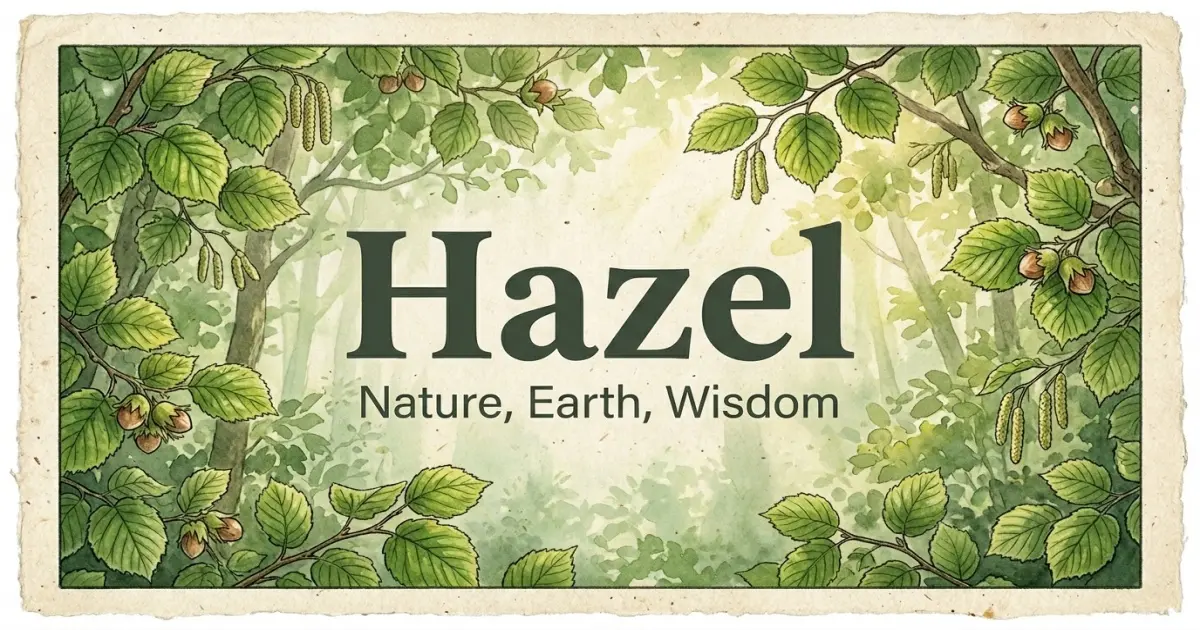
Hazel Came from Ordinary English and Stayed Remarkably Exact
Hazel belongs to the English habit of naming what can be seen
Hazel comes from English, and that origin is crucial to its style. English naming has long had a talent for turning ordinary nouns into names when those nouns were tactile, place-based, or emotionally resonant enough to survive the leap. Hazel is one of the best examples of that process. It does not sound like a foreign import or a newly made invention. It sounds like a word that crossed naturally into personhood because people kept finding beauty in it. For more names shaped by the same tradition, explore browse English baby names.
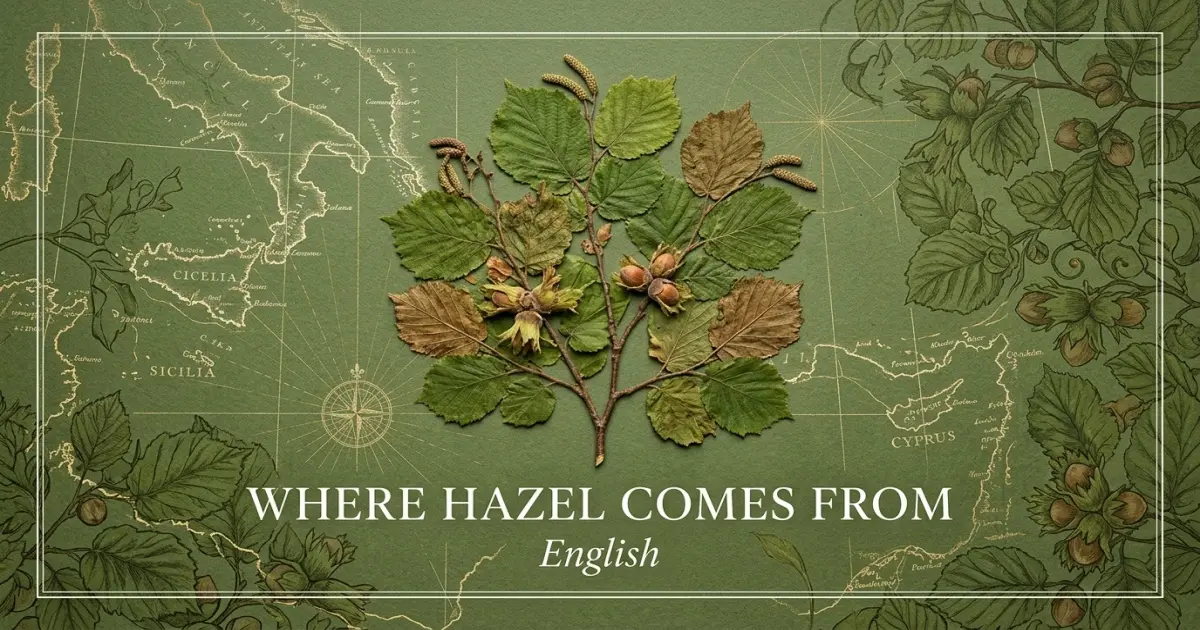
Traditional references often trace the word to older English forms connected to the hazel tree and the greenish-brown or light-brown shade associated with it. That continuity matters because it keeps Hazel from feeling like a recent branding exercise. The name may feel fully contemporary now, but it rests on an old and ordinary vocabulary. That is one of the reasons it feels trustworthy.
There is also something aesthetically important about that English directness. Hazel means what it appears to mean. Parents do not have to explain it through complicated derivation or remote legend. The name offers immediate legibility, and immediate legibility often gives a name social strength.
Why Hazel never feels overworked
Some names depend heavily on styling. They need a certain wardrobe, a certain family aesthetic, or a certain atmosphere around them to sound convincing. Hazel does not. It has enough character to feel distinct, but not so much that it becomes a performance. This is a subtle but valuable quality. It means the name can belong to many kinds of families without losing its identity.
Hazel can sound literary, rustic, polished, artistic, or quietly classic depending on the surname, middle name, and the person herself. That flexibility is partly semantic and partly sonic. Because the meaning is grounded and the sound is controlled, the name can absorb a lot without splitting apart.
This is what separates durable names from merely fashionable ones. Fashionable names are often admired for surface novelty. Durable names can survive very different personal styles because their structure is sound. Hazel has that structure.
Hazel in Cultural Memory, Domestic Life, and the Eye
Hazel benefits from living at the intersection of several kinds of cultural memory. Traditional name books place it among tree names and color names alike, and both categories matter. Tree names tend to carry stability and natural strength. Color names tend to carry immediacy, image, and atmosphere. Hazel gets to hold both without feeling overloaded.
It also picks up a domestic quality through long use. This is not a name that sounds remote or aristocratically untouchable. It feels familiar in the best sense: not common to the point of blur, but intimate enough to feel lived in. Older reference books also preserve notable bearers such as Hazel Abel and Hazel Scott, reminders that the name has already moved through public life in more than one register—political, artistic, and everyday social use. That history helps Hazel feel culturally real rather than purely aesthetic.
Then there is the eye. Even people who never think of hazel trees usually know the phrase “hazel eyes.” That phrase matters because it has trained generations of English speakers to hear the word as descriptive, observant, and slightly poetic. Hazel as an eye color is rarely flat. It shifts with light. That makes the name feel watchful, alive, and nuanced in ways a simpler color-term name might not. In this respect, Hazel is unusually sophisticated for a name that sounds so effortless.
The result is a name with an almost documentary richness. It contains field and face, botany and gaze, landscape and human nearness. That is one reason it feels larger than its two syllables.
What Hazel Sounds Like Before Meaning Arrives
Hazel is short, but not slight
HAY-zuhl is a compact sound pattern, but it is not flimsy. The opening aspirated h gives the name breath. The long ay vowel brightens it immediately. Then the z adds a small internal current, a spark of friction that keeps the name from becoming too soft. The relaxed final syllable lands the whole thing gently. In phonetic terms, Hazel balances air, brightness, texture, and softness very efficiently.
This is one reason the name feels stronger than many other short feminine names. It has internal grain. That z matters more than people think. Without it, Hazel would be much sweeter and softer. With it, the name keeps a subtle sharpness that makes it feel intelligent and memorable.
Why the sound suits the meaning so well
Good names often have a quiet agreement between sound and sense. Hazel does. The bright first syllable and textured middle fit a name associated with a tree and a variable eye color surprisingly well. The opening catches the light. The rest of the word settles into something earthier. This mirrors the meaning almost perfectly: brightness above, grain underneath.
That helps Hazel sound equally convincing on different kinds of people. A child can make the name sound lively. An adult can make it sound composed. The sound profile supports both readings because it has both clarity and weight.
Hazel Beside Ivy, Violet, Olive, and the Other Modern Nature Favorites
Hazel makes the most sense when placed beside the cluster of contemporary names it often travels with. It belongs near choices like Ivy, Olive, Violet, Willow, and Juniper. Yet even inside that group, Hazel holds a distinct position. It is less floral than Violet, less airy than Willow, less culinary than Olive, and less whimsical than Juniper. It has more grain than all of them.
That difference matters because parents are not only choosing “a nature name.” They are choosing what kind of nature a child’s name should evoke. Hazel evokes wood, shade, shell, undergrowth, and the precise language of color. It feels mature without becoming severe. It feels natural without becoming pastoral fantasy.
This is one reason the name fits so well into current taste without becoming swallowed by it. Hazel may rise alongside other nature names, but it keeps its own weather. It is not just trendy because the culture likes plants. It is strong because it turns the natural world into something tactile and socially elegant at the same time.
What No. 19 Says About Hazel Right Now
Official Social Security Administration (SSA) data places Hazel at No. 19 for girls in 2024, and that ranking says several useful things. First, Hazel is no longer a niche revival. It has become a fully mainstream modern choice. Parents know it, teachers know it, and strangers are unlikely to stumble over it. That kind of broad trust matters in daily life.
Second, No. 19 is the kind of popularity that suggests genuine cultural fit rather than brief novelty. Hazel is not riding only on eccentricity. It is succeeding because it satisfies several strong contemporary preferences at once: nature without excess whimsy, vintage feeling without dust, and clarity without plainness. The name sits exactly where many parents want to be.
Its far lower boys’ ranking is also informative. While the word itself is simple enough to feel slightly open-edged, real-world usage is overwhelmingly female. That gives the name social clarity while preserving just enough lexical plainness to keep it from sounding over-feminized. If you want to compare Hazel with similar choices, explore popular girl names and meanings.

Where Hazel Opens Next
Middle names that sharpen Hazel or widen it
Because Hazel is compact and textured, middle names can shift its mood quickly. A classic middle makes it feel more timeless, while a longer lyrical one can give the full name more sweep without taking away its grounded quality. If you want the full pairing logic behind that contrast, see Hazel middle names.
Nicknames that tend to stay close to Hazel itself
Hazel is already short enough that many families never shorten it dramatically. When nicknames do appear, they tend to orbit the name through affection rather than necessity. To see how those different moods shorten in real life, explore nicknames for Hazel.
Pronunciation that keeps Hazel clear and textured
HAY-zuhl is straightforward, but the name’s appeal depends on the balance between the bright opening and the grainier middle. Spoken well, Hazel sounds polished without sounding polished-over. For the detailed stress pattern, accent notes, and IPA, see how to pronounce Hazel.
Why Hazel Still Feels Like a Name with Grain and Light
In the end, Hazel works because it trusts modest materials. It does not need crowns, myths, or grand abstractions to feel beautiful. It takes a tree, a color, an old English word, and the human habit of noticing eyes and landscapes closely, then turns all of that into a name that feels complete. That is harder than it sounds. Many names are attractive. Fewer are exact. Hazel is exact.
That exactness is what gives the name its lasting emotional force. It belongs to the vocabulary of attention. It suggests a world made of bark, weather, shade, shell, and the subtle colors that only become visible when someone looks carefully. A child named Hazel carries not only beauty, but a kind of grounded radiance.
That may be the clearest final truth about Hazel. It is not merely a pretty nature name. It is a name that makes the ordinary world feel worth seeing clearly. And names that do that tend to last.