
Harriet Pronunciation: The Sounds Behind the Name, Made Simple

By 2024, official U.S. data still placed Harriet in active use, even if far from the most crowded part of the chart. That creates a very particular pronunciation moment in real life. Harriet is familiar enough that people recognize it, but uncommon enough that they often pause for half a second before saying it aloud. You hear that pause on the first day of school, when a teacher scans a class list. You hear it in waiting rooms, at graduation ceremonies, and in introductions where the speaker knows the name is traditional but wants to get its rhythm exactly right. Harriet rewards that care, because it is one of those names whose whole personality depends on how the stress is carried.
When spoken well, Harriet sounds brisk, grounded, and quietly intelligent: HA-ree-uht. The name opens clearly, moves quickly through the middle, and lands softly rather than heavily. That matters because Harriet means “estate ruler,” a meaning with real authority behind it. A clumsy pronunciation can make the name sound stiff or overly old-fashioned. The right pronunciation does the opposite. It lets Harriet sound capable, warm, and fully alive in modern speech.
What Harriet is actually clarifying every time the name is said aloud
| Element | Phonetic Detail | Quick Tip |
|---|---|---|
| Standard spoken form | HA-ree-uht | Give the first syllable the main stress, then let the remaining two syllables move lightly. |
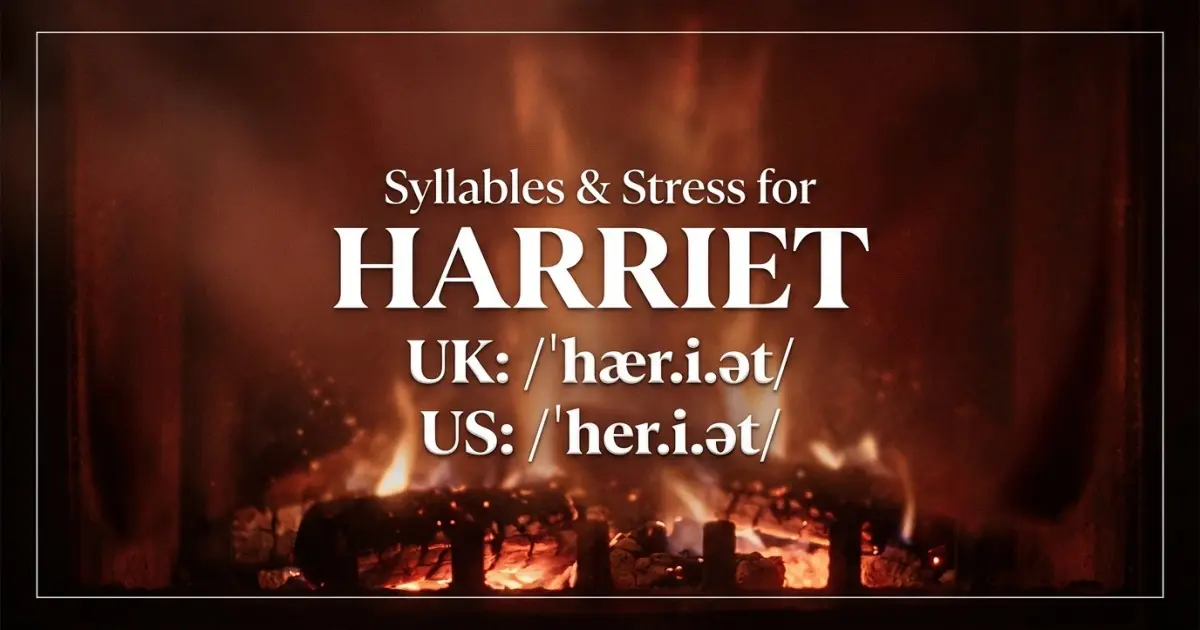
| US IPA | /ˈhæriət/ | The opening vowel is the short a sound heard in “hat,” not a broader or darker vowel. |
| UK IPA | /ˈhæriət/ | The standard British form closely matches the American one, which keeps Harriet stable across accents. |
| Syllable count | 3 syllables | Keep all three beats present enough to preserve the name’s vintage structure. |
| Stress pattern | First syllable stressed | Say HA-ree-uht, not ha-REE-ut and not harry-ET. |
| Key sound character | Strong opening, quick middle, softened finish | The name should feel brisk and grounded, not dragged out or overperformed. |
Why Harriet sounds brisker than many other vintage names
Harriet is a traditional name, but its sound is more energetic than people sometimes expect. Many revived antique girls’ names lean heavily on softness or ornament. Harriet does not. It begins with a clear, audible opening and moves quickly through the rest of the line. That is why it often sounds more practical than dreamy, more companionable than remote. The sound matters more once you know what the name is meant to carry, which is why the wider frame starts in Harriet meaning.
The opening of Harriet gives the name its authority
The first syllable, HA, carries most of the force. It uses a short, direct vowel, and that makes the opening clean rather than floating. The initial h also matters. It is breathy and audible, which helps the name begin with presence without becoming hard. Harriet does not burst into the room, but it certainly arrives.
This is one reason the name fits its meaning so well. “Estate ruler” implies steadiness and control, and the opening sound gives Harriet that exact quality. It feels grounded from the start.
The middle of Harriet keeps the name moving
After the stressed opening, the name moves into the ree sound. The r here is a liquid consonant, which means it flows rather than stops sharply. In everyday terms, that makes Harriet feel lively instead of rigid. The sound transitions forward quickly, so the name keeps its pace without becoming clipped.
This is one of Harriet’s secret strengths. It has historical weight, but the middle keeps that weight from turning into drag. The name remains mobile, not monumental.
The ending of Harriet softens the authority
The final syllable, -uht, is where Harriet becomes human and close. Without that ending, the name could feel too brisk or too stern. Instead, the last syllable relaxes the line just enough to keep the whole name warm. Harriet does not end with a hard stop. It settles.
That softened finish is a big part of why the full name still feels usable in modern life. The beginning gives command. The ending gives approachability.
How Harriet holds its shape in everyday speech
One of Harriet’s practical advantages is that its American and British IPA are the same: /ˈhæriət/. That does not mean every speaker will sound identical, but it does mean the basic structure is highly stable. The stress stays on the first syllable, the short vowel stays clear, and the ending stays light. Harriet is one of those names whose form survives accent differences very well.
Accent notes that change little
In real conversation, some speakers may compress the final syllable more than others, and some may let the middle sound slightly flatter or lighter depending on region. But these are surface differences, not competing pronunciations. Harriet still begins with the stressed HA, still moves through the liquid middle, and still ends without overemphasis.
That kind of stability is useful. A name that keeps its identity across voices feels easier to live with, especially in schools, workplaces, and families spread across different English-speaking regions.
Why Harriet does not need to be overenunciated
Because Harriet is traditional and three syllables long, some speakers are tempted to over-pronounce it, as though the name should sound ceremonious simply because it is old. But Harriet works best when spoken naturally. It should be clear, not theatrical. The moment the speaker tries too hard, the name can tip toward stiffness.
The best Harriet pronunciation keeps the architecture of the name but still lets it live in ordinary speech. That is where its real charm lies.
Where people most often get Harriet wrong
Mistake pattern: stressing the middle syllable
The most common error is shifting the main emphasis away from the first syllable and landing too hard on the middle. In standard pronunciation, Harriet is front-stressed. The name should begin with its strongest beat. If the middle takes over, the whole line feels unstable.
Mistake pattern: blurring Harriet into “Harry-et” too heavily
Because Harriet shares sounds with Harry, some speakers may make the name too blocky, turning it into something like “Harry-et” with an overly separate ending. But Harriet is smoother than that. The name should move through its middle and final syllables with more flow than a strict split suggests.
Mistake pattern: clipping the last syllable away
Another common issue is rushing the final syllable so much that Harriet becomes almost two beats instead of three. That weakens the form of the name. Harriet does not need every syllable exaggerated, but it does need all three to remain audible enough for the structure to hold.
Harriet beside its sound neighbors
It helps to understand Harriet by hearing what it is not. It is not Hattie, which is shorter, sweeter, and more openly affectionate. It is not Henrietta, which is longer and more ornate. It is not Harry, which is more clipped and direct. Harriet sits in its own place: brisker than Henrietta, more formal than Hattie, and warmer than Harry. That is why pronunciation matters so much. If the speaker rushes Harriet too much, it starts to collapse toward Harry. If the speaker overworks it, it can start to sound heavier than it really is. Because the strongest energy lands early, the shorter forms often grow from the opening of the name, and that pattern is easier to see in Harriet nicknames.
Done properly, Harriet sounds exactly where it should: intelligent, grounded, and lightly vintage without becoming dusty.
How Harriet settles naturally in the mouth
Practice help: build Harriet around the first syllable
The easiest way to say Harriet well is to think of it as one strong beat followed by two lighter ones: HA + ree + uht. The first syllable should do most of the work. The other two should move quickly but clearly. Once that pattern is right, the name tends to sound balanced on its own.
Practice help: use Harriet in ordinary lines
Names become easier when spoken in real phrases rather than isolation. Try lines such as these:
- Harriet, it’s your turn.
- Have you met Harriet yet?
- Harriet is ready to go.
- Come here, Harriet.
- Harriet Jane sounds clear and balanced.
These examples show why the name works. Harriet moves comfortably through ordinary speech, keeps its strong beginning, and still lands softly at the end. That is the sign of a successful pronunciation pattern: the name sounds correct not just in explanation, but in life.