
How to Pronounce Harper: How to Avoid the Most Common Pronunciation Slips
The real pronunciation test for Harper does not happen in a phonetics chart. It happens in ordinary public life: on the first morning of kindergarten, when a teacher scans a roster and says the name aloud without hesitation; in a pediatric waiting room; at a coffee counter; across a soccer field when someone calls a child back to the sidelines. Harper passes that test well. Official data shows the name remained highly visible for girls in the United States in 2024, which helps explain why most English speakers already have a stable spoken version in mind when they see it written down.
Still, Harper is more interesting in the mouth than its familiarity might suggest. It begins with a broad, open vowel, picks up weight through the middle, and finishes differently depending on accent. In American English, the ending keeps its r sound. In many British pronunciations, that final r disappears unless another vowel follows. So Harper is one of those names that stays recognizably the same across English varieties while still changing its texture slightly. That makes it a useful pronunciation name: easy enough for daily life, but rich enough to reveal how accent and sound structure work together.
What Harper Clarifies the Moment It Is Said Aloud
| Element | Phonetic Detail | Quick Tip |
|---|---|---|
| Everyday pronunciation | HAHR-pər | Say it in two beats, with the first syllable clearly stronger than the second. |
| US IPA | /ˈhɑːrpər/ | In American English, keep the r sound audible in both syllables. |
| UK IPA | /ˈhɑːpə/ | In many British pronunciations, the final r is not pronounced unless another vowel follows. |
| Syllable count | 2 syllables | Think of the name as HAR + per or pə, not one rushed blur. |
| Stress pattern | Stress on the first syllable | The name sounds most natural when HAR carries the weight. |
| Consonant profile | Begins with /h/, includes a liquid /r/, and ends with a light second syllable | The h keeps the opening airy, while the r adds firmness and shape. |
| Most common confusion | Over-flattening the first vowel or overplaying the ending | Keep the opening broad and clear, then let the second syllable finish the name lightly. |
How Harper Actually Works in Everyday Speech
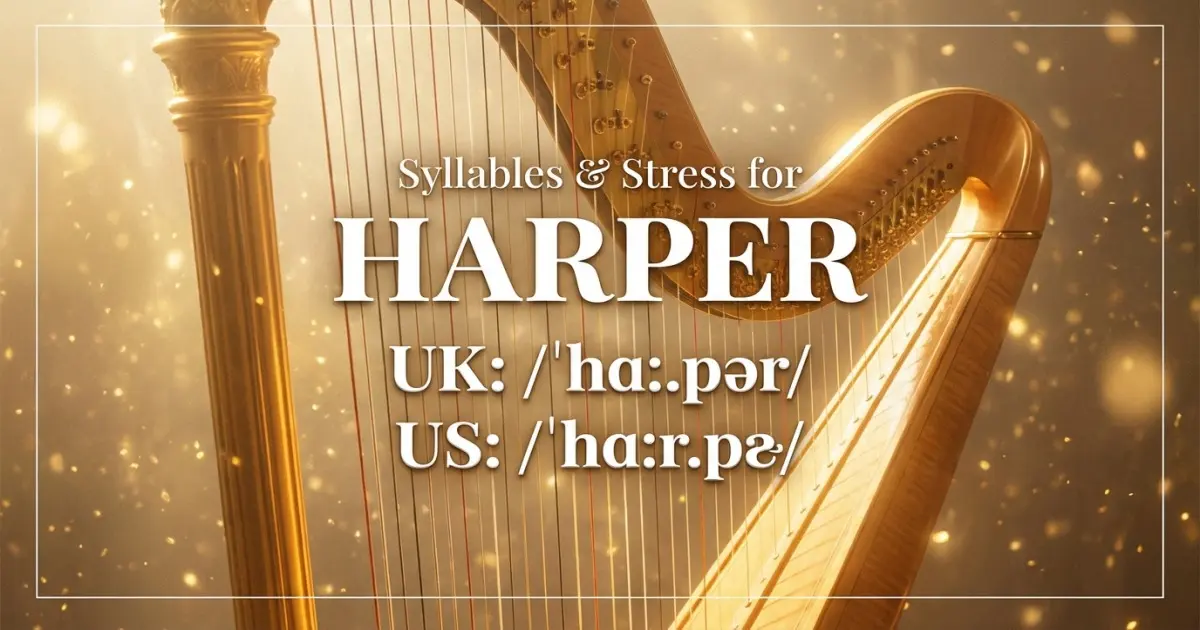
Harper is a two-syllable name with stress on the first syllable. That first fact explains most of its spoken character. The opening Har- carries the identity of the whole name. The second syllable does not vanish, but it does not compete for attention either. This front-loaded pattern gives Harper its confidence. The listener gets the main information immediately, and the rest of the name trails off in a controlled way. The sound matters more once you know what the name is meant to carry, which is why the wider frame starts in Harper meaning.
Why the opening of Harper matters so much
The name begins with /h/, a soft breathy consonant. In phonetics, /h/ is not a fricative in quite the same way as /f/ or /s/, but it still has that airy, friction-like quality of moving breath through the mouth. That makes the opening of Harper feel open rather than abrupt. It does not hit as hard as a name beginning with /k/ or /t/. Instead, it enters the air more lightly.
After that comes the broad vowel /ɑː/, the sound represented in your supplied pronunciation as the long open vowel in HAHR. This vowel gives Harper much of its weight. It is what keeps the name from sounding thin. If the vowel is narrowed too much, the name can lose some of its natural authority. The first syllable should sound open, grounded, and clearly stressed.
Why the middle of Harper gives it shape
The /r/ sound inside Harper is important, especially in American English. It acts as a liquid consonant, which means it flows rather than stopping the voice sharply. Liquids such as /r/ and /l/ are often what give a name internal texture. In Harper, the /r/ stops the broad opening from feeling too loose. It gathers the sound back in and directs it toward the second syllable.
This is one reason Harper sounds tailored rather than dreamy. The name begins openly, but the liquid consonant tightens the line. Without that, the broad vowel might drift. With it, Harper stays architecturally neat.
Why the ending should stay lighter than the front
The second syllable in Harper is structurally important but not dominant. In American English, /pər/ gives the ending a faint firmness because the r is still pronounced. In British English, /pə/ makes the landing softer. In both cases, though, the second syllable should feel lighter than the first. If both syllables are equally stressed, the name becomes heavy and unnatural. Harper sounds best when the ending supports the opening rather than trying to match it.
Where Harper Changes Across Accents Without Losing Itself
Harper is a useful example of how English accents can alter texture without altering identity. The supplied U.S. pronunciation is /ˈhɑːrpər/. The supplied U.K. pronunciation is /ˈhɑːpə/. The major difference is rhoticity: whether the r sound is pronounced. In most American accents, it is. In many standard British accents, it is not unless another vowel follows.
US Harper: firmer and more rhotic
In American English, Harper usually sounds a bit more sculpted because the /r/ remains audible. The name has a stronger middle and a clearer pull into the ending. This can make it sound slightly more decisive or more anchored. The second syllable still stays lighter than the first, but it has more audible shape.
UK Harper: softer at the edges
In many British pronunciations, the name becomes smoother because the final /r/ is dropped. The result is not a different name, only a different finish. The first syllable still carries the stress and the broad open vowel. The ending simply relaxes more. This version can sound a touch softer and more flowing, but it remains clearly Harper.
This stability across accents is one of the name’s practical strengths. Parents choosing Harper do not usually need to worry that the name will become unrecognizable abroad. The accent may change the sound’s texture, but not its core pattern.
Why Harper Sometimes Goes Slightly Off Course
Harper is easy to say for most English speakers, but there are still a few places where pronunciation can drift. These are usually not dramatic mistakes. More often, they are slight changes in vowel quality, stress balance, or ending weight.
Mistake pattern one: flattening the first syllable
The most important thing not to lose is the broad stressed opening. If the first vowel becomes too flat or too short, Harper can sound less distinctive and more mechanically read. The name should open with a full HAHR quality in the pronunciation you supplied, not with a clipped or muffled first beat.
Mistake pattern two: making the second syllable too heavy
Another common issue is overemphasizing -per. The second syllable matters, but it should not compete with the first. In real speech, Harper works because the name lands quickly and then tapers. Overplaying the ending can make it sound stiff or overcareful.
Sound neighbors that help people get Harper right
If someone is learning the name by ear, it can help to think of familiar sound neighbors. The opening resembles the start of harp itself, which makes sense given the meaning. Then add a lighter second syllable. In American English, that gives you something like harp-er. In British English, it softens closer to har-puh. Either way, the basic contour stays the same: strong first beat, softer second beat. Once the sound pattern is clear, some shortenings stop feeling optional and start feeling natural, and the clearest map is in Harper nicknames.
It may also help to remember what Harper is not. It is not stressed on the second syllable. It is not clipped into one syllable. And it is not supposed to sound rushed. The name has modern brevity, but it still needs its two-part structure.
How to Practice Harper Until It Feels Natural
The best way to settle a name into the mouth is to say it in full sentences. Harper benefits from this because its stress pattern becomes obvious once it is placed in ordinary speech. The first syllable naturally rises. The second falls away.
Simple practice lines for Harper
- Harper is waiting by the door.
- I saved a seat for Harper.
- Did Harper already call back?
- Harper will be here after lunch.
Read those lines aloud and listen for the same shape each time. The name should start broad and strong, then settle into a lighter second syllable. If the rhythm stays consistent in connected speech, the pronunciation is probably secure.
How to know you are saying Harper well
You are probably pronouncing Harper correctly if three things happen at once: the first syllable carries the clear stress, the opening vowel sounds broad and open, and the second syllable stays lighter than the first. In American English, that will usually include a stronger r. In many British pronunciations, it will not. But in both forms, the name should feel balanced and easy rather than forced.
That is the elegance of Harper as a spoken name. It changes slightly from accent to accent, yet it remains fully itself. It sounds contemporary, but it is not thin. It sounds efficient, but it still carries shape. And because those qualities matter so much in real life, Harper continues to work not just on paper, but in the voice.