
How to Pronounce Haroon: Syllables, Stress, and Common Tips
A teacher reads down a new class list and reaches Haroon. The spelling looks simple, but English stress habits can pull the name in the wrong direction. Some readers may say HA-roon, giving the first syllable too much weight. The intended pronunciation is hah-ROON: a light opening followed by a long, clearly stressed final syllable.
Haroon has only two syllables, and every sound is familiar to English speakers. The main challenge is rhythm. The name should rise toward ROON rather than begin at full strength. Once that stress pattern is established, the pronunciation becomes natural: a breath-like h, a short opening vowel, a smooth r, a long oo, and a final n that closes the name cleanly.
How Haroon Is Actually Said in Everyday Speech
| Element | Phonetic Detail | Quick Tip |
|---|---|---|
| Simple pronunciation | hah-ROON | Keep “hah” light and let “ROON” carry the emphasis. |
| Syllable count | Two syllables: hah-ROON | Do not compress the name into one beat or add a third syllable. |
| Stress | Second syllable | Say hah-ROON, not HA-roon. |
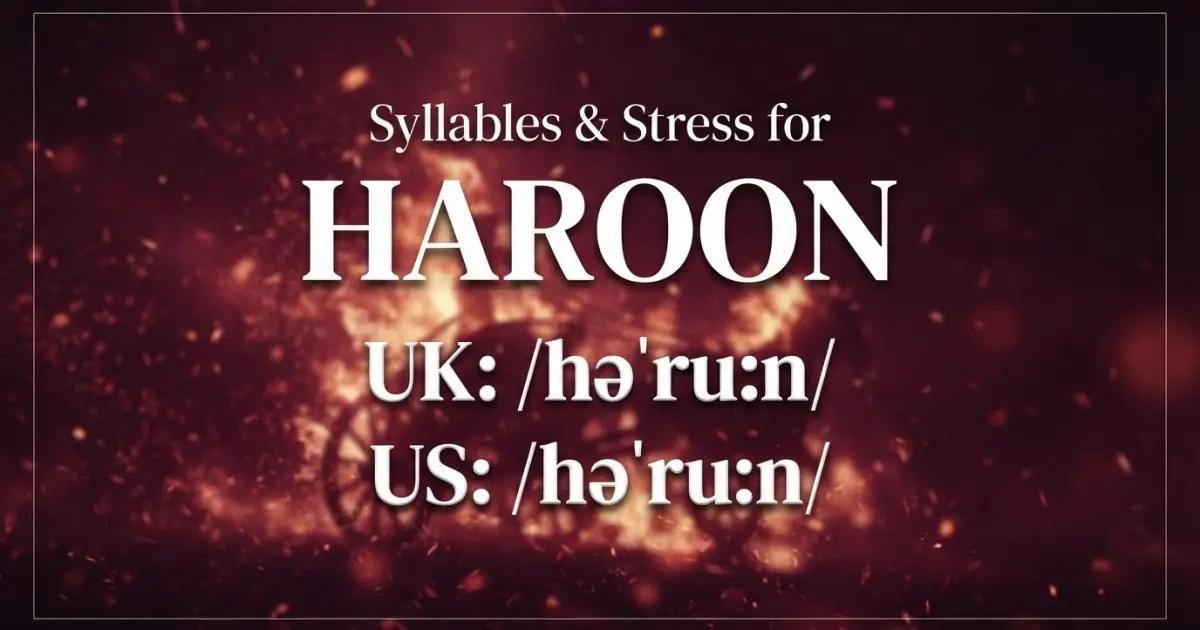
| U.S. IPA | /hɑːˈruːn/ | The first vowel is broad, while the final “oo” is long and stressed. |
| U.K. IPA | /hæˈruːn/ | The first vowel may sound lighter or more fronted, but ROON remains dominant. |
| Opening sound | /h/ | Begin with a gentle breath, not a hard throat sound. |
| Final sound | /n/ | Finish clearly with “n” so the name does not trail off after the long vowel. |
Haroon Rises Toward the Long “Oo” Sound
The defining feature of Haroon is its second-syllable stress. In both the American and British IPA forms, the stress mark appears before /ruːn/. That means the voice should move toward the ending. The first syllable introduces the name; the second completes it with greater clarity, length, and emphasis. Pronunciation lands more fully when the name’s roots and history are already in view, so begin with Haroon meaning.
The opening “h” should remain gentle
The first sound, /h/, is a voiceless glottal fricative. In everyday terms, it is the breath-like sound heard at the beginning of home, happy, and hope. There is no hard closure in the mouth and no strong vibration in the throat.
Haroon should not begin with a rough or forced sound. Let a small stream of air start the name, then move directly into the first vowel. Overworking the opening can make the pronunciation sound heavier than intended.
The first syllable prepares rather than dominates
In the U.S. pronunciation, the first syllable contains /ɑː/, a broad vowel similar to the sound in many American pronunciations of father. The British form uses /æ/, which may sound closer to the vowel in cat or hat. This difference affects the color of the opening, but not the basic rhythm.
In both cases, the first syllable should remain unstressed. It is not HA with a strong, separate beat. It is a lighter hah that moves quickly into ROON.
The liquid consonant connects the two halves
The /r/ sound begins the stressed second syllable. Linguistically, r is often described as a liquid consonant because the airflow continues rather than stopping sharply. It acts as a bridge between the light first syllable and the long vowel that follows.
English speakers should avoid inserting a pause before the r. Haroon should flow as one name: hah-ROON, not “hah—ROON” with an unnatural break. The syllables are distinct, but they remain connected.
The long “oo” carries the name
The stressed vowel /uː/ is the long sound heard in moon, room, and soon. It should be clear and slightly sustained, but not dramatically stretched. This vowel gives Haroon its most memorable sound.
A useful practice pattern is to say roon first, then place the light opening syllable before it: hah-ROON. Starting with the stressed half helps prevent the common mistake of giving too much force to the beginning.
American and British Accents Color Haroon Differently at the Start
The U.S. IPA form is /hɑːˈruːn/, while the U.K. form is /hæˈruːn/. The main distinction lies in the first vowel. American speakers may use a broader “ah” sound, while British speakers may use a shorter or more fronted vowel.
The second syllable remains much more stable. Both forms use /ruːn/, with a clear r, a long oo, and a closing n. This shared ending preserves the identity of Haroon across accents.
What should remain constant across accents
Haroon should always have two syllables. The stress belongs on the second. The long oo should remain audible, and the final n should close the name rather than disappear.
Accent variation is natural. A family does not need to force a specific American or British vowel if it does not match the way they normally speak. The best pronunciation is the one that preserves the intended stress and sound structure within the family’s authentic accent.
How much should the “r” be heard?
In both supplied forms, the r is clearly part of the stressed syllable. American speakers may produce a stronger, more prominent /r/, while some British speakers may articulate it more lightly. It should not vanish entirely, because ROON is the central sound of the name.
The goal is not to roll or exaggerate the consonant. A natural English r is enough to make the second syllable clear.
The Most Common Haroon Mispronunciations Come From Stress
Stressing the first syllable
Incorrect pattern: HA-roon.
Correct pattern: hah-ROON.
The first syllable should remain light. Let the voice rise toward the second beat rather than begin at full strength.
Shortening the “oo” sound
Incorrect pattern: hah-RUN.
Correct pattern: hah-ROON.
The stressed vowel is long, like the vowel in moon. Do not replace it with the short vowel heard in run.
Turning the ending into two syllables
Incorrect pattern: hah-ROO-un.
Correct pattern: hah-ROON.
The letters oon form one syllable. The vowel and final consonant should remain together.
Dropping the final “n”
Incorrect pattern: hah-ROO.
Correct pattern: hah-ROON.
The final n gives the name its complete shape. Keep it audible, especially when Haroon appears at the end of a sentence.
Making both syllables equally strong
Overcareful pattern: HAH-ROON, with two heavy beats.
Natural pattern: hah-ROON.
The first syllable should not disappear, but it should clearly support the second rather than compete with it.
Sound Neighbors Make Haroon Easy to Practice
The strongest practice anchor is the final syllable ROON, which rhymes with moon, soon, and tune in many accents. Once that sound is secure, add the lighter opening: When the stress sits in the center, the nickname logic often follows that same center of gravity, which is why Haroon nicknames is the natural next step.
“Hah” + “roon” = hah-ROON.
It may also help to clap the two beats. Use a light clap for hah and a stronger one for ROON. This makes the stress pattern physical and easier to remember.
Practice Haroon in natural sentences
- “This is Haroon.”
- “Haroon will join us this afternoon.”
- “I spoke with Haroon yesterday.”
- “Please give the folder to Haroon.”
- “His name is Haroon, pronounced hah-ROON.”
Practice first at a deliberate pace, then repeat the sentences conversationally. At the beginning of a sentence, resist the urge to overemphasize the first syllable. In the middle of a sentence, keep ROON clear. At the end, preserve the final n.
Haroon Becomes Natural Once the Ending Leads
Haroon is pronounced hah-ROON, with two syllables and the stress placed firmly on the second. The opening should feel light and breath-like, while the long oo carries the main sound of the name.
The American and British forms differ in the first vowel, but both share the same rising rhythm and strong ending. Once listeners understand that ROON leads, the pronunciation becomes easy to retain.
How to Pronounce Haroon: FAQ
How do you pronounce Haroon?
Haroon is pronounced hah-ROON. It has two syllables, and the stress falls on the second.
Is Haroon pronounced HA-roon?
No. The first syllable should remain light. The correct stress pattern is hah-ROON.
Does the “oo” in Haroon sound like “moon”?
Yes. The stressed vowel is the long “oo” sound heard in moon, room, and soon.
Do American and British speakers pronounce Haroon differently?
The first vowel may differ, as shown by /hɑːˈruːn/ in U.S. English and /hæˈruːn/ in U.K. English. Both forms stress ROON and keep the long “oo” sound.
Is Haroon difficult for English speakers to pronounce?
No. The individual sounds are familiar. Most mistakes come from stressing the first syllable instead of the second.