
Harley Name Meaning: A Soft, Elegant Name with Lasting Appeal
Harley is one of those names that seems to have traveled much farther than its meaning. On paper, its core image is pastoral and still: “hare’s meadow,” a place-name formed from animal life and open land. But in modern naming life, Harley rarely feels still. It feels mobile, charged, and socially alert. That tension is the real key to the name. Harley begins in an English landscape, yet it survives because it no longer sounds only like a field. It sounds like movement through the field, personality entering the field, a surname stepping out of geography and into style. The old meadow remains under the name, but the name itself has learned to move quickly.
That is why Harley has become such an interesting unisex choice. It does not behave like a soft floral name or a severe biblical classic. It comes from the English surname tradition, from the world of place-names turned family names turned given names, and that gives it a built-in social flexibility. A name that once would have identified someone by where they came from now identifies them by tone: bright, casual, modern, lightly rebellious, and easy to recognize. Yet beneath that modern surface is one of the oldest English naming structures of all, the landscape name. Harley sounds contemporary because it is restless, but it lasts because it is rooted.
Harley's U.S. popularity rank over time, 1880–2024
Popularity statistics are based on official data from the Social Security Administration baby name records.
Harley: A Fluid Identity with Genuinely Shared Use
Harley behaves as a name with a fluid identity that still feels stable, showing meaningful visibility across both sides of the chart. This shared use suggests how its spirited sound and “nature-meadow” structure make the name feel open across lanes in modern naming culture .
The chart indicates that while both sides are visible, the name can travel well without becoming fully anchored to one side. Meaning “hare’s meadow,” its friendly two-syllable rhythm offers a texture of approachable charm.
Where Harley stands before the full story opens
| Key Facts | Information | Quick Insight |
|---|---|---|
| Name | Harley | The form is casual and modern in sound, yet structurally it belongs to an older English surname and place-name tradition. |
| Primary gender usage | Unisex | Harley is one of those modern English names whose sound and surname origins allow it to move across gendered expectations with unusual ease. |
| Origin | English | The name’s roots in English place-language help explain its groundedness even when the modern impression feels fast and stylish. |
| Meaning | Hare’s meadow | The image is gentle and rural, which creates a surprising contrast with the name’s sharper modern social energy. |
| Pronunciation | HAR-lee | The strong first syllable and bright ending give the name motion and memorability. |
| Syllables | 2 | Two syllables keep Harley brisk enough for contemporary taste while still allowing it to feel complete as a first name. |
| U.S. standing (2024) | No. 397 for girls and No. 1017 for boys | Official data shows Harley remains clearly unisex, but in current U.S. use it leans feminine while still retaining male visibility. |
| Historical profile | English surname and place-name turned given name | Harley belongs to the surname-to-first-name pipeline that has shaped many modern unisex choices. |

Harley begins in a meadow, which is why the name feels more grounded than trendy
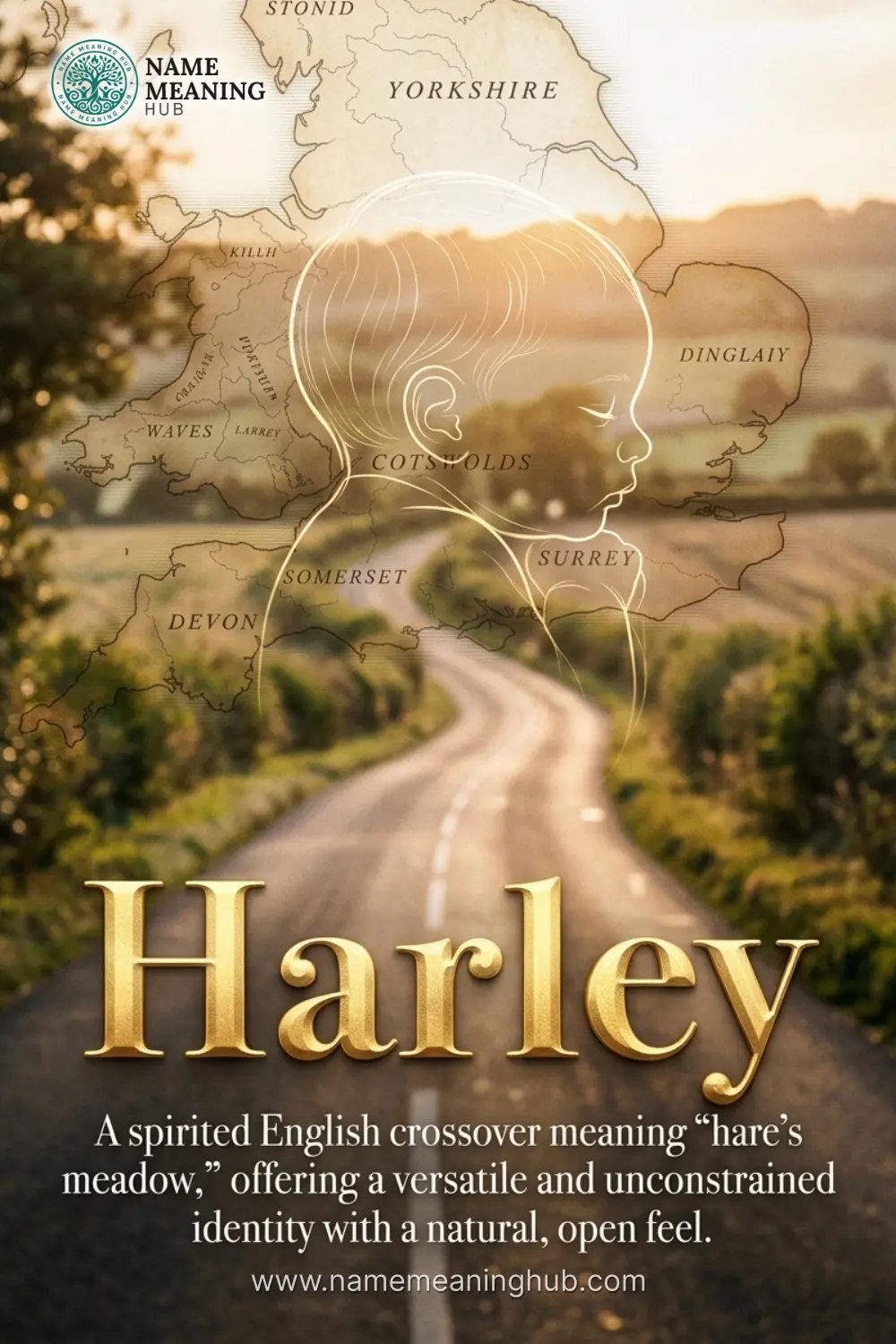
Harley’s meaning, “hare’s meadow,” matters because it places the name in one of the most durable English naming patterns: the landscape surname. Historically, names of this kind began by pointing to a place. They did not initially describe personality or aspiration. They identified terrain, settlement, land-use, or a recognizable feature of the natural world. That makes Harley very different in spirit from names built around beauty, rank, or direct blessing. It starts in geography. It says, in effect, this is the place where something living was seen.
The image itself is unexpectedly delicate. A hare is not a heraldic lion or a mythic eagle. It is quick, watchful, vulnerable, and tied to open ground. A meadow is not a fortress or an estate. It is space, grass, exposure, life near the earth. Put the two together and Harley becomes a name of motion inside openness. That is more subtle than many modern users may notice, but it helps explain why the name still feels alive under its fashionable surface. The meaning is not abstract. It is sensory. You can almost see it.
This is part of why Harley avoids some of the emptiness that trendier surname names can develop. Even when parents choose it for sound alone, the name still carries a vivid rural scene. It has animal life, open land, and English weather somewhere behind it. That gives Harley an earthy core that many highly styled modern names lack. The name may sound social, but it remembers the field.
Harley as a surname is what gave it its modern life
Harley did not rise in the modern era because parents suddenly became obsessed with meadows. It rose because surname names became one of the dominant engines of contemporary English naming. Naming guides repeatedly identify Harley as originally a surname before it became a given name, and that history is essential. A surname carries a different social texture from an ancient saint’s name or a direct vocabulary word. It tends to sound mobile, tailored, and somewhat detached from overt sentiment. Harley inherited all of that. If you want to expand your shortlist within this origin, browse more names from this origin.

Why the surname pathway matters so much for Harley
When a place-name becomes a surname and then a first name, it gains flexibility. It no longer belongs only to the landscape. It begins to belong to social identity. That shift is one reason Harley can feel modern despite its old English roots. Surnames turned first names often project competence, individuality, and ease. They feel less ornamental than purely invented modern names and less formal than many older classics. Harley sits squarely in that lane.
This also helps explain the name’s gender flexibility. Surname-style names have often crossed more easily between boys and girls than older first names with stronger historical gender coding. Harley belongs with names like Hadley, Harlow, Riley, Avery, and Presley in that broad modern category: names whose form feels stylish and transferable because their origin is not locked into a single gendered script.
Harley’s surname energy gives it more edge than its meaning predicts
A name meaning “hare’s meadow” could easily sound airy or pastoral to the point of softness. Harley does not. The surname history toughens it. It gives the name a little grit, a little social sharpness, and a more tailored surface. This is one reason Harley can read very differently from other meadow names. A name like Meadow speaks directly in the language of nature. Harley speaks first in the language of identity, and only underneath that in the language of land.
That layering is what makes Harley so adaptable. It can sound outdoorsy, but not fragile. Stylish, but not invented. Casual, but not empty. The surname history is doing much of that work behind the scenes.
Harley became unisex because the sound sits on a useful border
Official Social Security Administration (SSA) data now places Harley among the names that are unmistakably unisex in principle but not perfectly balanced in current U.S. use. With girls ranked at No. 397 and boys at No. 1017 in 2024, the name remains active for both, yet clearly leans feminine at the moment. That makes Harley especially revealing as a case study in how English unisex names evolve. A name may begin in male surname transfer, widen socially, and then become more common for girls without ever fully surrendering its male side. For related naming ideas in the same category, visit unisex baby names and meanings.
Harley’s sound helps this happen. The first syllable is sturdy and grounded; the -lee ending is lighter, brighter, and more socially flexible. English has many names ending in that sound that travel across gender lines easily. That ending does not automatically feminize the name, but it does soften it enough to make the full form widely usable. Harley therefore lives on a border that modern parents often like: strong at the front, approachable at the end.
This is also why Harley feels different from some other unisex names. It is not neutral in the flat sense. It is dynamic. On a boy, it can sound lively and slightly rugged. On a girl, it can sound playful and energetic without becoming delicate. The core sound does not change. The social reading around it does. That flexibility is one of Harley’s real modern strengths.
Harley sounds faster than its meaning, and that is part of the appeal
Phonetically, Harley is built for movement. HAR-lee begins with a strong stressed syllable and then releases into a lighter ending. This is one of the most efficient and memorable patterns in English. The opening is clear and grounded. The ending is quick and bright. The result is a name that sounds energetic without needing extra ornament.
The first syllable matters most. Har is sturdy, familiar, and easy to catch in the ear. It connects Harley to a whole family of English names beginning with Har-: Harlan, Harlow, Harper, Harold, Harriet, Harrison. That shared opening gives the name familiarity even when its full form feels more modern. The second syllable, -lee, keeps the name moving. It prevents the first half from becoming too heavy. That combination is one reason Harley feels contemporary even to people who have never thought about its origin.
Phonetically, it is also a highly usable public name. There is little ambiguity in pronunciation, little spelling strain beyond variant forms, and enough clarity that the name can move easily through classrooms, workplaces, and introductions. In a naming landscape where many parents want individuality without friction, that is a major advantage.
Harley belongs to the larger English family of meadow and hare names
One of the more revealing things about Harley is the company it keeps in naming books. It repeatedly appears near names like Harlan, Harlow, Hadley, Hanley, and Hartley—names built from English place-language, field imagery, or animal references. This family resemblance matters because it places Harley inside a broader pattern. It is not an isolated modern invention. It is one branch of a very old English habit of turning landscape into identity.
That pattern helps explain why Harley sounds so natural even when parents cannot immediately define its meaning. English speakers already know these forms. We know meadow names. We know surname names. We know the Har- opening. So Harley arrives carrying an invisible web of familiarity. It feels intuitively name-like because it has structural cousins all around it.
At the same time, Harley is one of the more socially kinetic names in this family. Harlan can sound weightier. Harlow can feel glossier. Hadley tends toward a more polished preppy note. Harley sounds looser, brighter, and more alive in motion. That is part of what has kept it relevant. It belongs to the meadow-name family, but it does not stand still in the meadow.
Harley in American life is familiar, but still not generic
Official data shows Harley remains comfortably visible in current American naming, especially for girls, while still retaining active use for boys. That gives the name an interesting status. It is recognizable, but it does not feel dull. Most people have heard Harley before, but it still carries enough character that each new use sounds like a real choice rather than a background default.
This is a valuable place for a name to sit. Too rare, and a name can feel forced or fragile. Too common, and it can lose its edges. Harley currently occupies a middle ground that many modern parents seek: socially legible, stylistically clear, and still distinct. That is especially useful for a unisex name, where clarity of tone matters more than a simple popularity number might suggest.
It also means Harley can serve several different naming temperaments at once. Some parents will hear the landscape roots and like its English groundedness. Some will hear the surname coolness. Some will hear the unisex flexibility. Some will simply hear a name that is upbeat and easy to say. Harley works because all of those interpretations can be true at the same time.
Where Harley opens next once the meaning has settled in
Harley with middle names can steer the name masculine, feminine, or fully unisex
Because Harley sits on a genuine gender border, the middle name does more than add rhythm. It often decides which direction the full combination leans in everyday use. If you want the full pairing logic behind that contrast, see middle names for Harley.
Harley and nicknames are part of its easy social life
The name’s two-syllable structure invites natural shortenings and playful family forms, which is one reason Harley feels so relaxed in real-world conversation. To see how those different moods shorten in real life, explore nicknames for Harley.
Harley and pronunciation are quietly part of its success
HAR-lee is easy to catch, easy to repeat, and highly legible in English, which helps the name stay wearable even as styles shift. If you want the full sound pattern behind that rhythm, read how to pronounce Harley.
Why Harley still sounds like open ground crossed by modern life
Harley endures because it does two jobs at once without splitting apart. It keeps the English meadow under its feet while sounding fully at home in modern naming culture. The meaning gives it land, animal life, and rural depth; the surname history gives it movement, style, and flexibility. The result is a name that feels more alive than many of its peers. It is not just scenic. It is social. Not just old. Not just new. It is old material moving through new rhythms.
That may be the deepest reason Harley remains compelling. It offers a rare kind of balance: a name with roots but not stiffness, edge but not hardness, unisex range without vagueness, and a pastoral meaning that somehow still sounds urban enough for contemporary life. Harley, at its best, feels like one of those English names that remembers the field but refuses to stay fenced inside it. That is why the name still works. The meadow is there. So is the motion. Harley carries both.