
How to Pronounce Halo: How the Name Is Usually Said
The pronunciation test for Halo usually happens in a setting that leaves no time for theory. A teacher pauses over a new class list. A receptionist glances at a waiting-room screen. A barista reads a name from a cup before looking up. Halo tends to do well in those moments because the spelling is unusually honest. It looks like a word people already know, and that familiarity gives speakers confidence. But the fact that it is familiar can also make people say it too casually, flattening the lift that makes the name feel luminous rather than merely ordinary.
In this profile, the intended everyday form is HAY-loh. The name is only two syllables long, but that does not make rhythm unimportant. In fact, short names often depend on rhythm even more because every sound carries more weight. Halo works because the first syllable opens brightly and the second rounds off softly. When that balance is respected, the name sounds clear, airy, and quietly radiant. When it is rushed or clipped, it can lose some of the grace that makes it distinctive.
How Halo is actually said when the name sounds right
| Element | Phonetic Detail | Quick Tip |
|---|---|---|
| Everyday guide | HAY-loh | Let the first syllable carry the name and let the second syllable close it gently. |
| Syllable count | 2 syllables | Think of it as HAY / loh, not as one blurred unit and not as two equally heavy beats. |
| Main stress | First syllable | The emphasis belongs at the front, which is what gives Halo its brightness and clarity. |
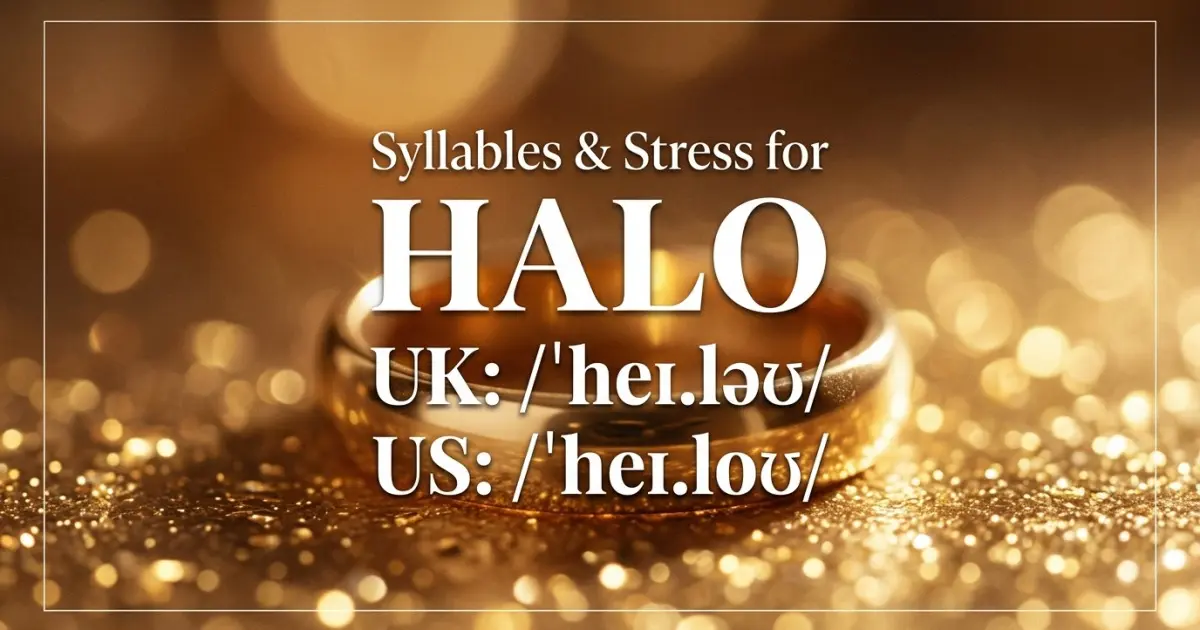
| US IPA | /ˈheɪloʊ/ | The American ending has a rounded long o glide, which helps the name feel open and complete. |
| UK IPA | /ˈheɪləʊ/ | The British ending shifts slightly in vowel shape, but the overall rhythm remains the same. |
| Ending | Soft rounded -loh | Do not clip the second syllable too abruptly. The name needs that gentle rounded finish. |
| Rhythm shape | Strong + soft | Halo sounds best when it opens with light and settles with calm. |
Why Halo depends on a bright opening and a rounded finish
Halo is a good example of how a very short name can still carry a lot of atmosphere. The first syllable, HAY, does most of the identity work. It opens on a breathy h, then moves into the long ay vowel, which gives the name its brightness. That opening is what makes Halo feel radiant rather than flat. The second syllable, loh, is where the name softens. It rounds the sound and lets it settle. Together, these two parts create the arc that makes the name feel airy and complete. Pronunciation lands more fully when the name’s roots and history are already in view, so begin with Halo meaning.
Why the first syllable carries the image
The opening matters because Halo is such an image-heavy name. If the first syllable is weak or underplayed, the whole name can lose some of its presence. The h is a fricative, a breath-based consonant, which means the name begins with air rather than impact. That already suits the imagery behind it. Then the long ay vowel gives the name lift. This is why Halo often feels brighter in the mouth than it may appear on paper. The sound itself opens outward.
That bright opening is also what keeps Halo from sounding too solemn. A name connected to something as elevated as a divine aura could easily become heavy. Halo avoids that because the sound begins with lightness, not weight.
Why the ending should stay soft and audible
The second syllable should not disappear. Because Halo is short, some speakers rush the ending, especially in casual speech. But the -loh part matters. It is what gives the name roundness and emotional softness. Without it, the name can feel cut off. The ideal pronunciation keeps the second syllable light, but still fully present.
There is also a subtle musical quality here. The long o in the ending acts almost like an echo of the first bright vowel. It does not compete with the opening. It completes it.
Halo stays stable across accents because the structure is so clean
One of the practical advantages of Halo is how little it changes between major English accents. The supplied American IPA is /ˈheɪloʊ/, and the British IPA is /ˈheɪləʊ/. The difference lies mainly in the precise shape of the final vowel glide. The syllable count stays the same. The stress stays the same. The identity of the name stays the same.
What changes between American and British speech
In American English, the final vowel tends to sound a little fuller and more rounded. In British English, it often shifts slightly in texture. But these are small accent-color differences rather than structural changes. The listener still hears the same basic name: bright first syllable, softer second syllable, stress at the front.
Why this makes Halo easier than some other symbolic names
Many concept names or word-style names can become awkward when they move between accents because speakers are unsure whether to treat them like vocabulary words or like names. Halo avoids that problem because it is already a familiar English word and because its pronunciation pattern is so straightforward. The sound travels well. That gives the name everyday practicality to match its unusual symbolic richness.
In real life, this matters more than people sometimes think. A name can be beautiful in theory but tiring in use if it constantly needs correction. Halo rarely has that issue.
Where people go wrong with Halo, and how to keep it sounding graceful
Most pronunciation issues with Halo are not dramatic mistakes. They are small shifts in pacing or tone. Because the name is familiar-looking, speakers often assume they can rush it without losing anything. That is where the trouble begins. Halo is simple, but it is not shapeless.
When Halo gets flattened into two equal chunks
One common issue is overbalancing the name, giving both syllables nearly equal weight. That makes Halo sound more mechanical than it should. The name needs a clear first-syllable stress. Without it, the sound loses some of its brightness and direction.
When the ending is clipped too hard
Another frequent problem is swallowing the final -loh. This often happens in very quick speech. While listeners will still understand the name, the sound becomes less elegant. The rounded final vowel is part of what makes Halo feel calm and complete. It deserves to be heard.
When the name is made too dramatic
Because Halo carries such a vivid image, some speakers may overperform it, stretching it or making it overly breathy. That usually makes the name feel more theatrical than it needs to. Halo already has built-in atmosphere. It works best when said clearly rather than ceremonially.
How Halo sounds beside nearby names and words
It helps to hear Halo in relation to names that share some of its sound profile. Halle is sharper and ends more abruptly. Harlow is heavier and more grounded because of the extra consonant and darker ending. Hayley feels busier because the final vowel moves differently. Halo sits in a rarer place. It has the brightness of Hay-, but the rounded close of -loh gives it more calm and more symbolic spaciousness.
This is one reason the pronunciation matters. The sound of Halo is part of the meaning experience. If the rhythm is right, the name feels open and luminous. If it is flattened, it becomes more ordinary than it needs to be.
How to practice Halo until it feels effortless
The easiest way to internalize Halo is not to say it like a glossary entry, but to place it into the kinds of lines where names actually live. That lets the rhythm settle naturally.
- “Halo, your table is ready.”
- “This is Halo Brooks.”
- “Have you met Halo yet?”
- “Halo called earlier.”
- “I’m here to see Halo.”
It also helps to remember the physical pattern: bright opening, rounded ending. HAY-loh. Once that shape is secure, the name becomes extremely easy to say well. That is one of Halo’s quiet strengths. It carries a big image, but it does not ask for complicated pronunciation to do it.