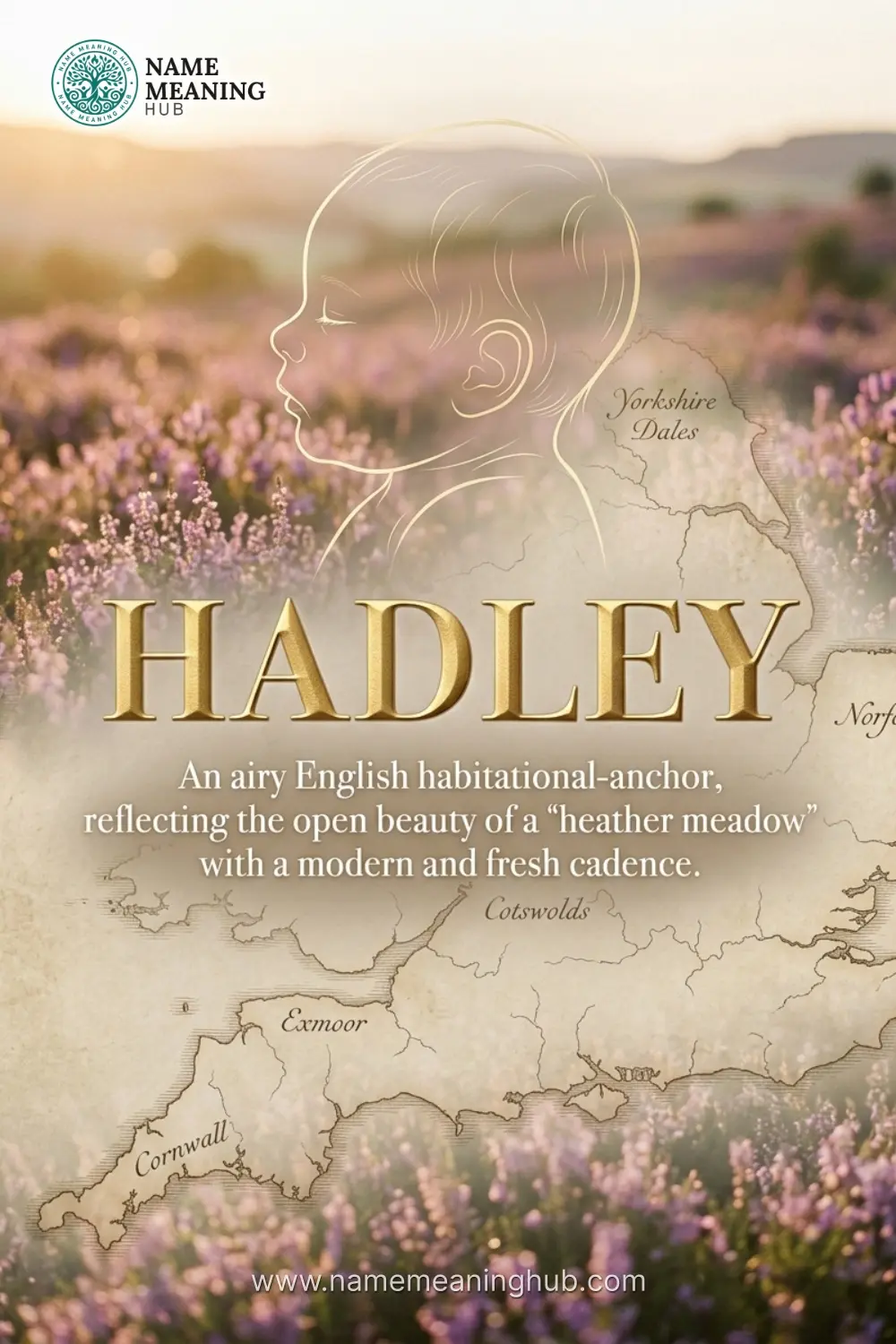
Hadley Name Meaning: Its Background, Symbolism, and Enduring Tone

Hadley is the kind of name that sounds polished before you ever stop to ask what it means. It moves quickly, lands cleanly, and fits easily into the modern ear. That surface efficiency is part of its appeal, but it is not the whole story. Underneath it lies a landscape. Its meaning, “heather field,” gives the name a quiet geography: open ground, hardy bloom, wind, space, and a beauty that belongs more to the natural world than to arrangement or ornament. That is what makes Hadley more interesting than many other contemporary surname-style names. It does not only sound current. It carries a place inside it.
That interpretive thread matters because Hadley is not a lush, dreamy nature name in the obvious sense. It does not arrive trailing petals or perfume. A field of heather is different from a rose garden. It suggests openness, resilience, and a kind of beauty that survives weather. The image is less delicate than decorative names usually are, and less severe than overtly tailored names often become. This is why Hadley can feel both feminine and grounded, both modern and rooted. It takes a landscape and translates it into a social identity that sounds bright, capable, and quietly outdoorsy. In that sense, the name’s real strength is not prettiness alone. It is atmosphere with structure.
Hadley's U.S. popularity rank over time, 1906–2024
Popularity statistics are based on official data from the Social Security Administration baby name records.
Hadley: A Distinctive Center with a Scattered Edge
Hadley reads as a name with one dominant center of gravity and a volatile, low-count edge. Its modern strength on the girls’ side likely reflects a taste for “surname-style” names that offer a sense of character while remaining easy to use .
The trace presence in the boys’ lane looks more like experimentation than a broad shift in identity. Meaning “heather field,” its two-syllable rhythm provides a texture of pastoral charm that fits the modern era.
What Hadley tells you before the deeper story begins
Before personality, style preference, or family associations come into the picture, Hadley already arrives with a clear set of facts that explain why it feels so workable in modern life.
| Key Facts | Information | Quick Insight |
|---|---|---|
| Name | Hadley | The form is polished and contemporary, which helps the name feel easy in modern English-speaking life. |
| Primary gender usage | Unisex | Hadley belongs to the shared-name category, but current use gives it a clearly stronger feminine center of gravity. |
| Primary origin | English | The English root keeps the name anchored in place-language rather than in abstract invention. |
| Core meaning | Heather field | This is a landscape meaning, which gives the name an atmosphere rather than just a trait. |
| Pronunciation | HAD-lee | The strong first beat and easy ending give Hadley a brisk, socially confident shape. |
| IPA | US /ˈhædli/ · UK /ˈhædli/ | The same basic pattern across US and UK use makes the name unusually stable aloud. |
| Syllable count | 2 | Two syllables keep the name efficient, which is one reason it feels so natural in contemporary use. |
| U.S. standing (2024) | No. 114 for girls and No. 4744 for boys | Official data shows Hadley remains technically unisex, but in actual American use it now reads much more strongly feminine. |
Hadley turns an English landscape into a modern identity
Why “heather field” gives Hadley more than a pretty image
There are names that describe qualities and names that describe places. Hadley belongs to the second group, and that changes the emotional effect immediately. A place-name meaning does not simply assign a virtue to a child. It creates a setting around the child. “Heather field” suggests open land, low bloom, texture close to the ground, and beauty that lives in breadth rather than in showiness. That is a very different atmosphere from a name built around one flower, one jewel, or one moral quality. It feels wider. Airier. More inhabited.
Historically, English surnames often came from topography: meadows, woods, hills, clearings, streams, and fields. That background matters because it means Hadley belongs to an older naming logic rooted in land and location. It was not constructed to sound fashionable. It began as a way of identifying people through place. That lends the name quiet legitimacy. Even when used now as a given name, it still carries the feel of something mapped rather than fabricated. If this origin is what attracts you most, browse names with English roots.
The word “field” is doing important work here too. A field is not a hothouse. It is not a manicured garden. It implies openness, weather, horizon, and room. The name therefore carries a subtler idea of beauty than many modern girls’ names do. It is not about delicacy. It is about expanse.
Why the heather in Hadley changes the tone
Heather is not a fragile bloom in the cultural imagination. It is hardy, low-growing, and associated with open country rather than curated domestic prettiness. That makes Hadley feel quietly stronger than names that simply point toward blossom or softness. The image is floral, but not ornamental in a sugary way. It has weather in it. That may be one reason the name manages to feel feminine without feeling flimsy.
This matters for parents who want a daughter’s name to feel graceful and appealing without sounding too decorative. Hadley solves that problem elegantly. It offers beauty through setting and resilience rather than through obvious adornment. The result is a name with a light social touch and a tougher emotional center than first impressions might suggest.

A meadow is not a garden, and that is why Hadley feels different
How Hadley separates itself from softer nature names
One reason Hadley has lasted is that it lives in the nature-name neighborhood without behaving exactly like a nature name. It does not sound as obviously botanical as Heather or Daisy, and it does not sound as overtly pastoral as Meadow. Instead, it takes a landscape image and filters it through the cleaner, more tailored structure of an English surname. That gives it a different texture. It feels less like a direct description and more like a human name that happens to have soil under it.

This is important because many parents want natural imagery in a name but hesitate when a name feels too literal. Hadley avoids that problem. The nature element is real, but it is softened by distance and structure. You can know the meaning and love the image without feeling that the name is trying too hard to perform its own symbolism. That restraint is one of its strongest modern qualities.
The field-versus-garden distinction also helps explain the name’s social mood. Gardens suggest cultivation, arrangement, and visible refinement. Fields suggest openness, freedom, and the kind of order that belongs to the land itself. Hadley inherits some of that wider, less managed feeling. It sounds polished, yes, but not precious. That is why it often appeals even to parents who normally dislike overtly “pretty” names.
What Hadley’s sound contributes to the landscape meaning
Phonetically, Hadley supports its own image extremely well. The first syllable, HAD, gives the name footing. It is direct, grounded, and unmistakably stressed. Then the -lee ending softens the line and allows it to lift lightly at the end. This arc matters. If Hadley were all softness, the landscape meaning might dissolve into mere prettiness. If it were all hardness, the meadow image would disappear. Instead, the name begins with earth and ends with air.
The liquid l sound in the final syllable also helps. Liquid consonants often make names feel smoother and more humanly wearable. In Hadley, that smoothness turns a place-derived name into something socially warm. It is one reason the name can carry a field and still sound at home in a modern classroom or workplace.
The total effect is one of controlled brightness. Hadley does not sing. It glides. That glide is part of why the name feels so easy in contemporary use even though its imagery is older and more rooted than its surface style first suggests.
How Hadley moved from surname territory into everyday first-name life
Why surname-style names have appealed to modern parents
Hadley belongs to the broad modern movement of surnames becoming given names, especially in English-speaking countries. That shift did not happen by accident. Surname-style first names often give parents a useful combination: they sound polished and contemporary, they feel less obviously fragile than many traditional girls’ names, and they often carry a hint of lineage or place. Hadley fits that pattern very well. It is crisp enough to feel current, but its meaning keeps it from sounding empty.
What distinguishes Hadley from some other surname-style names is that it has warmth built in. Some names in this category can sound all edge and no atmosphere. Hadley is different. The -lee ending softens it, and the heather-field meaning gives it actual sensory depth. So while it participates in the surname trend, it does not flatten into that trend completely. It keeps its own emotional color.
Why Hadley sounds so contemporary without feeling invented
That distinction matters because modern naming is full of forms that sound fashionable but not necessarily rooted. Hadley feels rooted. It may be current in style, but it carries an English landscape behind it and an older surname history beneath it. That combination makes the name feel safer, more durable, and more socially coherent than some newer inventions built from similar sounds.
It also helps that the pronunciation is so straightforward. Names often rise faster when they are visually neat and easy to say. Hadley benefits from that accessibility. It looks contemporary, but it does not force anyone to learn new rules in order to use it. That practicality is part of its success.
Hadley in the modern ear sounds bright, tailored, and gently outdoorsy
Where Hadley sits among current girls’ names
In present-day American use, Hadley occupies an interesting social position. It is recognizable, but not exhausted. Feminine, but not ornate. Fresh, but not bizarre. That balance is difficult to achieve. Many names that sound modern also sound highly trend-sensitive. Many names that sound grounded also sound older than some parents want. Hadley sits between those poles. It feels contemporary without feeling disposable.
The name also behaves well across age groups. On a little girl it sounds sunny and easy. On a teenager it sounds current without strain. On an adult it remains polished enough to be credible in serious settings. That age-range flexibility is one of the most practical advantages a name can have, and Hadley has it.
It is also worth noticing that the current US ranking pattern creates a particular social reality. Official data shows Hadley is still technically unisex, but overwhelmingly more common for girls. In practice, that means most listeners will now hear it as female first. Yet the name still retains some of the cleaner edges and surname-style neutrality that probably helped it appeal in the first place. That makes it feel feminine without becoming highly frilled. For related naming ideas in the same category, visit a wider list of unisex names.
Why Hadley’s outdoor quality feels quiet rather than rustic
Names connected to landscape can sometimes tip into either obvious pastoral sweetness or overtly rustic roughness. Hadley avoids both. It sounds too streamlined to be rustic in a raw way, but too rooted to feel synthetic. The field in its meaning does not turn it into a country-costume name. It simply gives the name open air behind its neat modern silhouette.
This quiet outdoors quality is one of its real strengths. Parents who like names with nature in them but do not want something too direct often find exactly the right compromise in names like Hadley. It sounds urban enough for contemporary life, yet still carries a piece of weathered English landscape inside it. That layering gives the name charm without overstatement.
What parents usually ask once Hadley feels right
Once the meaning and overall tone of Hadley settle into place, the next questions are usually practical. They reveal how the name will actually behave in daily use, in family life, and on paper.
Which middle names give Hadley more depth or more contrast?
Because Hadley is already polished and light, the middle name often decides whether the full combination feels more classic, more tailored, more feminine, or more rooted in family history. A short classic can sharpen it. A longer traditional middle can ground it. If you want the full pairing logic behind that contrast, see middle names for Hadley.
What nicknames emerge naturally from Hadley, and what do they change?
Hadley is short enough to stand on its own, but it still contains believable nickname material. Some shortenings keep the modern edge, while others bring out a softer or more playful side. Which one feels right usually depends more on relationship than on formal necessity. To see how those different moods shorten in real life, explore Hadley nicknames.
How does the pronunciation of Hadley stay so stable in everyday life?
The answer lies in clarity. The first syllable is strongly stressed, the spelling points directly toward the usual sound, and the overall rhythm is simple enough to be learned after one hearing. If you want the full sound pattern behind that rhythm, read Hadley pronunciation guide.
Why Hadley still sounds like a place you could step into
In the end, Hadley succeeds because it does not force parents to choose between polish and place. It offers both. On paper it looks modern, trimmed, and efficient. In meaning it opens into a field of heather, which gives it space, texture, and a kind of durable beauty that is very different from surface prettiness. That combination is rare. Many names are stylish. Fewer are atmospheric. Fewer still are both atmospheric and socially easy.
There is also a deeper literary pleasure in the name’s restraint. Hadley does not arrive loudly announcing its symbolism. It lets the landscape remain just beneath the surface. That gives the bearer room. The name can be worn in the everyday world without turning into a costume or a theme. But if you know what it means, you hear the weather in it—the heather, the field, the sense of land held open under light.
That may be the best final way to understand it. Hadley is not simply a modern name with an old meaning attached. It is a place-name made wearable, a landscape made human-sized. It sounds neat in public, but carries openness behind it. And that is why Hadley continues to feel so convincing: it gives the child not just a stylish label, but a horizon.