
How to Pronounce Greta: Syllables, Stress, and Common Mistakes
The real test of a name’s pronunciation almost never happens in a quiet moment. It happens in motion: a teacher pausing over a class list, a nurse calling into a waiting room, a host glancing at a card just before saying the name aloud. Greta is the kind of name that looks simpler than it can feel in that split second. Most people recognize it immediately, but recognition and confidence are not always the same thing. A speaker may wonder whether the first vowel should lean toward gray, whether the second syllable should sound clipped, or whether the name ought to carry a more continental edge. That hesitation matters because Greta is a name whose effect depends on its neatness. Said correctly, it sounds concise, poised, and quietly strong. Said vaguely, it loses some of its clean shape.
In everyday English, the answer is reassuringly clear. Greta is most naturally pronounced GREH-tuh. It is a two-syllable name with the stress firmly on the first syllable. That first beat gives the name its presence. The second syllable relaxes and softens the line, which is why Greta sounds polished rather than severe. In practice, it is a very wearable pronunciation: easy to say, easy to hear, and stable enough that speakers in the United States and the United Kingdom keep essentially the same rhythm even when the exact vowel color shifts slightly.
How Greta is actually said when the name keeps its shape
| Element | Phonetic Detail | Quick Tip |
|---|---|---|
| Common spoken form | GREH-tuh | Think of one firm opening syllable followed by a light, relaxed ending. |
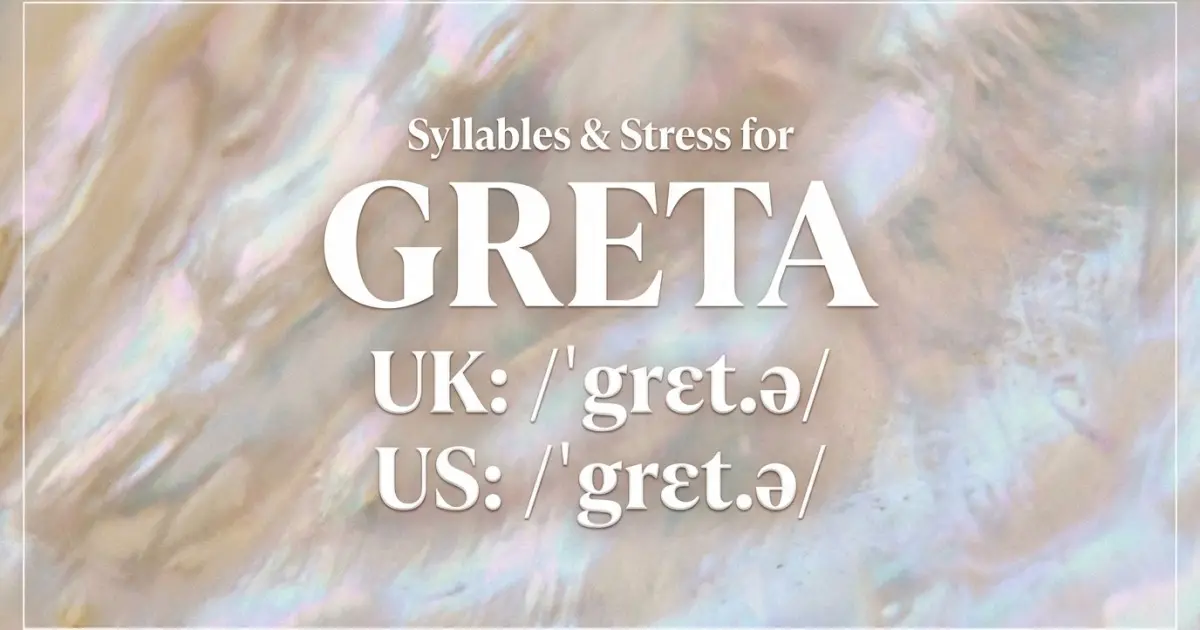
| US IPA | /ˈɡrɛtə/ | The first vowel is open and clear, like the start of dress, not gray. |
| UK IPA | /ˈɡretə/ | The UK form is very close, with a slightly tighter vowel but the same overall rhythm. |
| Syllable count | 2 syllables | Keep Greta compact. It should sound brisk and finished, not stretched. |
| Stress pattern | First syllable stressed | Put the weight on GREH. The second syllable should not compete for attention. |
| Opening consonant cluster | /ɡr/ | Let the gr arrive cleanly together; it is part of what gives the name its edge. |
| Ending vowel | Schwa-like final syllable | The last syllable should soften the name. Do not overpronounce it as a full, dramatic ah. |
| Everyday sound goal | Firm front, gentle finish | Greta sounds best when the first syllable leads decisively and the second simply settles the line. |
Where Greta gets its firmness and where it softens
Greta works so well in speech because its sound design is efficient. The name begins with a consonant cluster, moves immediately into a stressed vowel, and then relaxes into a neutral final syllable. That gives it both presence and ease. It sounds capable from the start, but it does not end hard. Before focusing only on syllables and stress, it helps to step back into the fuller frame of Greta meaning.
The front of Greta does the real work
The opening gr matters more than many speakers realize. Consonant clusters often create a sense of shape immediately, and Greta benefits from that. It does not float into the ear. It arrives. Then the stressed vowel in the first syllable gives the name its center of gravity. That is why the name still sounds substantial even though it is only two syllables long.
In the U.S. IPA, the vowel is /ɛ/, the same general vowel family heard in words like dress or best. In the UK form, the vowel may sound a little tighter, but it does not transform the name into something fundamentally different. In both cases, the listener hears a bright but grounded first syllable.
The ending keeps Greta from sounding too hard
The second syllable, -tuh, is what makes Greta human rather than blunt. A final schwa-like sound is one of English’s most useful softening tools. It appears in countless names and ordinary words, and it allows strong openings to resolve naturally. Without that gentle ending, Greta might feel too clipped. With it, the name sounds controlled instead of severe.
This is a useful thing for parents to understand. If the final syllable is overemphasized, Greta can sound heavier than it should. If it is too weak, the name may sound unfinished. The best pronunciation lets the last syllable do its work quietly. It closes the name without stealing attention from the first half.
Why Greta gets mispronounced even though it looks familiar
Greta is recognizable, but names that feel familiar often attract small pronunciation errors because speakers assume rather than listen. In Greta’s case, the most common slips usually come from vowel guesswork or from trying to make the name sound more exotic than it needs to be.
The most common mistake patterns with Greta
One likely mistake is drifting toward GRAY-tuh, especially for speakers who instinctively read the vowel as if it belonged to a different English pattern. Another is pulling the first syllable toward GREE, especially if the reader is trying to guess a more foreign-sounding form. A third mistake is making the ending too emphatic, almost turning it into a full tah rather than a softer tuh.
None of these are disastrous, but they do change the feel of the name. GRAY-tuh makes Greta sound looser and less grounded. GREE-ta shifts it into a different tonal world entirely. Overweighting the last syllable can make the name sound theatrical rather than clean. The standard form, GREH-tuh, avoids all three problems by keeping the first vowel open and the ending modest.
Why Greta should not be over-Europeanized
Because Greta is associated in many people’s minds with Germanic or Scandinavian usage, some speakers may try to “honor” the name by making it sound more exaggeratedly continental in English. That instinct is understandable, but it can create a pronunciation that feels less natural in everyday speech. The best English pronunciation of Greta is not careless and not ornamental. It is simply clear.
That clarity is part of the name’s appeal. Greta does not need dramatic handling to sound elegant. Its elegance comes from restraint.
Greta stays impressively stable across English accents
One of Greta’s quiet strengths is that it travels well between major English-speaking accents. The U.S. and UK IPA forms differ only slightly in the quality of the first vowel. The name’s stress, compactness, and overall shape remain essentially the same. That makes Greta unusually reliable in public life.
What changes slightly between U.S. and UK speech
In American English, the first vowel often sounds a touch more open. In British English, it may feel a little cleaner or narrower. But the listener still hears the same underlying name: strong opening, soft ending, two-syllable structure. These are surface variations, not identity-level differences.
That matters more than it may seem. A name that remains stable across accents is easier to carry internationally, easier to hear correctly after one introduction, and less likely to produce repeated correction fatigue. Greta benefits from exactly that sort of stability.
Sound neighbors that help people place Greta
If someone needs a comparison point, it is usually more useful to focus on the rhythm than to search for a perfect twin. Greta should feel brisk and balanced: one strong syllable, one soft one. It is not drawn out. It is not sing-song. It does not tumble forward. It arrives, then settles. Once that pattern is heard, the pronunciation becomes very easy to retain. The way the name resolves at the end often decides which short forms feel natural in speech, and that becomes clearer in nicknames for Greta.
How to practice Greta until it feels completely natural
The easiest way to learn a name is to use it in ordinary speech rather than treat it like a recital piece. Greta is especially responsive to that method because its charm lies in natural firmness, not in elaborate articulation.
Practice lines that make Greta easy to feel
Try saying these aloud at normal conversational speed:
“Greta is here.”
“Have you met Greta?”
“Greta will join us later.”
“This seat is for Greta.”
In each line, keep the first syllable clear and let the second fade gently. If you hear yourself leaning toward GRAY, pull the vowel back toward GREH. If the final syllable feels too dramatic, relax it. Greta should sound neat, not overperformed.
What correct Greta should feel like in the mouth
A well-spoken Greta should feel compact and deliberate. The mouth gathers slightly at the front, the stress lands immediately, and then the ending releases the name without fanfare. That physical feeling is useful because it matches the name’s style. Greta is not showy. It is precise. Once the body feels that pattern, the pronunciation usually becomes automatic.