
How to Pronounce Grayson: Clear Pronunciation Help for Everyday Use

The real test of a name’s pronunciation rarely happens in a quiet nursery. It happens when a teacher reaches the next line on a class list, when a receptionist calls across a waiting room, when a coach reads a roster aloud without rehearsal, or when a stranger glances at a name tag and has to make a fast decision with the mouth. Grayson usually does well in that moment. It looks contemporary, but it does not behave like a spelling puzzle. Most English speakers can say it correctly on first encounter, which is one reason the name has stayed so easy to carry in public life.
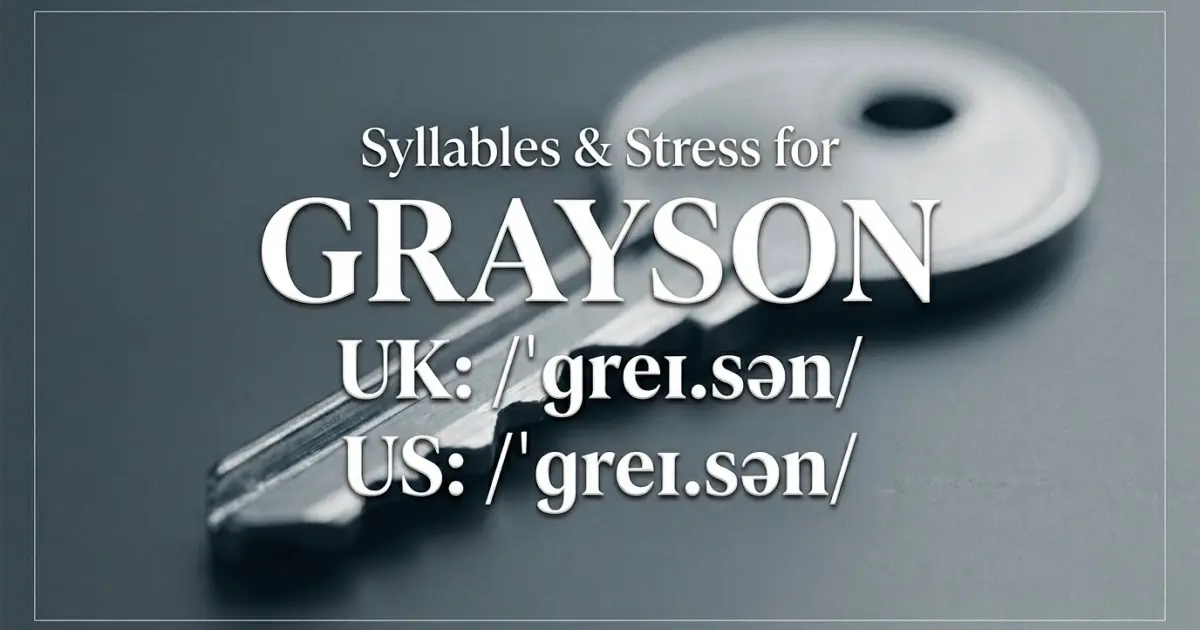
That ease comes from structure. Grayson is only two syllables, the stress falls where English speakers expect it to fall, and the sounds themselves are familiar and stable. The standard everyday pronunciation is GRAY-sun. Both the U.S. and U.K. IPA forms align at /ˈɡreɪsən/, which is a quiet advantage: the name keeps the same basic spoken identity across major English accents. So while Grayson may feel polished and current in style, its pronunciation is cooperative rather than delicate. It asks for almost no explanation.
What Grayson Is Actually Clarifying When People Say It
| Element | Phonetic Detail | Quick Tip |
|---|---|---|
| Everyday pronunciation | GRAY-sun | Say the first syllable clearly, then let the second syllable relax behind it. |
| Syllable count | 2 syllables | Think of the name as one strong opening beat followed by a softer landing. |
| Primary stress | Stress on GRAY | If the second syllable gets too much weight, the name starts to sound unnatural in English. |
| US IPA | /ˈɡreɪsən/ | The opening vowel matches the sound in “day” or “gray.” |
| UK IPA | /ˈɡreɪsən/ | The same core pattern holds in British English, so the name travels cleanly. |
| Opening consonant | /ɡ/ voiced stop | Start firmly, but do not over-hit the first consonant. |
| Middle flow | /s/ into a reduced vowel | Keep the ending soft enough that the name stays fluid rather than choppy. |
| Ending | Unstressed -sun with a schwa-like vowel | The last syllable should support the name, not compete with the opening. |
Grayson Lives on the First Syllable and Softens on the Second
The most important thing to hear in Grayson is stress. This is a first-syllable name. The voice lands on GRAY and then moves into a lighter -sun. That pattern is what gives the name its easy confidence. English speakers are highly sensitive to stress, even when they do not think consciously about it. A familiar-looking name can suddenly sound wrong if the emphasis shifts to the wrong place. With Grayson, the natural rhythm is very clear: GRAY-sun, not gray-SON. The sound matters more once you know what the name is meant to carry, which is why the wider frame starts in Grayson meaning.
Why the opening carries most of the identity
The first syllable does almost all of the heavy lifting. It begins with a voiced stop, /ɡ/, which gives the name a clean, grounded start. Then comes the long A sound, /eɪ/, which is one of the most familiar and stable vowels in English. Together, they create an opening that feels bright, firm, and instantly recognizable. This is part of why Grayson sounds polished rather than harsh. The first syllable has clarity, but not aggression.
That opening also helps the name feel socially visible. It lands quickly in the ear. It is easy to catch across a room, easy to repeat, and easy to remember after one hearing. These practical qualities are often underrated, but they matter enormously in daily life. A name that arrives cleanly tends to be repeated with confidence, and confidence helps a name settle into the culture.
Why the second syllable should stay lighter
The ending of Grayson is much less emphatic. In natural English speech, the vowel in the second syllable is reduced, which means it sounds softer and more neutral than the opening. This is normal. It is one reason the name feels easy and modern. If the second syllable is over-pronounced, Grayson can begin to sound heavier and more deliberate than it should.
The key is balance. You do not want the last syllable swallowed entirely, but you also do not want it landing with the same weight as the first. The best version of Grayson sounds like one strong beat followed by one gentle echo. That is what keeps the name crisp without making it abrupt.
Grayson Is Easier Than It Looks Because the Sounds Are Familiar
One of Grayson’s quiet strengths is that it is built from very cooperative English sounds. There are no difficult clusters, no unstable vowels, no surprising silent letters, and no hidden extra syllables. The first syllable is common, the final -son pattern is extremely familiar in English naming, and the whole name fits ordinary speech habits very comfortably.
Why the /s/ and reduced ending matter
The central transition into the second syllable is smoother than people sometimes realize. After the bright opening, the s sound helps guide the name forward into a reduced vowel. This is a gentle kind of movement. It prevents the name from sounding blocky. If the final syllable were harder or more sharply articulated, Grayson would feel more abrupt. Instead, the ending lightens the line and makes it socially easy.
From a pronunciation standpoint, this is useful because it means the name remains clear even at speed. Many names become muddy in fast speech. Grayson generally does not. The shape holds even when spoken casually, which is one reason it feels natural in everyday settings.
Why Grayson travels well across accents
Since both the U.S. and U.K. IPA forms are given as /ˈɡreɪsən/, the basic spoken pattern remains stable across major English accents. Accent color will always shift slightly from speaker to speaker, of course, but the structure stays the same. That kind of portability matters more than people often realize. A name that keeps its identity across regions is easier to carry socially because it asks for fewer corrections and less adaptation.
Grayson benefits from being modern in style but conservative in sound. That is a very effective combination. It looks current, but it behaves predictably.
Where Grayson Gets Misheard, Flattened, or Slightly Overdone
Grayson is not a difficult name, but a few small pronunciation problems still appear. Most of them come from overcorrection rather than genuine confusion.
Mistake pattern one: over-stressing the ending
The most common issue is giving the second syllable too much weight. This can happen when a speaker tries to pronounce the name too carefully or assumes every part should be equally clear. But Grayson does not work like that. The first syllable leads. The second supports. If the ending becomes too strong, the whole name starts to sound less natural in English. Once the sound pattern is clear, some shortenings stop feeling optional and start feeling natural, and the clearest map is in nicknames for Grayson.
Mistake pattern two: clipping the opening too quickly
Another small problem is shortening the first vowel too much. Grayson should begin with the full long A sound heard in “gray.” If that vowel becomes clipped or flattened, the name loses some of its smoothness and brightness. The fix is easy: slightly lengthen the first vowel and let the name open properly before it settles into the final syllable.
Mistake pattern three: turning the second syllable into a hard word
Some speakers pronounce the ending as though it were a fully stressed standalone “sun.” That makes the name feel heavier and more segmented than it should. In ordinary speech, the ending is lighter and more reduced. This does not mean it disappears. It just means the name should move as one connected line rather than as two equally strong blocks.
These are all easy corrections, which is part of why Grayson remains so manageable. The name’s structure is clear enough that most listeners naturally drift toward the correct pattern anyway.
Grayson Sounds Best When It Moves as One Easy Line
The easiest way to pronounce Grayson well is not to overthink it. The name works best when it is said as a connected whole. It should sound like something a person would naturally call across a room, not like a demonstration in a phonetics class.
Three useful practice lines for Grayson
Try these aloud:
Grayson is ready.
Come here, Grayson.
This is Grayson James.
These lines matter because they place the name at the beginning, middle, and end of real sentences. If the rhythm still feels natural in all three places, then the pronunciation is probably right. The self-check is very simple: the opening should sound bright and steady, and the ending should feel lighter and more relaxed.
The quickest self-correction for Grayson
If Grayson ever sounds too clipped, too formal, or too segmented, the solution is usually the same. Restore the long A in the first syllable, keep the stress there, and soften the ending. The name should have one clear front anchor and one easy trailing syllable. That is exactly what gives Grayson its everyday polish.