
How to Pronounce Gavin: Syllable Guide and Easy Stress Tips
The clearest test of a name’s pronunciation is not a phonetics chart. It is a human voice in a public room: a teacher reading a class list for the first time, a barista calling a cup from the counter, a coach scanning the roster before practice, a presenter pausing for half a second because this is the moment when the written name becomes sound. Gavin usually passes that test well. It is familiar enough in modern English-speaking life that most people land close to the correct form on the first try, and short enough that they do not have many places to go wrong. That everyday reliability is one of the name’s practical strengths.
What makes Gavin work is its compact architecture. The name is only two syllables, but it is not flimsy. It opens with a hard G, settles into a bright short vowel, and carries a v that gives it texture before the second syllable closes lightly with -in. Say it aloud and the pattern becomes obvious: GAV-in. The stress arrives early, the ending stays relaxed, and the whole name feels crisp without sounding abrupt. In pronunciation terms, Gavin is one of those names that sounds almost exactly as well in ordinary speech as it looks on paper, which is rarer than parents sometimes expect.
What this clarifies about how Gavin is actually said
| Element | Phonetic Detail | Quick Tip |
|---|---|---|
| Common spoken form | GAV-in | Keep the emphasis on the first syllable and let the second fall lightly. |
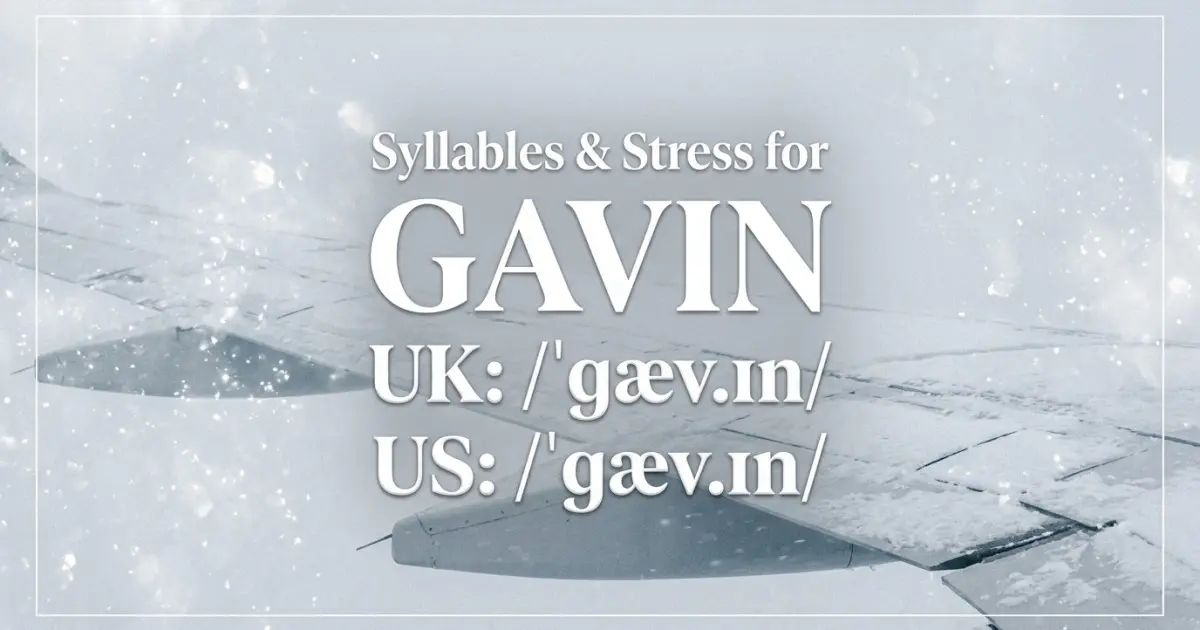
| U.S. IPA | /ˈɡævɪn/ | The opening vowel is the same short a sound heard in words like have or cab. |
| U.K. IPA | /ˈɡævɪn/ | The core pronunciation is essentially the same in standard American and British English. |
| Syllable count | 2 syllables | Think in two clean beats, not three: GAV | in. |
| Stress pattern | Primary stress on the first syllable | If the second syllable starts sounding equally strong, the name loses its natural English rhythm. |
| Ending sound | Light -in | Do not overpronounce the ending into -een or -en with extra weight. |
| Nickname clue | Gav comes from the stressed opening | The most intuitive short form keeps the strongest sound zone of the full name. |
How Gavin lands in the mouth
Gavin sounds simple because, structurally, it is simple in the best way. The name begins with a voiced velar stop, the g sound, which gives it a firm opening. That is followed by the short a vowel, bright and open rather than dark or drawn out. Then comes v, a fricative. That word sounds technical, but the idea is easy: a fricative is made by letting air pass through a narrow space, creating friction. In Gavin, the v is what gives the name some texture and buzz. Without it, the name would feel flatter. After that, the final syllable, -in, closes with a short vowel and the nasal n, which softens the finish. The sound matters more once you know what the name is meant to carry, which is why the wider frame starts in Gavin meaning.
There is another reason Gavin stays stable in speech: it does not rely on sounds that vary wildly across accents. It has no r, which is a liquid consonant that often changes character depending on region. It has no th, which can trip speakers from other language backgrounds. It has no unusual cluster like gw or rh, which some Welsh-derived names carry into English awkwardly. Gavin therefore comes across as both traditional and accessible. The linguistic material is straightforward, and that gives the name a kind of public confidence.
Why the first syllable does most of the work
The identity of Gavin lives in the first beat. GAV is where the stress sits, where the mouth opens, and where the name announces itself. That early stress makes the name sound brisk and self-possessed. It is also why the common nickname Gav feels so natural. English speakers often shorten names to their stressed syllable, and Gavin follows that pattern neatly.
Why the second syllable should stay light
The second syllable is not meant to compete. It should sound like a quick, relaxed landing. If you weigh it down too much, Gavin starts sounding overcareful. The best everyday pronunciation lets the name move forward: GAV-in, not gav-IN and not GAV-eehn.
Why Gavin stays stable across accents
One of the most practical things about Gavin is that the standard American and British IPA forms are the same: /ˈɡævɪn/. That does not mean every speaker sounds identical, only that the underlying structure remains consistent. The short a in the first syllable stays recognizably the same, the stress remains at the front, and the ending stays light. In other words, Gavin does not undergo a dramatic accent shift the way some names do.
Accent notes that parents usually want to know
In many American accents, the first syllable may sound a touch wider or more open. In many British accents, it may sound slightly tighter and quicker. But these are subtle texture changes, not structural ones. The name still reads as Gavin immediately. For families who care about international readability in English-speaking contexts, this is a quiet advantage. The name travels well.
Gavin and its sound neighbors
Where confusion does sometimes happen is not with accent, but with neighboring names. Gavin sits near names like Kevin, Galen, Garvin, Gaven, and Gawain in the listening field. The strongest comparison is probably with Kevin, because the rhythm is similar and both names end in a light -in. But the opening consonants are distinct enough that the names usually separate quickly in context. Gavin is also related historically to Gawain, but the pronunciation is not the same. Gavin in ordinary English does not become ga-WAYN. That is the literary cousin, not the everyday spoken form. Once the sound pattern is clear, some shortenings stop feeling optional and start feeling natural, and the clearest map is in nicknames for Gavin.
Where Gavin gets misheard and how to avoid it
Gavin is not especially error-prone, but a few small drifts do occur. Most of them come from either vowel confusion or people trying to “improve” the name into something more elaborate than it is.
Mistake pattern one: flattening the first vowel
The correct opening is the short a of GAV. If speakers slide toward a softer or longer vowel, the name can sound blurred. The safest mental anchor is to think of the opening sound as matching the a in everyday English words like have. Gavin wants brightness, not murkiness.
Mistake pattern two: giving too much weight to the ending
Sometimes people overcarefully pronounce the second syllable, making it sound almost like GAV-een or GAV-en with extra emphasis. In natural English, the ending should be quick and low-pressure. The first syllable leads; the second simply resolves.
Mistake pattern three: drifting toward a related name
Because some naming guides discuss Gavin alongside Gawain and alternate spellings such as Gaven or Gavyn, speakers occasionally overthink it. But the standard spoken form remains plain and stable: GAV-in. The name’s power lies partly in the fact that it does not need theatrical handling.
Practising Gavin until it sounds effortless
The easiest way to practice Gavin is to say it in ordinary speech frames rather than in isolation alone. Because the name is so rhythm-dependent, short sentences help you hear whether the first syllable is carrying enough weight and whether the second is staying light enough.
Useful practice lines
- Gavin is here.
- This is Gavin Reed.
- Gavin, your table is ready.
- We named him Gavin.
If the name feels too flat, strengthen the opening. If it feels overenunciated, lighten the end. In most cases, one good rule solves the whole problem: say Gav first in your mind, then let the -in arrive gently after it. Because the nickname sits inside the name’s stressed syllable, it acts like a built-in pronunciation guide.
The quick memory trick
Use this simple cue: Gav + in. The front does the work, the back does the finish. That gives you the name’s natural English contour immediately.