
How to Pronounce Gary: A Simple Pronunciation Guide
Think of the places where a name has to work before anyone pauses to explain it: a teacher at attendance, a nurse at a waiting-room door, a coach reading a lineup, a colleague introducing someone across a conference table. Gary is one of those names that usually clears the room on first hearing. People may carry different cultural memories of it, but they rarely stop over how to say it. That matters. A name that does not snag in the mouth or stall in the ear tends to feel grounded, familiar, and socially easy long before anyone thinks about etymology.
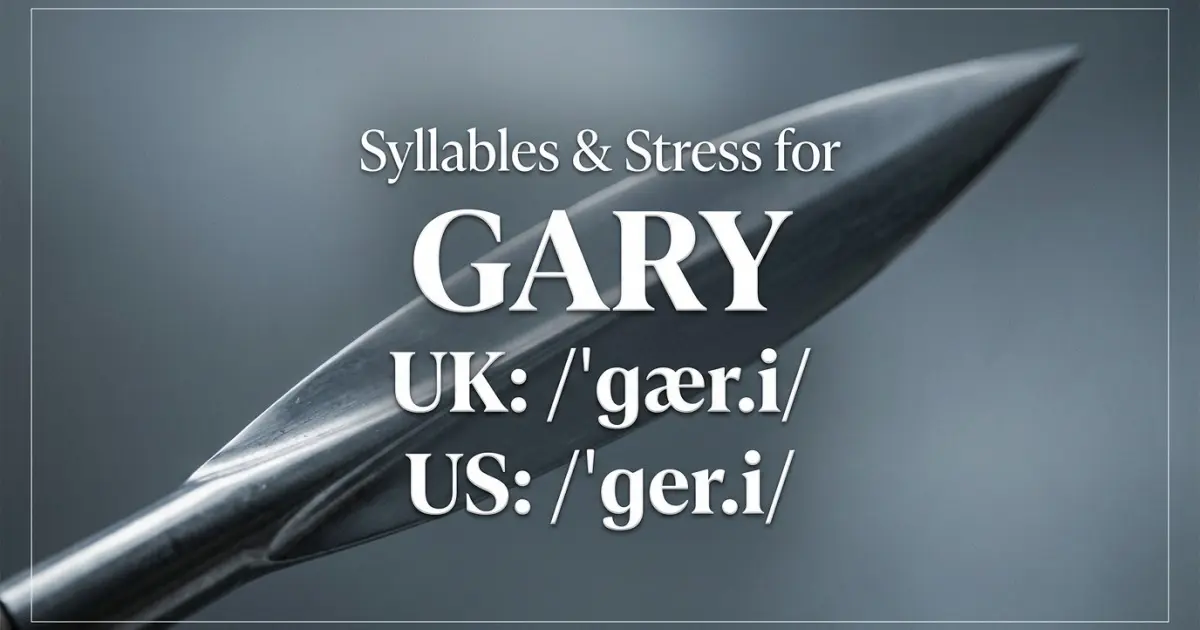
That ease is the real pronunciation story of Gary. The everyday spoken form is GAIR-ee, and both American and British English are commonly represented here with the same IPA: /ˈɡæri/. It is a two-syllable name with stress on the first syllable, a hard g opening, and a relaxed second syllable that keeps the whole word from sounding harsh. For a name whose meaning reaches back to “spear,” Gary sounds surprisingly approachable. The pronunciation does a great deal of that softening work.
What Gary Is Actually Doing When People Say It
| Element | Phonetic Detail | Quick Tip |
|---|---|---|
| Everyday form | GAIR-ee | Say it like “GAIR-ee,” with the first syllable clear and stronger than the second. |
| IPA (U.S.) | /ˈɡæri/ | The first syllable carries the stress; the ending is light and easy. |
| IPA (U.K.) | /ˈɡæri/ | The core pronunciation remains the same in this profile, which helps Gary travel well across English accents. |
| Syllable count | 2 syllables | Gary should sound like one strong beat followed by one softer beat, not like a clipped one-syllable name. |
| Stress | First syllable stressed | Emphasize GAIR, not the ending. It is GAIR-ee, not gair-EE. |
| Opening sound | /ɡ/ voiced stop consonant | Start with a firm hard g, as in “go,” not a soft j sound. |
| Middle vowel zone | /æ/ before r | Many speakers hear this as close to “air” in practice, which is why the simple guide GAIR-ee works well. |
| Ending sound | /i/ unstressed final vowel | Let the last syllable relax lightly into “ee” without overemphasizing it. |
Gary Sounds Friendly Because the Hard Start Immediately Softens
The hard G gives Gary its structure
Gary begins with /ɡ/, a voiced stop consonant. In plain English, that means the sound starts with a brief closure in the mouth and then releases cleanly. It is a firmer beginning than names that open with breathier sounds like h or more flowing sounds like l or r. That hard g matters because it gives Gary backbone. The name does not drift into the room. It arrives. Pronunciation lands more fully when the name’s roots and history are already in view, so begin with Gary meaning.
But Gary does not stay hard for long. The strong opening is quickly followed by a more open vowel and then a light second syllable. That balance is important. It keeps the name from sounding severe. The first consonant gives the name clarity; the rest of the sound keeps it human.
Why GAIR-ee works as a practical guide
The pronunciation display GAIR-ee is useful because it matches how many English speakers actually hear the first syllable in ordinary speech. Technically, the IPA here is /ˈɡæri/, which places the first vowel in the short a family. But because that vowel sits before r, many ears perceive it as leaning toward an “air”-like quality. That is why GAIR-ee is such an effective plain-English guide. It gets listeners very close to the real spoken shape without burdening them with phonetic theory.
This is a good example of how pronunciation guides and IPA do slightly different jobs. The IPA gives the structural sound. The simplified guide helps people say the name naturally. With Gary, both point to the same practical result.
The light ending is what keeps Gary approachable
The final syllable in Gary is unstressed and easy. It ends in /i/, the “ee” sound, and that soft finish helps explain why Gary sounds warmer than its old root meaning suggests. If the name ended on a hard consonant, it would feel much more abrupt. Instead, the second syllable releases the tension created by the opening. Gary begins firm and ends familiar. The way the name resolves at the end often decides which short forms feel natural in speech, and that becomes clearer in Gary nicknames.
That is one reason the name has worn so well in everyday life. It has enough consonant strength to sound masculine and clear, but enough softness at the end to remain socially easy.
Gary Across Accents Stays Remarkably Stable
Why the U.S. and U.K. forms remain aligned
Some names shift dramatically between American and British English. Gary is not one of them in this profile. Both are represented as /ˈɡæri/, which tells you something important: the name’s overall structure is stable. The stress stays on the first syllable, the hard g remains intact, and the ending stays light.
That stability is one reason Gary functions so smoothly in public speech. People may color the first vowel slightly differently depending on region, but they are almost always still saying the same name. The core identity does not wobble.
Small natural differences still happen
In real life, some speakers make the first syllable sound a little flatter, while others let the r influence the vowel more strongly. Some speak the second syllable almost as a quick release; others give it a little more room. These are normal accent textures, not competing standard pronunciations. Gary remains Gary in all of them.
That is worth stressing because short, familiar names can sometimes feel more variable than they really are. With Gary, the social impression may shift by accent, but the name itself stays very steady.
Where Gary Usually Gets Mispronounced
The biggest mistake is softening the hard G
The most important thing not to lose is the opening consonant. Gary should begin with a hard g, not a soft j. That means it starts more like “go” than like “giant.” In practice, most English speakers already know this instinctively, but it is still the most fundamental pronunciation point. If the opening changes, the whole name changes.
The second mistake is overflattening the first syllable
A more subtle issue is making the first syllable too flat or too clipped. Gary should not sound like a rushed “GAH-ree,” nor should it sound like a stiff, artificial “GAH-ree” with the second syllable overpronounced. The simplest guardrail is the provided guide: GAIR-ee. That keeps the first syllable lively and accurate enough for real speech.
Helpful sound neighbors include names and words such as Carrie, Harry, and airy in rhythm, though Gary begins with a hard g. These comparisons can help listeners hear the structure: one strong opening syllable, one lighter trailing syllable.
Do not overwork the ending
Because Gary is so familiar, some speakers overcorrect by pronouncing the second syllable too carefully. That tends to make the name sound stiffer than it should. The ending should be present, but not dramatic. Gary works best when the first syllable leads and the second follows lightly.
Practicing Gary Until It Sounds Natural in a Real Room
How to build the name cleanly
The easiest way to practice Gary is to feel it as two connected parts: GAIR + ee. Start with the firm hard g. Let the first syllable carry the weight. Then let the second syllable relax. The name should sound like it belongs in ordinary speech, not like it is being demonstrated in slow motion.
Useful practice lines include:
“Gary is here.”
“I spoke with Gary this morning.”
“Gary and Daniel are ready.”
“Please ask Gary to come in.”
When saying these aloud, listen for two things: whether the hard g is clear, and whether the first syllable is carrying the stress naturally. If both are in place, the pronunciation is usually right.
Why Gary sounds warmer than its meaning
The deeper lesson in Gary is that pronunciation can transform etymology. A name rooted in the idea of a spear could have sounded much sharper than this. But Gary’s actual sound shape—firm opening, open first syllable, light ending—makes it approachable. The pronunciation has helped domesticate the history. That is why Gary sounds more like a person than a symbol, even when the meaning behind it remains ancient and concrete.