
How to Say Gareth Correctly: A Simple Pronunciation Guide
The pronunciation of Gareth is often tested in the same quick, public places where names either settle smoothly or need a second try: a teacher moving through attendance, a receptionist reading from a form, a coach calling players into line, a presenter introducing someone from a printed program. The spelling looks old-world and familiar at the same time, but the ending can make people hesitate. Is it GARE-ith, GAR-eth, or something closer to guh-RETH?
The clean spoken form is GAIR-eth. Gareth is a two-syllable Welsh-origin male name meaning “spear strength,” and its pronunciation should feel firm but controlled. The first syllable carries the weight; the second syllable releases gently into the final th. That balance matters because the name’s sound mirrors its style: strong at the front, refined at the finish.
How Gareth is actually said when the first syllable leads
| Element | Phonetic Detail | Quick Tip |
|---|---|---|
| Everyday pronunciation | GAIR-eth | Put the stronger beat on GAIR, then soften into eth. |
| Syllable count | 2 syllables | Keep it compact: GAIR + eth. |
| Stress pattern | First syllable stressed | Do not shift the emphasis to the ending. |
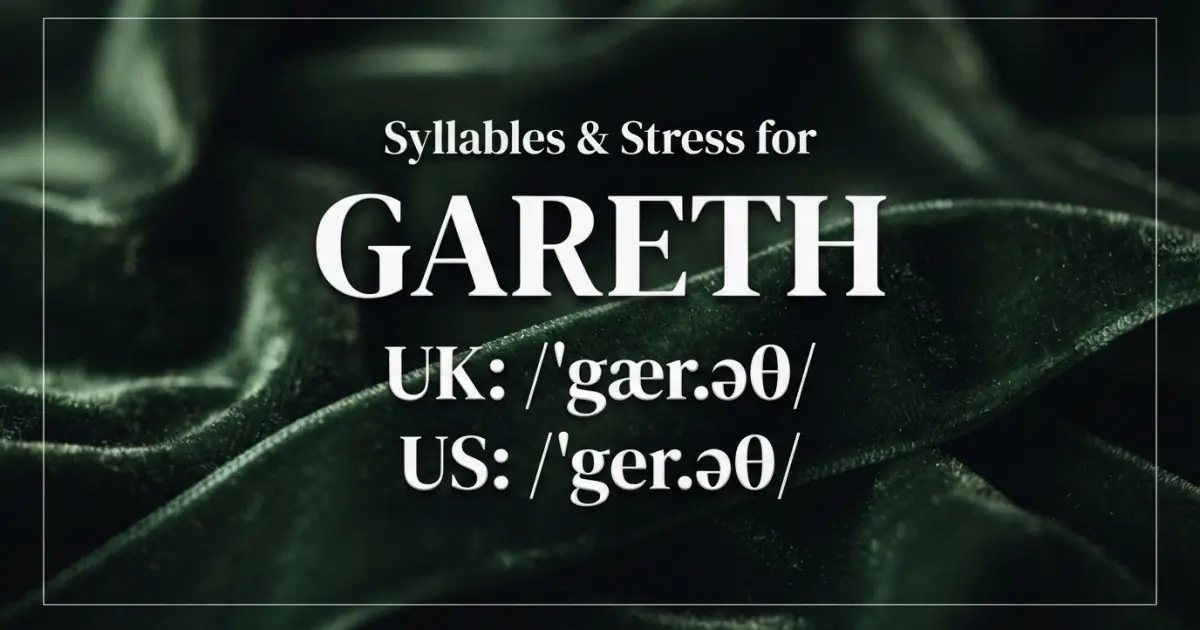
| US IPA | /ˈɡærəθ/ | The stress mark shows that the first syllable is the anchor. |
| UK IPA | /ˈɡærəθ/ | The U.S. and UK IPA forms match, so the name is stable across major English accents. |
| Opening sound | G followed by air/ar movement | Begin firmly, but do not overlengthen the first vowel. |
| Ending sound | -eth | Finish with a soft th, as in breath. |
Gareth is a front-stressed name with a soft final edge
The most important pronunciation rule for Gareth is stress. The name is GAIR-eth, not guh-RETH. The voice should land first, then relax. This front-stressed pattern is part of why Gareth feels steady and traditional in English. It begins with confidence and ends with restraint. Pronunciation lands more fully when the name’s roots and history are already in view, so begin with Gareth meaning.
The first sound is a hard g, as in go or garden. Linguistically, this is a voiced stop consonant: the sound begins with a brief closure, then releases. In everyday terms, Gareth starts firmly. After that comes the r movement, a liquid consonant that lets the sound flow rather than break abruptly. The name therefore has both firmness and movement in the first syllable.
The first beat gives Gareth its authority
The first syllable, GAIR, should be clear and strong. It is the part people hear first, and it carries the identity of the name. If the first syllable is weakened too much, Gareth loses its shape.
A useful way to remember it is to say the name in two deliberate steps: GAIR, then eth. Once that pattern feels natural, the full name can be said smoothly without sounding over-pronounced.
The final th gives Gareth its refinement
The ending -eth is one of Gareth’s most distinctive features. The final th is a fricative, made by letting air pass through a narrow space. It should be soft but present. The name should not end as GARE-et or GARE-ed.
This final sound gives Gareth a fine, literary finish. It is also what separates the name from rougher sound-neighbors. The ending should feel light, not swallowed.
Where Gareth is most often mispronounced
Gareth is not a difficult name once heard, but it can be misread because English speakers may compare it with nearby names such as Garrett, Garth, or Gary. Those comparisons can be helpful, but they can also pull the name away from its intended rhythm.
Do not turn Gareth into Garrett
One common mistake is reading Gareth as if it were Garrett. The names share some visual and sound territory, but they are not the same. Gareth ends with -eth, not -ett. The final sound should be a soft th, not a crisp t.
A simple correction is: “It’s GAIR-eth, with a soft th at the end.” That gives the listener the rhythm and the final sound in one sentence.
Do not stress the second syllable
Another possible mistake is guh-RETH. That shifts the name’s weight to the ending and changes its character. Gareth should feel balanced but front-led: GAIR-eth.
To test the stress, say the name in a sentence: “Gareth is here.” If the first beat feels natural and the second syllable stays lighter, the pronunciation is working.
Do not drop the th into a plain t or d
Some speakers may simplify the final th, especially if that sound is less common in their accent or first language. But in standard English pronunciation, Gareth ends with th. The final sound should resemble the ending of breath, not bret or bred.
The sound does not need to be exaggerated. A light, clear th is enough.
American and British Gareth stay unusually close
The U.S. and UK IPA forms for Gareth are both /ˈɡærəθ/. That shared form is useful because many names shift noticeably between American and British English, especially around vowels or final r sounds. Gareth is more stable. The stress remains first, the syllable count remains two, and the final th remains central.
The vowel may vary slightly by speaker, but the rhythm should not
Different accents may color the first syllable slightly. Some speakers may make it sound more like GAIR; others may keep it shorter and more compact. These small accent differences are normal. The essential structure is still GAIR-eth, with the first syllable leading.
The name should not be stretched into three beats or reduced into one. Gareth works best as a clean two-syllable name.
The ending should remain light in both accents
In both American and British English, the final -eth should remain gentle. It is not a heavy ending. It should finish the name with precision rather than force. Once the sound pattern is clear, some shortenings stop feeling optional and start feeling natural, and the clearest map is in Gareth nicknames.
This is part of Gareth’s appeal. It sounds strong without sounding blunt, and the ending helps preserve that restrained quality.
Practice Gareth in the sentences where names become real
Gareth becomes easy when it is practiced in normal speech rather than isolated syllables. The name should feel steady, not dramatic. A few simple lines can help the pronunciation settle quickly.
Slow practice for Gareth
- Gareth.
- GAIR-eth.
- Gareth has two syllables.
- The first beat is GAIR.
- The ending is eth.
Everyday practice for Gareth
- Good morning, Gareth.
- Gareth, your name is next.
- I’d like you to meet Gareth.
- That belongs to Gareth.
- Gareth is ready.
For a friendly correction, the simplest line is: “It’s pronounced GAIR-eth.” If the listener needs one more clue, add: “Soft th at the end.” That keeps the correction clear without making the name feel difficult.