
How to Pronounce Gage: Syllable Guide and Easy Stress Tips
The pronunciation of Gage usually gets tested in the kind of public moments that decide whether a name feels easy in real life: a teacher calling the roll on the first day of school, a receptionist speaking it across a waiting room, a coach glancing at a roster and saying it aloud without rehearsal. Gage performs well in those moments because it looks modern and compact, but it does not ask the speaker to solve anything. The eye sees five letters, the mouth forms one strong beat, and the name is already there.
That simplicity is one of Gage’s quiet strengths. Some names look straightforward and then splinter into multiple pronunciations once people start saying them. Gage does not usually do that. It is short, stable, and acoustically clean. Yet even a one-syllable name has a structure worth understanding. In Gage, the hard opening, the long vowel, and the firm closing sound all contribute to its personality. Pronounced well, the name sounds crisp and controlled. Pronounced carelessly, it can flatten into something duller than it should be. With a name this short, every sound matters more.
How Gage Is Actually Said When People Meet It on the Page
| Element | Phonetic Detail | Quick Tip |
|---|---|---|
| Everyday guide | GAYDJ | Say it like “gauge” without adding an extra syllable. |
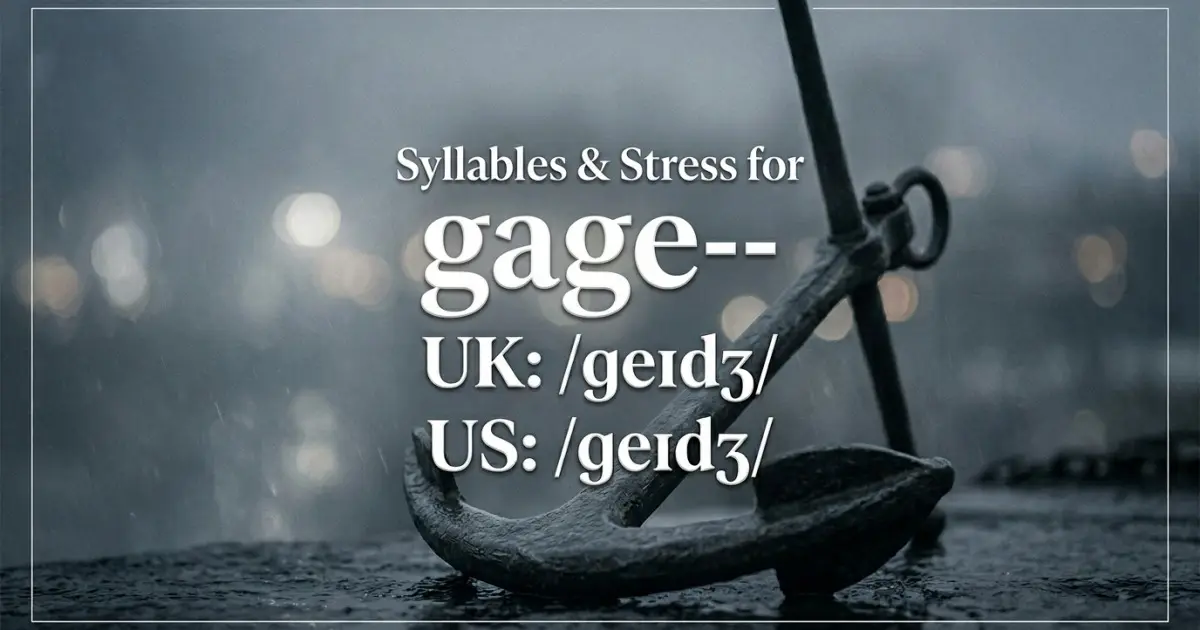
| U.S. IPA | /ɡeɪdʒ/ | The vowel is the long a sound heard in “day.” |
| U.K. IPA | /ɡeɪdʒ/ | The supplied British form matches the American one, so the pronunciation stays remarkably stable. |
| Syllable count | 1 syllable | Keep the name in one clean beat; do not stretch it into two. |
| Stress pattern | Single stressed syllable | The whole name carries stress, so clarity matters from start to finish. |
| Opening sound | /ɡ/ | Start with a hard g, as in “go,” not a soft j. |
| Closing sound | /dʒ/ | End with the same sound heard at the end of “judge” or “badge.” |
Gage Lives in One Strong Syllable
Why one beat makes the name feel so decisive
Gage is a one-syllable name, which means there is no place for the sound to hide. Longer names can spread their identity across several beats. Gage has to do everything at once. That is part of why it sounds so direct. The full name arrives in one compact unit, and that compactness gives it speed, memorability, and a certain modern confidence. Before focusing only on syllables and stress, it helps to step back into the fuller frame of Gage meaning.
In phonetic terms, Gage begins with the hard consonant /ɡ/, moves immediately into the diphthong /eɪ/, and closes on the affricate /dʒ/. That may sound technical, but the practical effect is simple: the name starts firmly, opens brightly, and shuts neatly. There is no loose ending and no vague center. It is a name built on control.
The long vowel is what keeps Gage from sounding blunt
The vowel in Gage is the same long a heard in day, gate, and gauge. That bright vowel is important because it stops the name from sounding too hard. If Gage were made only of clipped consonants, it might feel harsher. The long vowel gives it lift. It is one of the reasons the name can sound polished rather than merely tough.
This is also why the practical guide GAYDJ works well. It captures the fact that the vowel opens the name up before the closing consonant seals it. In a name this short, that tiny bit of openness matters. It is what gives Gage snap instead of heaviness.
Gage Stays Surprisingly Stable Across Accents
The supplied U.S. and U.K. forms are identical
The supplied IPA for both the United States and the United Kingdom is /ɡeɪdʒ/. That is worth noticing because many names shift when they cross accents. Vowels move, syllables soften, and stress can drift. Gage resists that. Its structure is so compact and so familiar to English speech that it remains highly consistent in both settings.
This stability makes the name especially practical. Parents do not have to worry that Gage will sound clean and confident in one country but awkward in another. The same strong beat holds. The same hard opening and bright vowel remain in place. Accent may color the sentence around the name, but the name itself usually stays intact.
Why compact names often travel well
Research suggests that short names built from common English phonemes tend to survive accent shifts better than longer names with more moving parts. Gage benefits from exactly that pattern. It uses ordinary sounds, but arranges them in a memorable way. There is no unstable middle syllable and no regional trap hidden in the spelling.
That makes Gage especially resilient in public life. It is easy for teachers, relatives, coaches, and strangers to say correctly on first reading. With modern names, that ease matters. A name can be stylish, but if it regularly needs correction, it adds friction. Gage does not usually create that problem.
Where People Mispronounce Gage and Why
Softening the opening into a “j” sound
The first mistake some people make is giving the opening letter a soft value, as though the name began with the sound of J. That usually happens when speakers are thinking of names or words where the letter g behaves differently before certain vowels. But in Gage, the opening is clearly hard: /ɡ/, like go or give. The name should begin with a firm g, not with j.
Flattening the vowel too much
A second error is flattening the vowel so the name begins to sound less like gauge and more like a duller, shorter form. That changes the whole personality of the name. Gage needs the long a. Without it, the name loses its brightness and starts to sound heavier than intended.
Over-segmenting a one-syllable name
Because the spelling looks neat and the ending -ge is visually familiar, some careful speakers may overpronounce the name, almost as if it were made of separate visible pieces. But Gage should not feel segmented. It is one beat. The sounds must connect cleanly. If the speaker treats it as a sequence of letter values instead of as a single spoken unit, the result can feel stiff or uncertain.
The easiest correction is to remember the sound neighbor gauge. Once that comparison is clear, most pronunciation uncertainty disappears immediately.
Gage Becomes Easier Once You Hear Its Sound Neighbors
“Gauge” is the simplest anchor
The most reliable everyday anchor for Gage is still the ordinary English word gauge. The pronunciation is effectively the same. This is useful because it gives teachers, relatives, and friends an instant point of reference. You do not need a full phonetics lesson to teach Gage. You just need one good neighboring sound. The way the name resolves at the end often decides which short forms feel natural in speech, and that becomes clearer in Gage nicknames.
Other helpful neighbors include page, wage, and sage. They all share the bright vowel and closing affricate. The difference is that Gage begins with a hard g rather than one of the softer or different openings those words may suggest. Once the beginning is secured, the rest follows easily.
Why the closing sound gives Gage its finish
The final sound in Gage, /dʒ/, is the same sound at the end of badge or judge. That closing affricate matters because it gives the name a sense of completion. It does not trail off. It lands. In style terms, that is one of the reasons Gage feels more polished than some other one-syllable names. The ending has enough shape to sound intentional, but not so much weight that it becomes harsh.
In a longer name, this detail might be easy to overlook. In Gage, it is part of the whole effect. The name’s clean ending is one reason it sounds controlled and modern rather than rough.
Practice Lines That Let Gage Sound Natural
The easiest way to confirm the pronunciation is to say the name inside ordinary phrases rather than in isolation. Try these aloud:
“Gage is here.”
“This is Gage Thomas Reed.”
“Has Gage called back yet?”
“Gage, dinner’s ready.”
These lines work because they imitate real life: introductions, school moments, phone calls, and family speech. If the name sounds smooth there, the pronunciation is secure. That is the real test. A name should not merely be technically pronounceable. It should move naturally through the situations where it will actually be used.