
Freddy Pronunciation: Sound Breakdown for Confident Speech
Imagine a teacher calling names on the first morning of school: Oliver, Maya, Lucas, Freddy. No one has to stop and decode it. The name moves easily from the page to the room: FRED-ee. It has the friendly rhythm of a name people feel they already know, with a firm first beat and a soft second beat that makes it sound approachable rather than formal.
That ease is one of Freddy’s strongest practical qualities. The name is male in primary use, German in origin, and means “peaceful ruler,” but its pronunciation keeps that old meaning warm and everyday. Official 2024 data places Freddy at rank 1328 for boys in the United States, making it uncommon but familiar-sounding. The pronunciation is simple: two syllables, stress on the first, and a clear FRED followed by a light ee.
Freddy Is Said With a Firm First Beat and a Friendly Ending
| Element | Phonetic Detail | Quick Tip |
|---|---|---|
| Everyday pronunciation | FRED-ee | Say it like Fred plus a light ee ending. |
| Syllable count | 2 syllables | Break it cleanly as Fred-dy, not as one rushed sound. |
| Stress pattern | First-syllable stress | The first beat is strongest: FRED-ee. |
| U.S. IPA | /ˈfrɛdi/ | American English uses the short e sound in red for the first syllable. |
| U.K. IPA | /ˈfredi/ | British pronunciation keeps the same two-syllable rhythm and first-syllable stress. |
| Opening sound | Fr blend | Begin with the same sound as friend, fresh, and frame. |
| Vowel sound | Short e | The first syllable sounds like red, not freed. |
| Ending | Light -ee | Let the final sound stay bright and relaxed, not heavy. |
The Everyday Pronunciation of Freddy Is FRED-ee
The simplest way to say Freddy is FRED-ee. The first syllable sounds like the name Fred. The second syllable is the light ee sound found at the end of names such as Teddy, Eddie, Charlie, and Archie. The name should not be pronounced FREED-ee, FRAID-ee, or fred-EYE. Its natural pattern is short, warm, and familiar. The sound matters more once you know what the name is meant to carry, which is why the wider frame starts in Freddy meaning.
Because Freddy already looks phonetic to most English speakers, serious pronunciation problems are rare. The main thing is keeping the first vowel short. The Fre- in Freddy does not use the long ee of free. It uses the short e of red, bed, and steady. Once that first syllable is right, the rest of the name follows easily.
The first syllable gives Freddy its grounded sound
The opening FRED is the anchor of the name. It begins with an fr consonant blend, where the f sound moves quickly into r. The r is a liquid consonant, which gives the opening a little movement after the soft friction of f. Then the short e keeps the syllable compact.
This is why Freddy sounds friendly but not flimsy. The first syllable has enough structure to hold the name steady, while the ending gives it warmth. The pronunciation mirrors the meaning in a subtle way: there is firmness at the front and peace at the finish.
The final -y makes Freddy sound affectionate
The final -ee sound is what gives Freddy its approachable quality. It is a common ending in affectionate English names and nicknames, which is why Freddy can feel familiar even when it is not currently a common name. The ending should be clear but not overemphasized.
In everyday speech, Freddy works best when the first syllable carries the weight and the second syllable lands lightly. The rhythm should feel like FRED-ee, not Fred-EE. Stressing the ending too strongly can make the name sound unnatural.
Freddy’s IPA Shows a Name With Clear English Rhythm
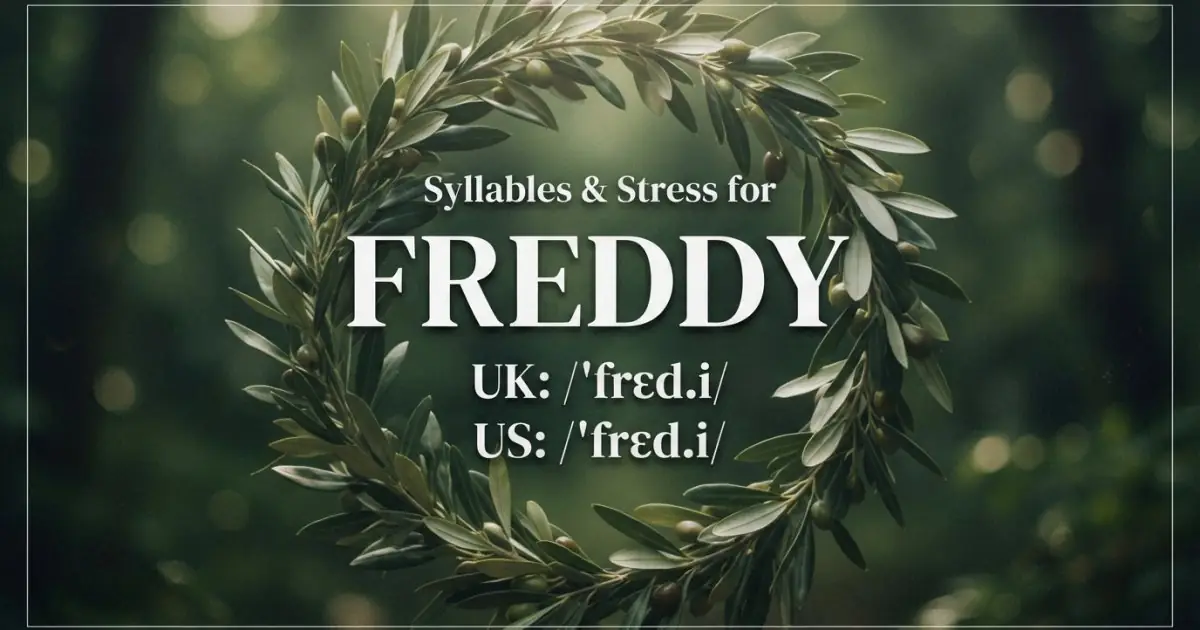
The U.S. IPA pronunciation of Freddy is /ˈfrɛdi/. The stress mark before the first syllable shows that the emphasis comes at the beginning. The /fr/ represents the opening consonant blend, the /ɛ/ represents the short e in red, and the final /i/ represents the bright ee ending.
The U.K. IPA form is /ˈfredi/. The rhythm remains the same: two syllables, first-syllable stress, and a light final vowel. The practical pronunciation guide stays simple in both major English accents: FRED-ee.
American pronunciation keeps the first vowel close to “red”
In American English, Freddy usually has a short e vowel in the first syllable, very close to the vowel in red. This makes the name crisp and familiar. The ending is a clear ee, but it stays unstressed.
A helpful memory device is to say Fred first, then add ee. That keeps both the vowel and stress pattern in the right place.
British pronunciation keeps the same name shape
In British English, Freddy is still pronounced with two syllables and stress on the first. Some speakers may shape the first vowel slightly differently, but the name does not change into a separate pronunciation. It remains FRED-ee, with the first syllable carrying the main beat.
This makes Freddy easy to use across English-speaking regions. Families do not need separate pronunciation rules for the United States and the United Kingdom.
The Most Common Freddy Pronunciation Mistakes Are Small
Freddy is generally straightforward, but small errors can happen when people overread the spelling or connect it to nearby words. The likely mistakes involve the first vowel, the final ending, or the stress pattern.
Mistake one: saying FREED-ee
The first syllable should not sound like freed. Freddy does not begin with the long ee sound. It begins with the short e sound in Fred: FRED-ee.
Mistake two: making the ending too strong
The final syllable should not carry the main stress. Freddy is not fred-EE. The first syllable is stronger, and the ending is lighter. This keeps the name natural and conversational.
Mistake three: confusing Freddy with Freddie as a different sound
Freddy and Freddie are usually pronounced the same way: FRED-ee. The difference is spelling and style, not sound. Freddy looks a little more direct, while Freddie may look slightly softer or more traditional, but the pronunciation is the same in everyday English.
Sound Neighbors Help Place Freddy in Everyday Speech
Freddy sits near a family of warm, familiar two-syllable names ending in -ee: Teddy, Eddie, Charlie, Archie, Alfie, Frankie, and Billy. These names share the same affectionate final sound, which helps Freddy feel immediately approachable. Freddy’s particular strength is the grounded Fred opening, which gives it more weight than some lighter nickname-style names. Once the sound pattern is clear, some shortenings stop feeling optional and start feeling natural, and the clearest map is in Freddy nicknames.
The closest sound neighbor is Freddie, which is pronounced the same way. Fred is the natural shorter form and provides a useful pronunciation anchor. If someone can say Fred, they can say Freddy by adding the light ee ending.
Practice lines for saying Freddy naturally
Use these lines to hear the name in ordinary speech:
- Freddy is ready for school.
- This is my son, Freddy.
- Freddy James has a classic rhythm.
- Can Freddy join the group?
- Freddy, your name is on the list.
In each sentence, keep the name light and natural. The first beat should be clear, and the second should feel friendly rather than forced.
Nicknames can clarify the pronunciation
The nickname Fred reinforces the correct first syllable. It shows that Freddy begins with FRED, not freed or frayed. Other playful forms such as Freddo, Red, or F may appear in close circles, but Fred is the clearest pronunciation helper.
For families introducing the name, the easiest guide is simple: “Freddy, like Fred with an ee.” That gives the sound, stress, and rhythm in one short explanation.
Pronouncing Freddy: Common Questions
How do you pronounce Freddy?
Freddy is pronounced FRED-ee. It has two syllables, with stress on the first syllable.
What is the IPA pronunciation of Freddy?
The U.S. IPA pronunciation is /ˈfrɛdi/. The U.K. IPA pronunciation is /ˈfredi/.
Are Freddy and Freddie pronounced the same?
Yes. Freddy and Freddie are typically pronounced the same way: FRED-ee. The difference is spelling, not pronunciation.
Is Freddy hard to pronounce?
No. Freddy is straightforward for English speakers. The key is to use the short e sound in Fred and keep the stress on the first syllable.