
How to Say Franco Correctly: A Clear Guide to Saying It Correctly
Picture a restaurant host reading a reservation list on a busy Saturday night. Some names vanish into the noise; others need to be said with a little more shape. Franco is one of those compact names that can sound instantly confident when pronounced well. The correct pronunciation is FRAHN-koh: two syllables, with the strongest beat on the first syllable and a warm “koh” ending that should stay rounded rather than clipped.
The name’s pronunciation carries much of its character. Franco means “free man,” and its sound has the same sense of self-possession: firm at the front, open at the end, and easy to remember. The opening “Fr” gives the name texture, while the final “-o” keeps it from sounding harsh. Said naturally, Franco feels direct, Italian, masculine, and polished without needing extra flourish.
How Franco Is Actually Said When the Name Keeps Its Italian Shape
| Element | Phonetic Detail | Quick Tip |
|---|---|---|
| Standard pronunciation | FRAHN-koh | Put the main emphasis on FRAHN, then finish with a rounded “koh.” |
| Syllable count | 2 syllables | Break it into FRAHN + koh. |
| Stress pattern | First-syllable stress | The name begins with the strongest beat; do not stress the final “koh.” |
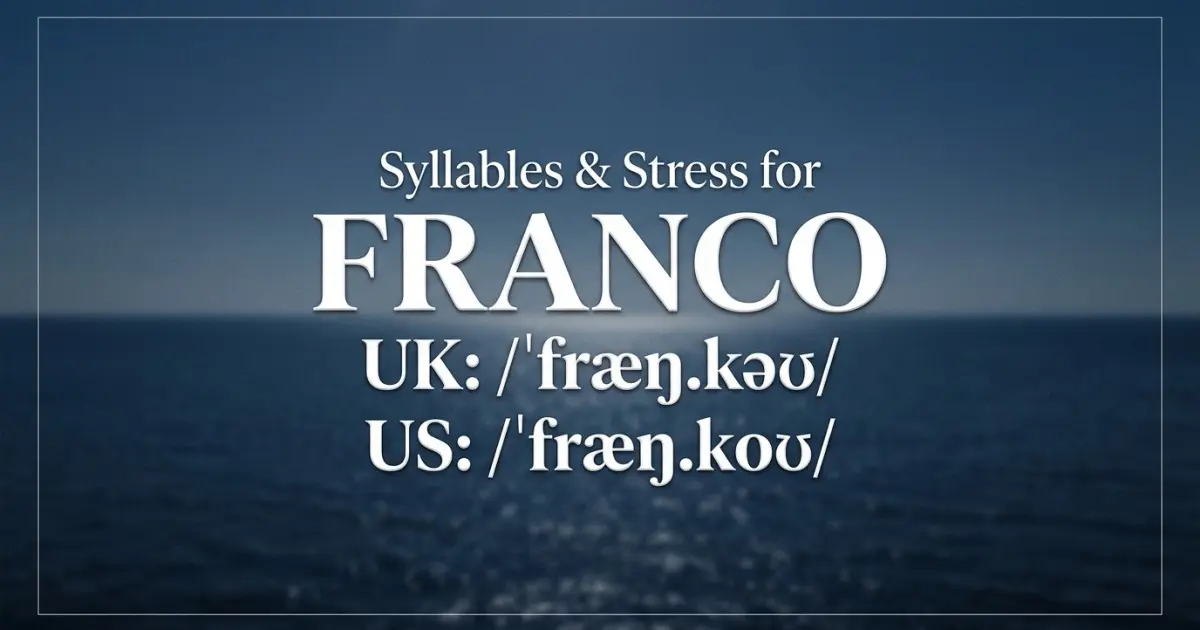
| U.S. IPA | /ˈfrɑːŋkoʊ/ | The U.S. form has a broad “ah” sound and a rounded “oh” ending. |
| U.K. IPA | /ˈfræŋkəʊ/ | The British vowel may sound slightly shorter or flatter, but the two-syllable rhythm remains. |
| Most common correction | Not FRANK-oh or fran-KOH | Avoid making it sound like the English name Frank plus a heavy final syllable. |
The Core Rhythm of Franco Starts Firm and Ends Warm
The easiest way to pronounce Franco is to separate it first: FRAHN-koh. The first syllable carries the weight, and the second syllable finishes the name smoothly. Because the stress comes first, Franco feels natural in English speech, but the vowel and ending still need care. It should not sound like a rushed version of Frank. It should have a little more openness and movement. Pronunciation lands more fully when the name’s roots and history are already in view, so begin with Franco meaning.
The opening “Fr” gives Franco its texture
Franco begins with an “f” followed by an “r.” The “f” is a fricative, which means it is made with airflow rather than a hard stop. The “r” then adds resonance and firmness. Together, the “Fr” opening gives Franco a textured start: strong, but not abrupt.
This opening is part of why Franco feels confident. It does not begin softly or fade into the background. The name arrives clearly. Still, the sound should not be forced. A natural FRAHN is stronger than an overemphasized one.
The first vowel should stay broad
In the standard U.S. guide, the first syllable sounds like FRAHN, with a broad “ah” vowel. It should not be pronounced exactly like the English name Frank if that makes the vowel too short or clipped. The “a” needs enough space for the name to keep its Italian feel.
That broad vowel is small but important. It gives Franco warmth and prevents it from sounding too blunt. The name should feel open in the first syllable, not squeezed.
The final “koh” rounds the name
The second syllable is “koh.” It should be lighter than the first syllable, but still clear. This ending gives Franco its smooth finish. Without it, the name would feel more abrupt; with it, the name becomes warmer and more complete.
The final “o” should not disappear into a dull “kuh,” especially in careful pronunciation. It also should not be over-stressed as fran-KOH. The best version is balanced: FRAHN-koh, strong first and rounded second.
Franco in IPA: What the U.S. and U.K. Forms Clarify
The U.S. IPA pronunciation of Franco is /ˈfrɑːŋkoʊ/. The U.K. IPA pronunciation is /ˈfræŋkəʊ/. These forms show the same practical structure: two syllables, stress on the first syllable, and a rounded final sound. The main difference is the vowel color, especially in the first syllable and the final “o.”
Why the stress mark matters
In IPA, the small stress mark appears before the first syllable. That confirms that Franco begins with the main emphasis. The name should not be pronounced fran-KOH with the second syllable carrying the weight. The correct rhythm is front-loaded: FRAHN-koh.
This stress pattern helps Franco feel direct and easy to call aloud. The first syllable gives the name its strength; the ending gives it polish.
What the “ngk” transition means in speech
The IPA includes a nasal sound before the “k,” which reflects how many speakers naturally move from the first syllable into the second. In everyday terms, the middle of Franco may sound slightly like “frahn-koh,” not “fran-koh” with a hard break. The transition should feel smooth.
This is not something parents need to explain in technical detail. It simply means the name flows best when the first syllable is open and the “k” begins the second syllable cleanly.
Accent Differences Should Preserve Franco’s Two-Syllable Strength
English accents can shape Franco differently, but the name should keep its basic form: two syllables, first-syllable stress, and a rounded ending. A speaker in the United States may use a broader “ah” sound, while a speaker in the United Kingdom may use a slightly shorter vowel. Both can still say the name clearly and naturally.
American English pronunciation
In American English, Franco is best guided as FRAHN-koh. The first syllable is broad, and the final “o” often sounds like “oh.” The name should not become flat or overly clipped. It should feel strong but open.
British English pronunciation
In British English, Franco may sound closer to FRAN-koh or FRANG-koh depending on accent, with a less broad first vowel than the U.S. guide. The final “o” may also sound slightly different, closer to a British “oh” glide. Even with those differences, the stress remains on the first syllable.
Why confident introduction helps
Franco is not difficult, but the name benefits from being modeled clearly. A simple introduction works well: “Franco, pronounced FRAHN-koh.” Once people hear the broad first syllable and rounded ending, they usually repeat it easily.
Common Mistakes When Saying Franco
Franco is short, but short names can still be misread when people rely on familiar English patterns. Most mistakes come from clipping the first vowel, over-stressing the second syllable, or treating Franco as though it were simply Frank with an “o” attached.
Mistake 1: Saying FRANK-oh too sharply
This mistake makes the first syllable sound too much like the English name Frank. While the names are related in sound, Franco should feel more open: FRAHN-koh. The first vowel should have enough breadth to keep the name warm.
Mistake 2: Saying fran-KOH
This error shifts the stress to the ending. Franco should not build toward the second syllable. The final “koh” is important, but it is lighter than the opening. The correct shape is strong-light, not light-strong.
Mistake 3: Weakening the final “o” too much
In fast speech, the ending can become too dull, almost like “kuh.” Careful pronunciation should preserve the rounded “koh.” That final vowel is part of Franco’s warmth and Italian character.
Sound Neighbors That Help People Learn Franco
Franco may remind listeners of Frank, Frankie, Marco, Enzo, Nico, or Lorenzo. Those comparisons can help place the name in the ear, but Franco has its own exact rhythm. It is not as clipped as Frank, not as playful as Frankie, and not as light as Nico. It has a firmer opening and a warmer close. Once the sound pattern is clear, some shortenings stop feeling optional and start feeling natural, and the clearest map is in Franco nicknames.
A useful guide is to think of a broad “FRAHN” followed by a clean “koh.” The name should sound compact but not cramped. Its strength comes from the first syllable; its charm comes from the ending.
Practice Lines for Saying Franco Naturally
Practice works best when Franco appears in normal sentences. The goal is to keep the name confident and smooth, not overly dramatic.
Slow practice
- FRAHN-koh.
- This is Franco.
- Franco is here.
- Thank you, Franco.
Everyday practice
- Franco, your table is ready.
- Can Franco join the group?
- I spoke with Franco this morning.
- Congratulations, Franco.
Full-name practice
When Franco is paired with a middle name or surname, keep the first name broad and clear before moving on. Try saying: “Franco James,” “Franco Matteo,” “Franco Hayes,” or “Franco Alexander.” The first syllable should still carry the main stress, even when the full name becomes longer.
Pronunciation FAQ for Franco
How do you pronounce Franco?
Franco is pronounced FRAHN-koh. It has two syllables, with the strongest stress on the first syllable.
How many syllables are in Franco?
Franco has two syllables: FRAHN and koh. The first syllable carries the main emphasis.
What is the IPA pronunciation of Franco?
The U.S. IPA pronunciation is /ˈfrɑːŋkoʊ/, and the U.K. IPA pronunciation is /ˈfræŋkəʊ/. Both forms show first-syllable stress.
What is the most common pronunciation mistake for Franco?
The most common mistake is saying it like a clipped FRANK-oh or stressing the ending as fran-KOH. The intended pronunciation is FRAHN-koh, with a broad first syllable and a lighter rounded ending.