
How to Say Francesco Correctly: A Clear Guide to Saying It Correctly
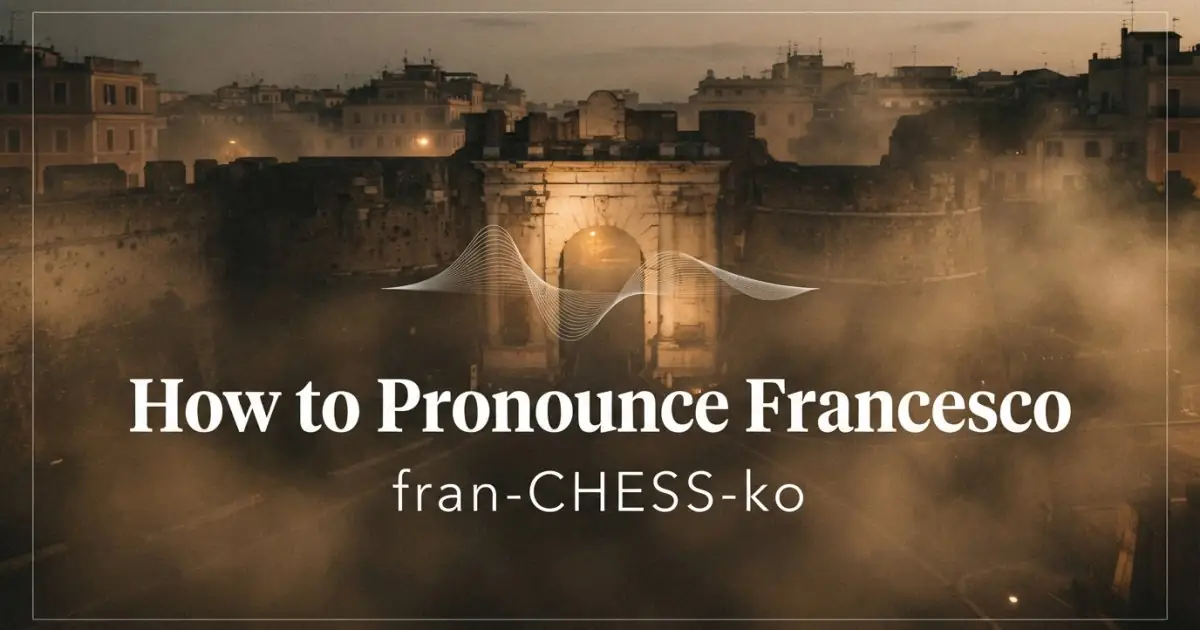
Francesco is the kind of name that often becomes clear the moment someone hears the middle syllable. On a classroom roster, a passport form, a wedding program, or a first introduction outside an Italian-speaking context, readers may see the familiar opening Fran- and guess a flatter English rhythm. The intended pronunciation is frahn-CHESS-koh: three syllables, stress in the center, and a warm final -koh that keeps the name distinctly Italian in sound.
That rhythm matters because Francesco means “Frenchman; free man.” The name carries movement, heritage, and liberty, and its pronunciation gives those ideas a musical frame. It should not sound like FRAN-ses-ko, with the first syllable doing all the work. It should rise into CHESS, then close smoothly: frahn-CHESS-koh. Spoken well, Francesco feels expressive without being difficult, formal without being stiff, and unmistakably full of Italian warmth.
Francesco Is Pronounced With Its Bright Center in CHESS
| Element | Phonetic Detail | Quick Tip |
|---|---|---|
| Standard pronunciation | frahn-CHESS-koh | Say it in three parts, with CHESS strongest. |
| Syllable count | 3 syllables | Keep all three beats clear: frahn + CHESS + koh. |
| Stress pattern | Second syllable stressed | The name rises in the middle, not at the beginning. |
| U.S. IPA | /frænˈtʃɛskoʊ/ | The American form keeps the central chess sound crisp and clear. |
| U.K. IPA | /frænˈtʃeskəʊ/ | The final vowel may sound slightly different, but the middle stress stays the same. |
| Main correction | Not FRAN-ses-ko or fran-ses-KOH | Place the emphasis on the middle syllable: frahn-CHESS-koh. |
The Everyday Sound of Francesco Depends on the Middle Syllable
The easiest way to pronounce Francesco is to let the name build toward its center. The opening frahn should be clear but not heavy. The second syllable, CHESS, is the main beat. The final koh closes the name with warmth, but it should not take the stress away from the middle. Pronunciation lands more fully when the name’s roots and history are already in view, so begin with Francesco meaning.
In natural speech, Francesco should move smoothly rather than sound chopped into separate parts. The three-part guide is useful for learning, but the spoken name should flow: frahn-CHESS-koh. It begins with a familiar Fran sound, brightens in the middle, and ends with the rounded Italian-style final vowel.
Why the CHESS syllable carries Francesco
The stress falls on the second syllable, so CHESS should be the clearest and strongest part of the name. This central emphasis gives Francesco its musical shape. It prevents the name from feeling flat or overly English in rhythm.
A helpful correction is simple: “It’s frahn-CHESS-koh, with the stress in the middle.” That gives speakers the key information without overcomplicating the name.
Why the final koh should be warm, not overdone
The last syllable is koh, but it should not be exaggerated. If the ending becomes too heavy, the name shifts toward fran-ses-KOH, which changes the intended pattern. The final syllable should feel open and rounded, not dominant.
This final -o sound is part of Francesco’s charm. It gives the name a warm close and helps it feel expressive rather than clipped.
Francesco’s IPA Shows a Three-Syllable Name With Central Stress
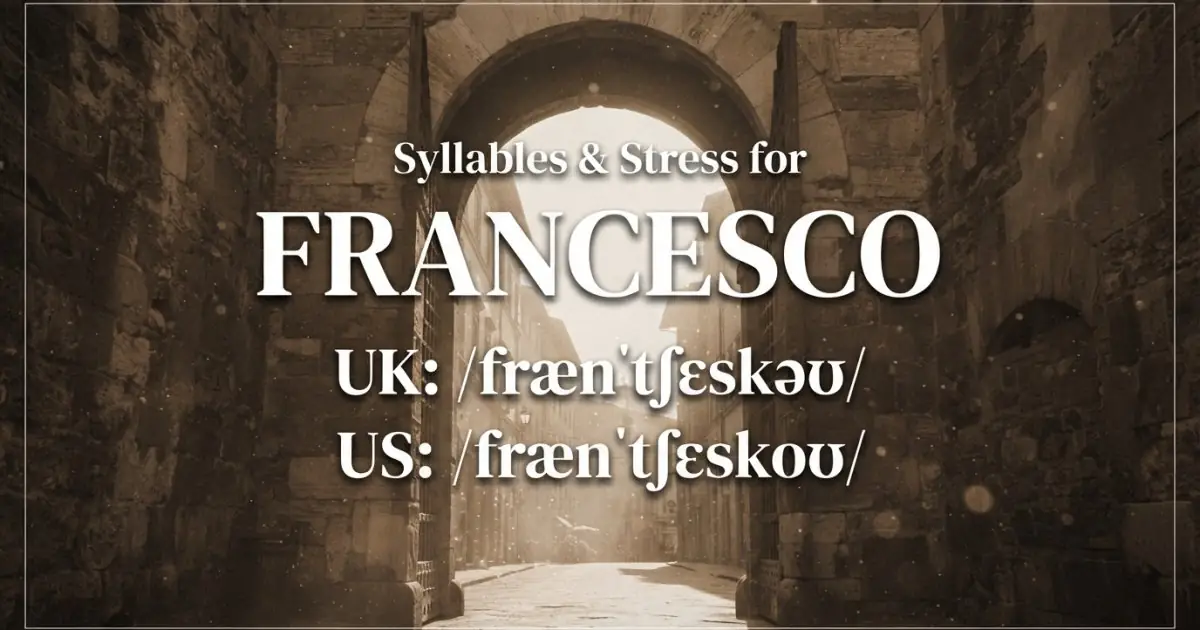
The U.S. IPA pronunciation of Francesco is /frænˈtʃɛskoʊ/, while the U.K. IPA is /frænˈtʃeskəʊ/. Both forms show the same essential structure: three syllables, stress on the second syllable, and a final koh-style ending. The stress mark before the middle syllable confirms that CHESS is the strongest beat.
The main accent difference appears near the ending. In American English, the final sound may feel like koh with a rounded oh. In British English, the final vowel may be colored slightly differently. But the core pronunciation remains stable: frahn-CHESS-koh.
The FR opening gives Francesco a familiar doorway
Francesco begins with an FR consonant cluster. In everyday terms, that means the F and R sounds come together at the start. This gives the name a familiar entrance for English speakers because it resembles the opening of names such as Francis, Franklin, or Franco.
The opening should not receive the main stress, but it should still be clear. It sets up the name before the sound rises into CHESS.
The CH sound gives Francesco its texture
The ch sound in Francesco is an affricate, which means it begins with a stop-like sound and releases into a softer rush. In plain speech, it is the same kind of sound heard at the start of chess. This gives the middle syllable a crisp, lively quality.
That sound is one reason Francesco feels animated. It has elegance, but it also has motion.
Francesco Is Accessible Across Accents When the Rhythm Is Preserved
Francesco may sound slightly different depending on accent, but the structure should stay the same. The name has three syllables, and the stress belongs in the middle. American and British speakers may treat the vowels differently, especially the final -o, but both IPA forms keep the central stress.
Official data shows Francesco ranked 1241 for boys in the United States in 2024, so the name is uncommon but active. Many people will understand it as a real, established name, but some may still need a pronunciation cue. Once they hear frahn-CHESS-koh, the pattern is easy to repeat.
Italian rhythm and English speech can meet naturally
English speakers do not need to overdramatize Francesco to say it well. The goal is not theatrical pronunciation; the goal is accurate rhythm. A clean frahn-CHESS-koh preserves the Italian feel while remaining natural in English conversation.
The name should sound warm and confident. It does not need to be rushed, but it should not be stretched into something overly formal either.
Sound neighbors that may shape first guesses
Francesco may remind speakers of Francis, Francisco, Franco, or Francesca. Francis may lead to a flatter English rhythm. Francisco may help people understand the Romance-language shape. Francesca may remind them that the central chess sound matters. Francesco’s own pattern is clear: frahn-CHESS-koh. When the stress sits in the center, the nickname logic often follows that same center of gravity, which is why nicknames for Francesco is the natural next step.
A good introduction is: “Francesco, pronounced frahn-CHESS-koh.” For extra clarity, parents can add, “The middle syllable is strongest.”
Common Francesco Pronunciation Mistakes Usually Come From Stress and the CH Sound
Francesco is not hard once modeled, but its rhythm can be misread when people apply English stress habits. The main mistakes involve placing the emphasis too early, softening the central sound, or overemphasizing the final syllable.
Mistake 1: Saying “FRAN-ses-ko”
This places too much weight on the first syllable and flattens the Italian rhythm. The intended pronunciation is frahn-CHESS-koh, with the middle syllable strongest.
Mistake 2: Saying “fran-SESS-koh”
This loses the crisp ch sound. The middle syllable should sound like chess, not sess.
Mistake 3: Saying “fran-ses-KOH”
This shifts the stress to the final syllable. The ending should be warm and clear, but the main stress belongs in the middle.
Mistake 4: Rushing the consonant cluster
The transition from Fran into ches should stay smooth. Avoid swallowing the middle so the name becomes unclear. Let the central syllable be heard.
Practice Lines Help Francesco Sound Smooth and Confident
The best way to practice Francesco is to say the middle syllable clearly, then let the name flow around it. The name should sound musical and natural, not chopped apart. Once CHESS is secure, the full pronunciation becomes much easier.
Slow practice for first-time speakers
- Francesco.
- frahn-CHESS-koh.
- Francesco is here.
- This is Francesco.
- We named him Francesco.
Everyday conversation practice
- Hi, Francesco, it is nice to meet you.
- Francesco has a three-syllable name.
- Francesco is pronounced frahn-CHESS-koh.
- The stress is on the middle syllable.
- Francesco will be joining the group today.
Gentle correction practice
- It is pronounced frahn-CHESS-koh.
- The middle syllable is strongest.
- The middle sounds like “chess.”
- It has three syllables: frahn, CHESS, and koh.
- The ending is koh, but it is not the stressed syllable.