
How to Pronounce Finley: Where People Hesitate and Why

The easiest place to hear Finley correctly is not in a dictionary recording but in a real room: a teacher pausing over a first-day attendance sheet, a parent calling across a soccer field, a barista repeating the name back after hearing it once, a grandparent saying it quickly enough for affection to show. Finley is one of those names that succeeds because it survives ordinary speech. It does not depend on theatrical emphasis or special explanation. When people hear it in everyday English, they usually understand the shape immediately. That kind of practicality matters more than many parents expect. A name may look charming on paper, but pronunciation is where it either joins life smoothly or keeps catching on small misunderstandings. Finley joins life smoothly.
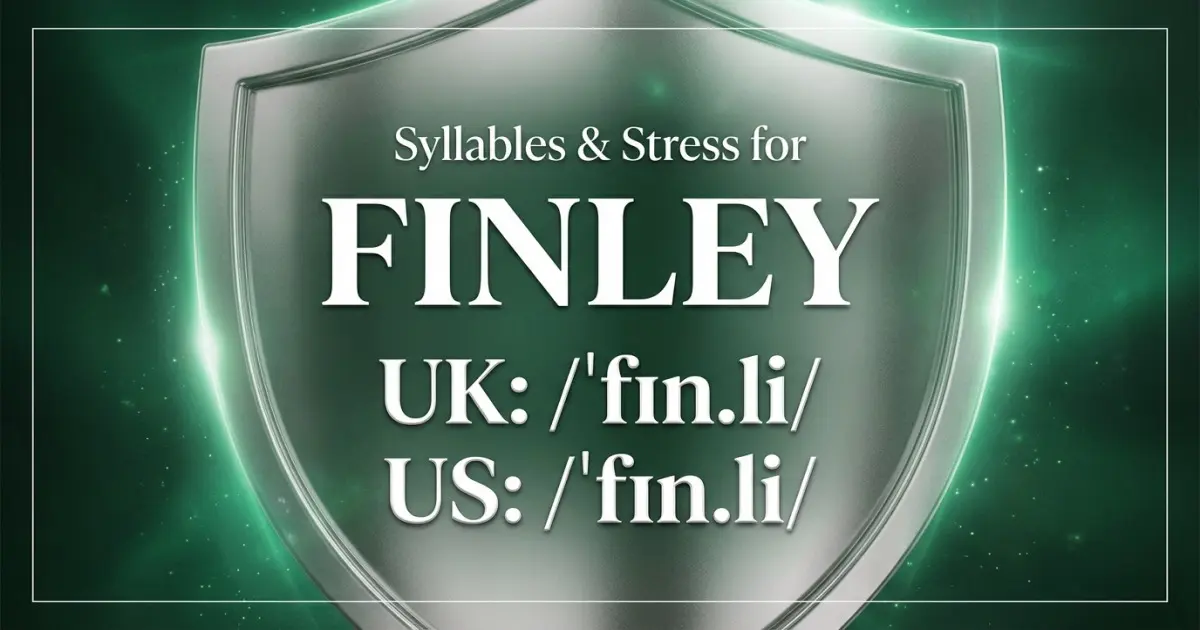
The standard pronunciation is FIN-lee, with two syllables and the stress landing firmly on the first. The supplied pronunciation guides for both American and British English point to the same IPA form: /ˈfɪnli/. That shared structure is one of the name’s quiet strengths. It means Finley does not split into dramatically different versions depending on whether the speaker is in the United States or the United Kingdom. Accent may slightly color the vowels or pacing, but the skeleton of the name stays stable. For parents, that is excellent news. Finley is readable, repeatable, and easy to carry into daily life without constant correction.
What Finley Sounds Like When People Say It Naturally
| Element | Phonetic Detail | Quick Tip |
|---|---|---|
| Standard pronunciation | FIN-lee | Say it as two clear beats, with the first sounding like the start of “finish.” |
| IPA in US English | /ˈfɪnli/ | The stress mark before the first syllable shows that FIN carries the emphasis. |
| IPA in UK English | /ˈfɪnli/ | The same IPA form in both major guides suggests strong cross-accent consistency. |
| Syllable count | 2 syllables | Think of the rhythm as one strong step followed by one lighter step: FIN + lee. |
| Stress pattern | First-syllable stress | If the second syllable gets too much emphasis, the name starts to sound less natural in English. |
| Key consonants | Opening /f/, middle /n/, ending /l/ | The sounds move forward cleanly, so keep the name crisp rather than overly drawn out. |
Finley Works Because the First Syllable Carries the Identity of the Name
The stressed opening is what makes the name feel steady
In Finley, the first syllable does most of the structural work. Fin is short, bright, and immediately recognizable to English-speaking ears. It begins with f, a voiceless fricative, which simply means the air passes through a narrow space to create that clean, unbuzzed sound. Then comes the short vowel /ɪ/, the same vowel you hear in words like “fin,” “win,” or “sit.” The syllable closes with n, which gives it a neat, grounded stop before the second half of the name opens out. Pronunciation lands more fully when the name’s roots and history are already in view, so begin with Finley meaning.
That opening is the reason Finley tends to sound so confident in everyday use. It does not slide in vaguely. It arrives clearly. Parents who want a name that sounds lively but not flimsy often respond to this kind of beginning without consciously analyzing it. The name is bright, but it is not airy from the first sound onward. It has a compact front edge.
The second syllable softens the name without weakening it
The second syllable, -lee, is lighter and more fluid. The l is a liquid consonant, which is why the back half of the name feels more flowing than the front. Then the long ee vowel releases the word with brightness instead of force. This is important. If Finley ended in a harder consonant, it would feel more abrupt and perhaps more strongly gendered in one direction. The -lee ending keeps it open and flexible.
That openness helps explain why Finley works so well as a modern unisex name. The first syllable gives it grip; the second gives it lift. Neither half cancels the other. Together they create a name that sounds capable and friendly at the same time.
Where Finley Can Be Misheard Even Though It Looks Straightforward
The most common mistake is drifting toward “fine-lee”
The main pronunciation risk with Finley is not a dramatic error but a vowel shift. Some people may glance at the spelling and momentarily wonder whether the first syllable should rhyme with “fine.” Standard pronunciation does not do that. Finley is FIN-lee, not fine-lee. The first vowel is short, not long. This matters because the short vowel gives the name its brisk, modern energy. Switching to a long vowel changes the entire social feel of the name and pulls it away from its established spoken pattern.
Historically, related Scottish forms such as Finlay reinforce that same core sound, which is another clue that the short opening vowel is the stable one. Once you hear Finley spoken correctly a single time, the shape becomes obvious and easy to remember.
Why overpronouncing the second syllable makes Finley sound less natural
Another small mistake is giving the second syllable too much weight, almost as if the name were split into two equal parts. In normal English rhythm, the second syllable should be lighter. You want FIN-lee, not fin-LEE. If the ending gets too much emphasis, the name starts to sound theatrical or overly careful. That is not how most people naturally say it.
This is especially worth noticing for parents who practice names slowly before birth. Slow rehearsal can flatten or exaggerate stress in ways real speech does not. Finley sounds best when spoken conversationally, not ceremonially.
Accent differences are usually tiny, not structural
Research suggests that some names shift noticeably across English-speaking accents, but Finley is not especially prone to that. The supplied IPA guides are identical in US and UK English, /ˈfɪnli/, and that reflects how stable the name is in actual use. A British speaker may color the vowels slightly differently from an American speaker simply because accents do that with almost every word. But the name’s structure remains the same: short first vowel, first-syllable stress, light second syllable.
That stability is a real advantage. It means Finley travels well across classrooms, family branches, and future workplaces without the child constantly needing to repair or reinterpret the sound of the name.
Finley in the Ear Sits Near Familiar Names but Keeps Its Own Shape
Sound neighbors that help people hear it correctly
Finley lives near a cluster of familiar English-language rhythms. It shares some of its brightness with names like Riley, Hadley, Wesley, and Keeley, while its opening links it to Finn and Finlay. Those relationships help the name feel immediately usable. People already know how to handle the structure: a strong first beat, a lighter second one, and a friendly ending that does not overcomplicate the line. Once the sound pattern is clear, some shortenings stop feeling optional and start feeling natural, and the clearest map is in nicknames for Finley.
But Finley still sounds distinct. It is firmer than Riley, less ornamental than some highly fashionable -ley names, and more expansive than Finn on its own. That distinctness is why the name feels fresh without feeling obscure.
Why the name performs well in noisy, real-world settings
One practical strength of Finley is that its sounds are easy to catch in conversation. The opening fricative f is audible, the n anchors the first syllable cleanly, and the liquid l keeps the transition into the ending smooth. In a hallway, playground, or waiting room, that matters. Some names look lovely but blur in speech. Finley usually does not. It has enough contour to stay recognizable even when spoken quickly.
This is one of the quiet reasons names like Finley remain attractive. People are not just choosing a look. They are choosing a sound that has to survive real life.
Finley Sounds Best When You Practice It in Real Sentences
Simple practice lines that reveal the true rhythm
The easiest way to practice Finley is to place it in ordinary speech. Try “Finley is here,” “Finley, your turn,” or “This is Finley Carter.” These lines show quickly whether you are keeping the first syllable strong enough and the second light enough. You should hear the name arrive in one clean motion rather than two equally weighted beats.
Another useful test is to say Finley beside different surname types. Finley James Reed, Finley Morgan Shaw, and Finley Elizabeth Hart all let you hear how the name behaves at different speeds and lengths. A good pronunciation should remain crisp without becoming clipped.
What families should listen for over time
Relatives may each shape the name slightly differently. A grandparent may soften the ending more. A sibling may clip it faster. A coach may stress the first syllable more strongly when calling from a distance. Those variations are normal. What matters is that the core pattern remains intact: FIN-lee, with a short first vowel and clear opening stress.
That resilience is part of Finley’s success. The name is stable enough to survive different voices while still sounding natural in all of them.
Why Finley Keeps Sounding Fresh
Finley continues to sound current because its pronunciation is efficient without being flat. The short first vowel gives it briskness, the liquid l gives it flow, and the bright ending keeps it open. It sounds modern, but not artificial. It sounds friendly, but not vague. Those are difficult qualities to combine in one two-syllable name, and Finley does it very well.
In the end, Finley is pronounced the way many durable modern names are pronounced: clearly, lightly, and without ceremony. Say the first syllable like “fin,” let the second syllable open into “lee,” keep the stress on the beginning, and the name does exactly what it is meant to do.