
Fenix Pronunciation: Easy Breakdown and Speaking Tips

Imagine the name being read from a registration form at a first pediatric appointment. The receptionist sees Fenix, pauses for only a moment, and says, “FEE-niks?” This time, the first attempt is correct. Although the spelling is less familiar than Phoenix, Fenix follows a compact and predictable sound pattern: one bright stressed syllable followed by a shorter closing syllable.
The key is to resist treating the name as visually unfamiliar. Fenix is pronounced FEE-niks, with the same basic sound as Phoenix. The opening carries the emphasis, while the second syllable ends quickly in the combined ks sound represented by the letter x. American and British English use the same IPA transcription, so the name remains unusually stable across those two pronunciation standards.
How Fenix Turns Five Letters into Two Clear Beats
| Element | Phonetic Detail | Quick Tip |
|---|---|---|
| Everyday pronunciation | FEE-niks | Stress the opening syllable and keep the ending brief. |
| Syllable count | Two: FEE | niks | Do not add an extra vowel between the final consonants. |
| Primary stress | FEE | The name begins at full strength and then relaxes. |
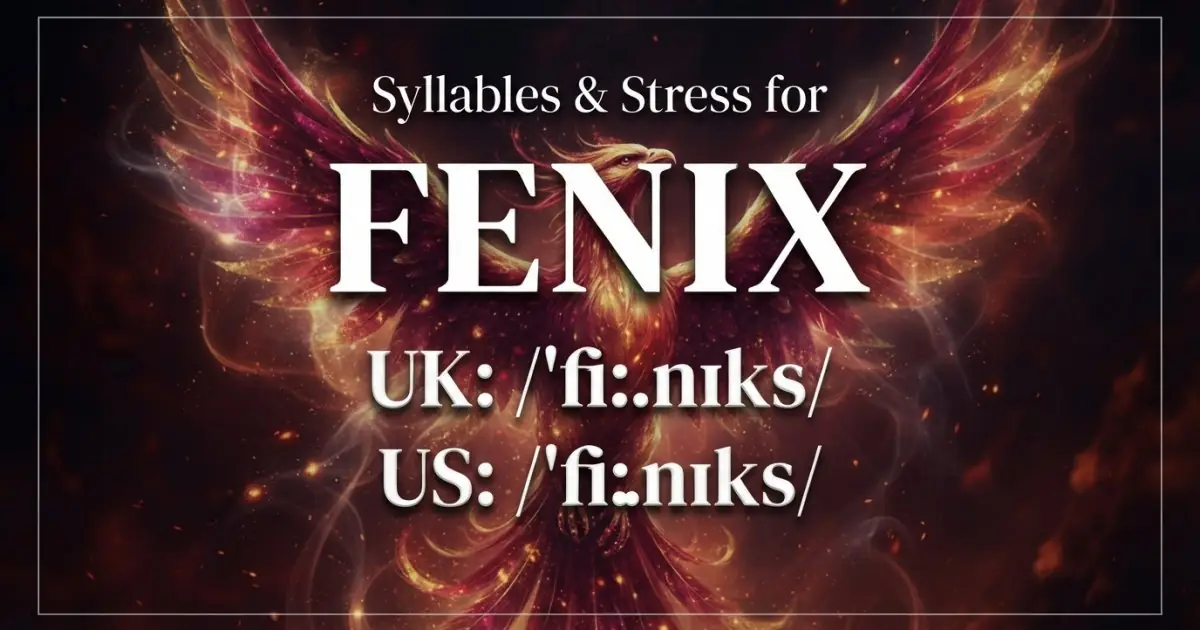
| U.S. IPA | /ˈfiːnɪks/ | The long /iː/ sounds like the vowel in “see.” |
| U.K. IPA | /ˈfiːnɪks/ | The standard transcription is identical to the U.S. form. |
| Final letter | x represents /ks/ | Finish with “k” and “s” together, as in “six.” |
| Closest familiar sound | Phoenix | Fenix changes the spelling, not the basic pronunciation. |
Fenix Depends on a Long First Vowel and a Short Ending
The pronunciation of Fenix is organized around contrast. The first syllable is long, bright, and stressed. The second is shorter, lighter, and closed by consonants. This produces a clean falling rhythm: FEE-niks. The sound matters more once you know what the name is meant to carry, which is why the wider frame starts in Fenix meaning.
The first syllable carries the entire name forward
The opening sound is FEE, represented in IPA by /fiː/. The mark /ː/ indicates vowel length, so the ee should be given enough space to sound like the vowel in “see,” “green,” or “peace.” It should not become the shorter vowel in “fit.”
A useful practice sequence is:
fee → fee-n → FEE-niks
The first syllable should be clear without becoming exaggerated. Fenix is not pronounced FEEE-niks with an artificially stretched opening. The vowel is simply longer and more prominent than the vowel that follows.
The second syllable closes quickly
The second syllable is niks, represented by /nɪks/. Its vowel is the short /ɪ/ sound heard in “sit,” “little,” or “finish.” This is one of the most important details because the spelling might tempt some readers to pronounce the second vowel like “ee.” The preferred form is FEE-niks, not FEE-neeks.
After the short vowel comes /ks/, the sound represented by the final x. The tongue briefly forms the hard /k/ closure and then releases into the fricative /s/. A fricative is created when air passes through a narrowed space, producing the soft hiss heard in sounds such as s, f, and sh.
Because the /k/ and /s/ arrive together, the ending should not be separated into nik-us. Fenix has two syllables, not three.
American and British English Agree on Fenix
Both the U.S. and U.K. IPA forms are written as /ˈfiːnɪks/. That shared transcription means the central structure does not require separate national guidance. In both standards, the first syllable is stressed, the opening vowel is long, the second vowel is short, and the name ends in /ks/.
Accent may color the voice without changing the pattern
Individual speakers will still sound different. An American speaker may pronounce the long ee with a slightly different resonance from a British speaker. Regional accents may also affect how sharply the final /s/ is heard or how quickly the two syllables connect.
Those differences are ordinary accent variation rather than different accepted pronunciations. The important features remain stable:
- The name begins with FEE.
- The stress stays on the first syllable.
- The second vowel remains short.
- The final x is pronounced as ks.
The opening “f” should remain light and clean
The first consonant /f/ is a voiceless fricative. To produce it, place the lower lip gently against the upper teeth and let air pass through. The vocal cords do not vibrate. This distinguishes /f/ from /v/, where the mouth position is similar but the voice is active.
Fenix should therefore begin like “fee,” not “vee.” The direct F spelling makes this sound easier to predict than the traditional Ph opening in Phoenix.
The Mistakes That Most Often Change Fenix
Fenix is straightforward once heard, but its uncommon spelling can still trigger several predictable errors. Most come from confusing it with a neighboring name or assigning the wrong sound to one vowel.
Fenix is not Felix
Incorrect: FEE-liks
Preferred: FEE-niks
Felix and Fenix share the same number of syllables, the same first and final letters, and a similar visual shape. Their middle consonants create the difference. Felix contains an l; Fenix contains an n.
The n is a nasal consonant, meaning air passes through the nose while the tongue touches near the ridge behind the upper teeth. To preserve the distinction, practice the final syllable alone: niks. Then add the opening: FEE-niks.
The second vowel is not another long “ee”
Incorrect: FEE-neeks
Preferred: FEE-niks
The second syllable uses the short vowel in “sit,” not the long vowel in “see.” Keeping it short also maintains the name’s natural falling rhythm.
The final “x” should not become “z”
Incorrect: FEE-niz
Preferred: FEE-niks
In Fenix, the letter x represents two sounds: /k/ followed by /s/. Both should remain audible. Think of the final sound in “six” or “mix.”
Do not add a third syllable
Incorrect: FEE-ni-kus
Preferred: FEE-niks
English speakers sometimes insert a vowel to make dense consonant endings easier. Fenix does not require that extra sound. Move directly from the short i into ks.
Fenix Shares Sound Territory with Phoenix, Felix, and Onyx
Sound neighbors can make an unfamiliar name easier to remember, but they can also create confusion. Phoenix is the closest guide because it shares the full pronunciation FEE-niks. The main difference is visual: Fenix uses a direct F and removes the traditional phoe sequence.
Felix offers a useful comparison for rhythm but not for the middle consonant. Both names follow a stressed two-syllable pattern, yet Fenix says niks where Felix says liks.
Onyx shares the short second vowel and final /ks/ sound. Saying “Onyx” can help a speaker isolate the compact -nix portion, although the first syllable and stress pattern differ. The comparison is most useful for hearing how the final consonant cluster should close without an added vowel.
Practice Lines Make Fenix Sound Immediate and Natural
Start by separating the two syllables:
- FEE
- niks
- FEE-niks
Next, keep the opening strong while saying the complete name at conversational speed:
- “This is Fenix.”
- “Fenix is ready to begin.”
- “Could you call Fenix, please?”
- “I saved a seat for Fenix.”
- “The package belongs to Fenix.”
For a longer rhythm exercise, say: “Fenix finished the picture before lunch.” The repeated initial f sounds help establish a clean opening, while the surrounding sentence encourages natural speed.
When correcting someone, a brief cue is usually enough: “It’s FEE-niks, like Phoenix, but spelled with an F.” That explanation gives the sound and spelling distinction in one sentence.
Fenix Sounds Simple Once the Spelling Stops Leading
Fenix is pronounced FEE-niks. It has two syllables, stress on the first, a long opening vowel, a short second vowel, and a crisp /ks/ ending. American and British IPA are identical, so the name does not divide into competing regional standards.
The most likely difficulties are visual rather than phonetic: confusion with Felix, a long vowel in the second syllable, or an unnecessary third syllable before the final consonants. Once listeners connect Fenix with the sound of Phoenix, the pattern becomes easy to retain. The spelling may be distinctive, but the pronunciation is compact, stable, and immediately usable.
How to Pronounce Fenix: FAQ
How do you pronounce Fenix?
Fenix is pronounced FEE-niks, with the stress on the first syllable.
Is Fenix pronounced the same as Phoenix?
Yes. Fenix and Phoenix share the same basic pronunciation. Their primary difference is spelling.
Does Fenix have two or three syllables?
Fenix has two syllables: FEE and niks. No extra vowel is added before the final ks sound.
What is the difference between Fenix and Felix?
Fenix is pronounced FEE-niks, while Felix is pronounced FEE-liks. The distinguishing sound is the n in Fenix versus the l in Felix.