
How to Say Ezra Correctly: How the Rhythm of the Name Really Works
The real pronunciation test for Ezra does not happen in a dictionary. It happens in ordinary public life: a teacher reading a class list on the first morning of school, a nurse calling a patient name from the waiting room, a coach shouting across a field, a grandparent hearing the name once and repeating it back without strain. Ezra passes that test unusually well. It is short, clean, and highly legible in speech. Official data shows the name remained one of the most visible boys’ names in the United States in 2024, and that matters because public familiarity often stabilizes pronunciation. People tend to know what they are hearing before they have fully analyzed it.
Even so, Ezra is not phonetically flat. The name has a crisp first syllable, a distinctive voiced consonant in the middle, and a relaxed second syllable that keeps the whole thing from sounding too abrupt. That balance is part of its charm. Ezra sounds intelligent without sounding precious, ancient without sounding stiff, and modern without sounding invented. Its pronunciation works because the name is brief but not blunt. It has shape.
What Ezra Clarifies as Soon as It Enters the Room
| Element | Phonetic Detail | Quick Tip |
|---|---|---|
| Everyday pronunciation | EZ-ruh | Say it in two beats, with the first syllable clearly stronger than the second. |
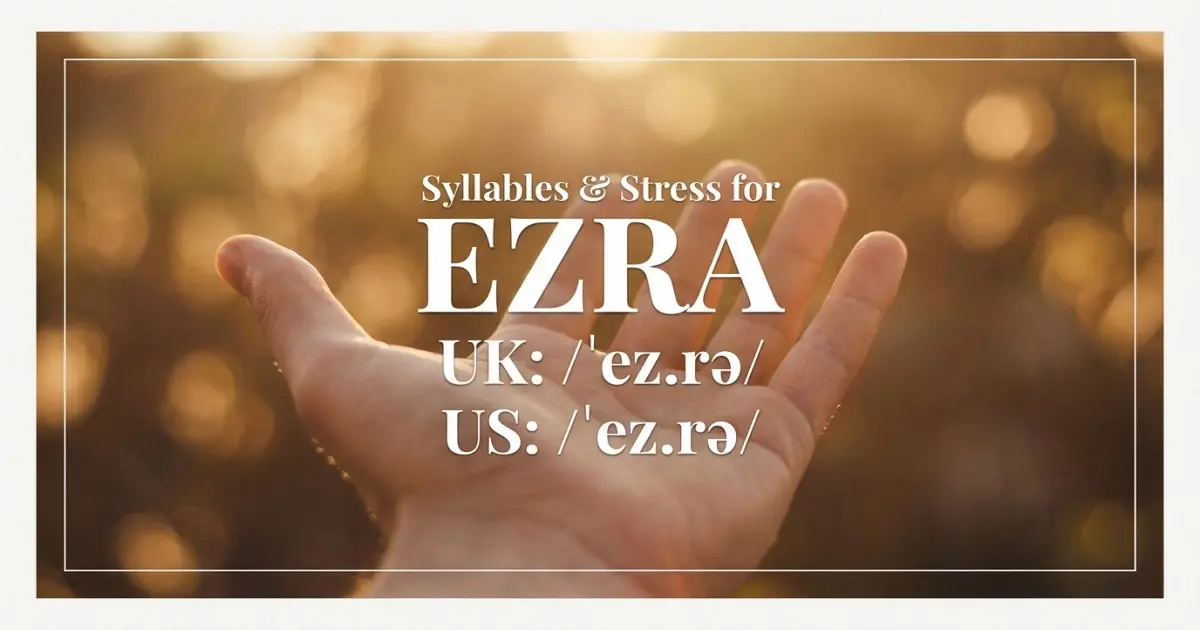
| US IPA | /ˈɛzrə/ | The first vowel sounds like the e in bed, not the long ee of easy. |
| UK IPA | /ˈɛzrə/ | The U.K. form is effectively the same, which gives Ezra unusual cross-accent stability. |
| Syllable count | 2 syllables | Think of it as EZ + ruh, not one compressed sound. |
| Stress pattern | Stress on the first syllable | The opening does the heavy lifting; the second syllable should stay lighter and looser. |
| Key consonant | Voiced fricative /z/ in the center | The z gives Ezra its brightness and keeps it from sounding too soft or too plain. |
| Most common drift | Overemphasizing the second syllable or changing the opening vowel | Keep the first syllable short and clear, then let the ending relax. |
How Ezra Actually Works in Everyday Speech
Ezra is pronounced EZ-ruh. The first syllable takes the stress, and that front-loaded stress is what gives the name its confidence. The second syllable is present, but it does not compete. In everyday English, that pattern feels natural because listeners receive the important information immediately. Ezra announces itself fast and then settles. The sound matters more once you know what the name is meant to carry, which is why the wider frame starts in Ezra meaning.
Why the first syllable carries the identity of Ezra
The opening vowel is /ɛ/, the short sound heard in words such as bed, said, and men. That matters because it keeps Ezra from drifting toward a brighter or more stretched opening. The first syllable should sound compact and grounded, not elongated. If the opening vowel changes too much, the name begins to lose the clean contour that makes it so recognizable.
The consonant that follows is /z/, a voiced fricative. In simple terms, a fricative is a sound made by forcing air through a narrow space, and the voiced part means the vocal cords are active while it happens. This is a small but important detail. The z gives Ezra its inner spark. Without it, the name would sound softer and flatter. With it, Ezra has a little brightness and tension inside the line.
Why the ending keeps Ezra from sounding too sharp
The second syllable is reduced and relaxed, usually landing close to a schwa sound: ruh. That reduced ending is part of what makes Ezra feel approachable. If the name ended in a harder or more heavily stressed syllable, it would sound much more rigid. Instead, the second half loosens the name just enough to keep it human and easy in ordinary speech.
This is why Ezra sounds balanced rather than severe. The opening gives it structure. The ending gives it ease. Together they create a name that feels thoughtful without feeling rehearsed.
Why Ezra Barely Changes Across Accents
One of Ezra’s quiet strengths is how little it changes between major English accents. The supplied U.S. and U.K. IPA are the same: /ˈɛzrə/. That is not true for every popular name. Many names shift in vowel quality, consonant force, or stress placement as they travel. Ezra remains unusually stable.
US and UK Ezra are almost the same name in sound
In both American and British English, the first syllable stays stressed, the opening vowel remains in the /ɛ/ range, and the second syllable stays reduced. Accent texture may slightly color the overall voice, as it always does, but the structure of the name does not usually change in any meaningful way. In everyday listening, Ezra sounds like Ezra on both sides of the Atlantic.
That stability is part of the reason the name feels so portable. Parents often want names that travel well without losing identity, and Ezra does exactly that. It sounds rooted, but not region-locked.
Why Ezra stays clear even in fast speech
Some names are easy in theory but get muddy in fast conversation. Ezra usually does not. The stressed opening syllable holds its place, the z keeps the center audible, and the reduced second syllable finishes the name without clutter. Even in quick speech, the outline remains visible. That is a strong sign of a well-built name.
It also helps that Ezra avoids difficult consonant clusters and unusual stress patterns. The name has an ancient background, but its spoken form fits modern English habits very comfortably.
Where Ezra Can Go Slightly Wrong
Ezra is easier than it looks, but a few pronunciation drifts are still possible. These are usually small and quickly corrected, yet they are worth naming because they show what parts of the sound structure matter most.
Mistake pattern one: changing the opening vowel
The most important thing not to lose is the short opening vowel. Ezra begins with the sound of Ez, not a stretched or overly bright version of it. If the first vowel shifts too far, the name begins to sound less anchored and less consistent with the supplied pronunciation. Keeping the opening short and clean preserves the name’s natural shape.
Mistake pattern two: overplaying the ending
Another common drift is placing too much weight on the second syllable. Ezra works because the ending is light. If the second syllable becomes too prominent, the whole name starts to sound over-enunciated. The closing ruh should complete the name, not compete with the first syllable.
Sound neighbors that help anchor Ezra correctly
If someone is unsure, it can help to compare Ezra loosely to the first part of Ezzie without the added ending, then let it fall into a relaxed ruh. It can also help to remember what the name is not. It is not EEZ-rah. It is not EZ-RAH with a fully stressed ending. It is EZ-ruh: short, clear, and easy on the landing. The way the name resolves at the end often decides which short forms feel natural in speech, and that becomes clearer in Ezra nicknames.
Those distinctions may look minor on paper, but they are exactly what make the spoken name sound natural rather than labored.
How to Practice Ezra Until It Feels Natural
The best way to learn a name is to say it in ordinary sentences rather than in isolation forever. Ezra benefits from this because its rhythm becomes obvious the moment it enters natural speech. The first syllable rises. The second falls away. Once that pattern settles, the name tends to stay stable.
Simple practice lines for Ezra
- Ezra is waiting by the door.
- I saved a seat for Ezra.
- Did Ezra already call back?
- Ezra will be here after lunch.
Read those aloud and listen for the same shape each time. The first syllable should carry the weight. The second should remain light. The name should feel crisp, not forced.
How to know you are saying Ezra well
You are probably pronouncing Ezra correctly if three things happen at once: the first vowel sounds like the e in bed, the stress clearly falls on the first syllable, and the second syllable stays soft and reduced. Once those three features are in place, Ezra sounds exactly as it should: compact, alert, and balanced.
That is the deeper strength of Ezra as a spoken name. It is easy to say not because it is empty, but because it is efficient. The sounds are familiar, the rhythm is intuitive, and the shape survives speed, accent, and everyday life. That kind of pronunciation durability is one of the quiet reasons names endure.