
Ethan Pronunciation: An Easy Guide to Saying It Naturally
The easiest place to hear Ethan clearly is not in a dictionary but in ordinary public life: a teacher calling attendance, a pediatrician stepping into a waiting room, a parent introducing a child at the park. In those moments, the name works because it moves quickly and cleanly. Nobody needs a second try. Ethan arrives in two beats, with the weight on the first one and the second trailing off gently. That real-life ease is a large part of the name’s success. It sounds familiar without sounding lazy, and clear without sounding hard.
That matters because Ethan sits in a useful modern category: names that feel effortless only because their sound pattern is well built. It begins with an open long vowel, passes through the th sound that English speakers already know from everyday words, and ends in a soft reduced syllable. The whole result is smooth rather than punchy. Even though the name means “strong; firm,” its pronunciation does not sound heavy. It sounds stable. That balance between firmness of meaning and ease of speech is exactly why Ethan has remained so durable in everyday naming.
How Ethan is actually said when people say it naturally
| Element | Phonetic Detail | Quick Tip |
|---|---|---|
| Common pronunciation | EE-thuhn | Start with a long ee sound, then let the second syllable relax. |
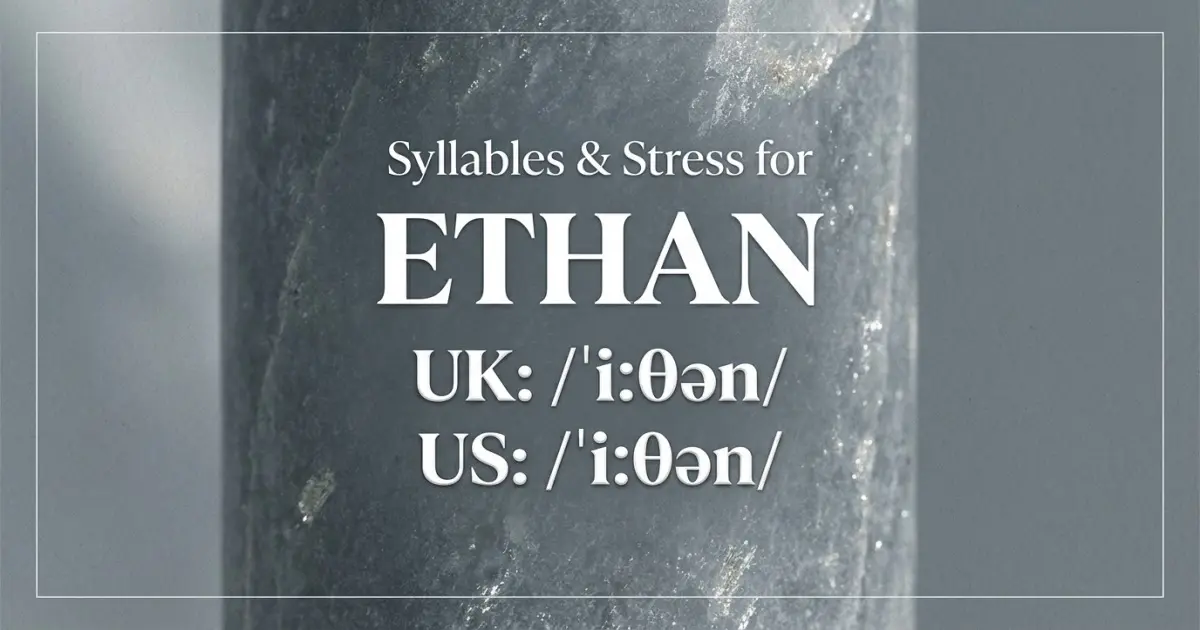
| IPA (US) | /ˈiːθən/ | The stress mark shows that the first syllable carries the main emphasis. |
| IPA (UK) | /ˈiːθən/ | In standard British and American speech, Ethan is pronounced almost the same way. |
| Syllable count | 2 syllables | Think of it as two clean steps: EE + thuhn. |
| Stress pattern | Strong-weak | Do not stress both syllables equally, or the name will sound stiff. |
| Key consonant | Voiceless th fricative /θ/ | Use the same th you hear in thin, not the sound in this. |
| Ending sound | Reduced vowel + n | The last syllable should be light, closer to thuhn than a fully stressed than. |
Ethan works because the first syllable does most of the work
The strongest feature of Ethan is its opening. The first syllable, EE, carries the stress, and that immediately gives the name brightness and clarity. In phonetic terms, the long vowel /iː/ is forward and clean. In ordinary listening, that means the name feels alert from the start. It does not mumble its way into the room. This is one reason Ethan is so effective in school, work, and public settings. People tend to catch it quickly the first time. Before focusing only on syllables and stress, it helps to step back into the fuller frame of Ethan meaning.
After that bright opening comes the sound that matters most: th. In Ethan, this is the voiceless dental fricative /θ/, the same sound heard in thin or thank. For accessible pronunciation teaching, the simplest advice is this: place the tongue lightly near the teeth and let the air pass through. There is no hard stop, and there is no buzzing voice behind it. The sound should feel airy rather than forceful.
Why the second syllable in Ethan should stay light
The last syllable is where people either keep Ethan elegant or accidentally make it clumsy. In normal English pronunciation, the second part is reduced. It is not a full, dramatic THAN. It is softer and less stressed: thuhn. Linguistically, that reduced vowel is close to a schwa, the neutral unstressed vowel sound that appears in countless English words. That is what keeps the name natural. If you overpronounce the ending, Ethan can suddenly sound overly deliberate.
What the rhythm should feel like in your mouth
The rhythm is best understood as strong-weak. Say EE-thuhn, not ee-THAN and not EE-THAN with equal force on both parts. The first syllable opens the name; the second simply completes it. Once that stress pattern is right, Ethan almost pronounces itself.
Where Ethan gets misheard, overpronounced, or flattened
Ethan is not a difficult name, but it still has a few predictable trouble spots. The first is the temptation to make the second syllable too sharp. Some speakers turn the ending into a heavy than, almost as if the name were built like a compound word. That makes it sound rigid. In natural English speech, Ethan works better when the final syllable relaxes.
Common mistake patterns with Ethan
- EE-than with a fully stressed second syllable: understandable, but less natural than EE-thuhn.
- AY-than: an occasional misread from people who guess before hearing the name spoken.
- EE-dhuhn: using the voiced th from this instead of the voiceless th from thin.
- EE-tan or EE-tuhn with the th dropped: usually a speed or accent issue rather than a true alternate English pronunciation.
Why the th is the real hinge sound
The most important distinction is the th. English has two common th sounds: the voiceless one in thin and the voiced one in this. Ethan uses the first. This is small, but it shapes the whole name. The wrong th can make the name sound heavier or blurrier than intended.
There is also a social reason this matters. Ethan is a familiar name, so most listeners already carry a mental model of how it should sound. When the stress or the th shifts too far, people notice, even if they do not consciously know why. Keeping the pronunciation close to the standard form helps the name retain its calm, polished feel.
Ethan in American and British speech sounds more alike than different
One of Ethan’s practical strengths is that its standard American and British forms are nearly identical: /ˈiːθən/ in both. That makes the name unusually portable across English-speaking contexts. Some names change color dramatically when they cross the Atlantic. Ethan generally does not. The core rhythm, vowel shape, and stress pattern remain steady.
What small accent differences can still happen
The differences that do appear are usually subtle. One speaker may make the final syllable slightly crisper, while another lets it fade more gently into the neutral vowel. But these are tiny shading differences, not separate pronunciations. The identity of the name stays intact.
Ethan’s closest sound neighbors
Ethan can sometimes be heard near names such as Evan, Eitan, or Etan, especially in quick conversation, but its sound profile is still distinct. The long opening ee and the central voiceless th give it a very specific shape. That shape is part of why the name feels both modern and well settled. It is recognizable on first hearing, but not blandly generic. Because the strongest energy lands early, the shorter forms often grow from the opening of the name, and that pattern is easier to see in Ethan nicknames.
Another reason Ethan travels well is that it contains no liquid consonants such as l or r, which can vary more dramatically between accents. Instead, it relies on a bright vowel and a fricative, then closes with an easy n. That keeps the name acoustically neat.
How to practice Ethan until it sounds effortless
The best way to practice Ethan is not to overthink it. Start with the long ee, move through the soft voiceless th, and let the final syllable stay light. If you feel yourself punching the second syllable too hard, slow down and rebalance the rhythm. Ethan should feel like one smooth gesture, not two separate words.
Quick practice lines for Ethan
Try these aloud:
- Ethan is ready.
- Come here, Ethan.
- Ethan and Emma.
- This is Ethan Parker.
These short lines help because they place Ethan in normal English flow. If the name sounds natural inside a sentence, you have probably got it right. That is always more useful than saying the name in isolation over and over.
A final spoken check
If you want one simple self-test, listen for the opening and the fade. The opening should be clean and bright: EE. The ending should taper: thuhn. When those two parts are balanced, Ethan sounds exactly the way it is meant to sound—steady, fluent, and easy to carry.