
How to Pronounce Emmanuel: An Easy Sound-by-Sound Breakdown
For many English speakers, Emmanuel is not a name they first meet on paper. They hear it first. It arrives through a school roll call, a church reading, a December hymn, a football team roster, a graduation program, or a formal introduction where the speaker instinctively slows down for a beat before saying it. That makes pronunciation part of the name’s identity from the start. Emmanuel is one of those names whose sound carries a little ceremony with it, but in daily life it still has to work quickly, clearly, and without strain. The challenge is not that the name is difficult. It is that people sometimes over-handle it because they assume a long biblical name must be more complicated than it really is.
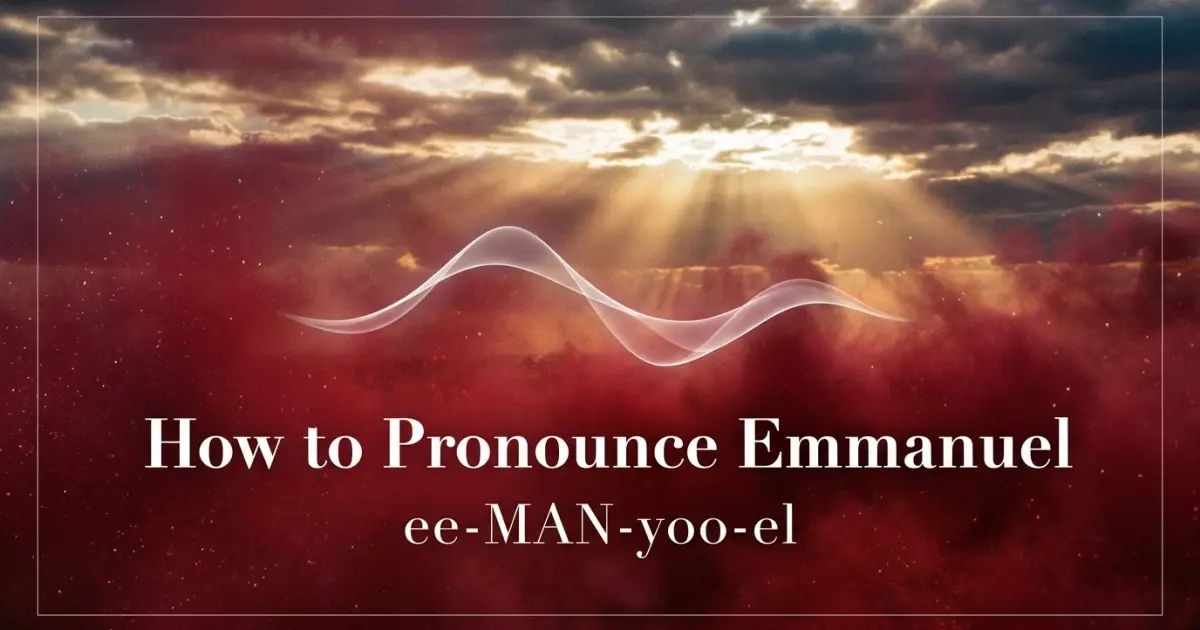
In practice, Emmanuel is steadier than it looks. Once the stress is placed correctly, the whole name settles into a natural rhythm: ee-MAN-yoo-el. The middle syllable does the structural work, and the remaining sounds flow around it. That is why the best approach to Emmanuel is not to pronounce every letter with equal force, nor to flatten the name into something rushed. It is to hear where the name naturally leans. Once you do that, Emmanuel stops sounding formal and starts sounding familiar, which is exactly where a good pronunciation guide should lead.
How Emmanuel is actually said in everyday English
The quickest way to make Emmanuel feel natural is to focus on its moving parts: the opening vowel, the stressed center, and the softened ending.
| Element | Phonetic Detail | Quick Tip |
|---|---|---|
| Common pronunciation | ee-MAN-yoo-el | Think of the name as four beats, but let the second one carry the weight. |
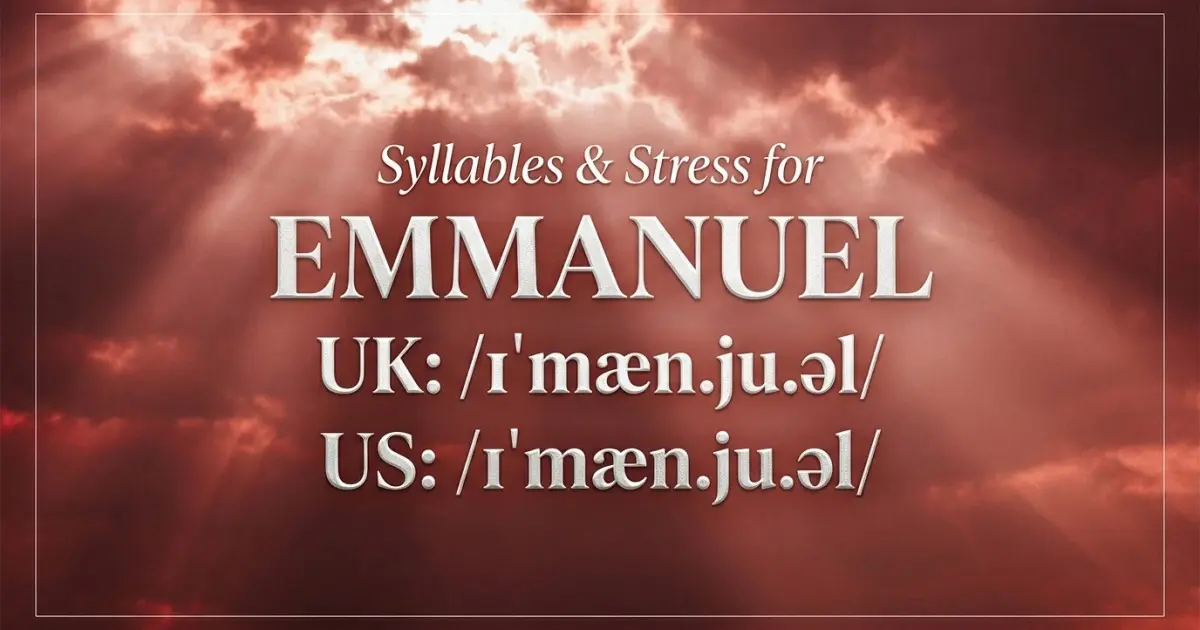
| U.S. IPA | /ɪˈmænjuəl/ | The opening sound is short and light, not a long dramatic “EE.” |
| U.K. IPA | /ɪˈmænjuəl/ | U.S. and U.K. English line up closely here, so there is little cross-Atlantic confusion. |
| Syllable count | 4 syllables | Say it as i-MAN-yoo-uhl rather than trying to make the ending too crisp or too slow. |
| Main stress | Second syllable: MAN | If the stress shifts away from MAN, the whole name starts to sound off-balance. |
| Ending sound | -yoo-el / -yoo-uhl | In real speech, the last part often softens slightly rather than landing in two sharply separate chunks. |
| Nickname influence | Manny, Manuel, Eman | Hearing Manny helps many people locate the natural stress point inside Emmanuel. |
Emmanuel falls into four beats, but the stress does the real work
The syllables are longer on paper than in the mouth
Emmanuel is a four-syllable name, but it should not be pronounced like a marching exercise. One reason people sometimes stumble on it is that they try to give each syllable equal weight: ee-man-you-el. That makes the name sound choppy and overly deliberate. In natural English speech, the unstressed syllables shorten and the stressed one expands. That is normal. It is how fluent pronunciation works. The sound matters more once you know what the name is meant to carry, which is why the wider frame starts in Emmanuel meaning.
The most useful breakdown is this: i-MAN-yoo-uhl. The opening vowel is brief. The second syllable, MAN, is the anchor. Then the final two syllables move lightly, with the ending often softening into something closer to yoo-uhl than a rigid yoo-EL. This does not mean the ending disappears. It means it relaxes.
Why the center syllable makes Emmanuel recognizable
The stress on MAN is what keeps Emmanuel from drifting. Stress is not only about loudness. It is about shape. In English, the stressed syllable tends to sound slightly longer, clearer, and more stable than the others. In Emmanuel, that center stress creates a strong spine. If you move the emphasis forward or backward, the name starts sounding uncertain.
This is also why the nickname Manny feels so natural. It is built directly from the stressed center of the full name. Even if a speaker has never studied phonetics, Manny teaches the ear where Emmanuel wants to land.
Where Emmanuel changes slightly across accents without changing identity
U.S. and U.K. English are remarkably close on Emmanuel
Some names change dramatically across accents. Emmanuel is not one of them. Both U.S. and U.K. pronunciation guides commonly render it as /ɪˈmænjuəl/, which means the broad structure stays stable in both varieties of English. The opening vowel remains short. The stress stays on the second syllable. The glide into yoo remains intact. That makes Emmanuel more portable than many long names with biblical or international roots.
In American speech, the final part may sound slightly smoother and more compressed. In British speech, the ending can sometimes feel a touch clearer, depending on the speaker. But these are shading differences, not identity differences. A child named Emmanuel is unlikely to experience the kind of cross-accent confusion that affects names with genuinely competing standard pronunciations.
Why the ending softens in fluent speech
The last part of Emmanuel contains a glide and a liquid consonant. The y sound in yoo moves quickly into the following vowel, and the l at the end is a liquid consonant, which means it flows rather than stops sharply. That combination encourages smoothing. Speakers rarely pronounce the ending as two fully isolated blocks in fast speech. Instead, they let it run together into a softer -yoo-uhl.
This is a good example of why accurate pronunciation is not always the same as hyper-careful pronunciation. Emmanuel sounds best when the ending is clear enough to hear but relaxed enough to feel spoken rather than recited.
Where Emmanuel gets misheard and how to fix it
The opening sound is often over-brightened
One common mistake is to begin the name with a long, emphatic EE, as though the first syllable were the main event. In reality, the opening sound is lighter. A short opening makes the name more natural and helps the stress fall where it belongs. If the beginning is too heavy, the rest of the name can sound theatrical.
The middle is sometimes under-stressed or over-separated
Another frequent error is flattening the stress so the name becomes nearly monotone. The opposite error is also common: over-separating the center into something like ee-MAN-YOU-EL, with every piece boxed off. The fix is simple. Let MAN be the clear center, then move forward without pausing. Emmanuel is a flowing name, not a stacked one.
The ending gets sharpened when it should be eased
Speakers who are trying especially hard to be correct often make the ending too crisp, almost like you-ELL. That can happen because English readers see the final letters and want to honor them separately. But in spoken English, the last part usually resolves more gently. You do not need to swallow it, but you should not strike it like a separate word either.
Sound neighbors can pull Emmanuel off course
Names such as Emanuel, Manuel, and the shortened Eman sit close enough to Emmanuel that they can influence how people say it. Manuel tends to shift attention toward the latter half of the name. Eman shortens the rhythm dramatically. Emmanuel keeps the fuller four-beat structure and the strong central stress. Hearing those neighboring forms is useful, but they should not drag the full name away from its own natural balance. When the stress sits in the center, the nickname logic often follows that same center of gravity, which is why Emmanuel nicknames is the natural next step.
Practice lines that make Emmanuel feel natural in the mouth
Start with the core beat, then add real speech around it
The best practice method is not repeating the name in isolation forever. It is placing the name inside ordinary sentences until it sounds unforced. Start with the center stress: i-MAN-yoo-uhl. Then move to short lines such as “Emmanuel is here,” “This is Emmanuel,” or “Emmanuel will join us later.” Once those feel easy, the pronunciation has probably settled.
Another useful trick is to pair Emmanuel with names or words that encourage smooth forward motion. “Emmanuel James,” “Emmanuel arrived,” and “Call Emmanuel, please” all help the name behave naturally in connected speech rather than in classroom-style repetition.
Use contrast to hear what Emmanuel is not
If the pronunciation still feels uncertain, compare three forms aloud: Emmanuel, Manny, and Manuel. Manny highlights the stress point. Manuel shows how a related form shortens the rhythm. Emmanuel then becomes easier to hear as the fuller original: not clipped like Manny, not narrowed like Manuel, but balanced between them.
That is often the real goal with a name like Emmanuel. You are not trying to make it sound grand. You are trying to make it sound lived in. Once the stress is right and the ending relaxes, Emmanuel does exactly that.