
Emilia Name Meaning: A Deeper Look at Its Meaning and Roots

Emilia is one of those names that seems to arrive already polished. It has air in it, light in it, a measured musicality that makes it sound almost effortless when spoken aloud. Yet the old force inside the name is not effortless at all. Historically, Emilia belongs to a family of names tied to striving, rivalry, and the desire to equal or surpass. In modern naming language, that edge has often been softened into words like industrious or hardworking. That softening matters, because it explains why Emilia feels so contemporary: parents hear grace first, but the structure underneath is discipline.
That double identity is the real story of Emilia. It is elegant without being fragile, feminine without sounding ornamental, and ambitious without becoming severe. Official Social Security Administration (SSA) data places Emilia at No. 43 for girls in 2024, which tells its own story: this is no longer a hidden gem, but it also has not become blunted by overexposure. The name still carries a faint continental sheen, a literary memory, and a sense of inward steadiness. Emilia works because it offers something many parents want now but do not always find in one name: beauty that does not drift, and strength that does not need to shout.
Emilia's U.S. popularity rank over time, 1880–2024
Popularity statistics are based on official data from the Social Security Administration baby name records.
Emilia: A Graceful and Industrious Choice
Emilia reads as a name with one unmistakable center of gravity, with one side of the chart carrying nearly all of its long-term visibility and familiarity. Its current momentum may be sustained by a broader taste for vowel-rich, multi-syllabic names that feel both classic and fresh .
The lighter side of the chart remains interesting but behaves more like occasional experimentation than a broad identity shift. Associated with elegance and “industrious” roots, its polished rhythm makes the name feel durable rather than fad-driven.
What Emilia says in one glance
Before the history, before the cultural echoes, Emilia already gives a strong first impression. It looks complete on the page, sounds fluid in the mouth, and carries a meaning profile that combines motion with discipline. That is a rare balance, and it helps explain why the name feels both romantic and reliable.
| Key Facts | Information | Quick Insight |
|---|---|---|
| Name | Emilia | The spelling feels classical and international at the same time, which gives it breadth without making it seem vague. |
| Primary origin | Latin | Its Latin foundation gives the name age, structure, and a sense of cultural continuity rather than trend-only appeal. |
| Primary meaning | Rival; industrious | This is the heart of Emilia’s appeal: not passive prettiness, but effort, drive, and a subtle competitive spark. |
| Pronunciation | eh-MEE-lee-uh | The stress pattern gives the name lift in the middle, so it sounds bright and poised rather than heavy. |
| Syllable count | 4 | Those four syllables create elegance and room to breathe, which is part of why Emilia feels graceful across ages. |
| Primary usage | Female | Current usage is strongly feminine, which makes the name feel socially clear while still retaining a cosmopolitan edge. |
| U.S. girls’ rank (2024) | No. 43 | Emilia is clearly established, but it still reads as more selective and refined than names that have become truly ubiquitous. |
| Secondary usage | No. 10,162 for boys in 2024 | That gap shows how decisively the modern American ear hears Emilia as a girls’ name. |
Emilia turns rivalry into purpose
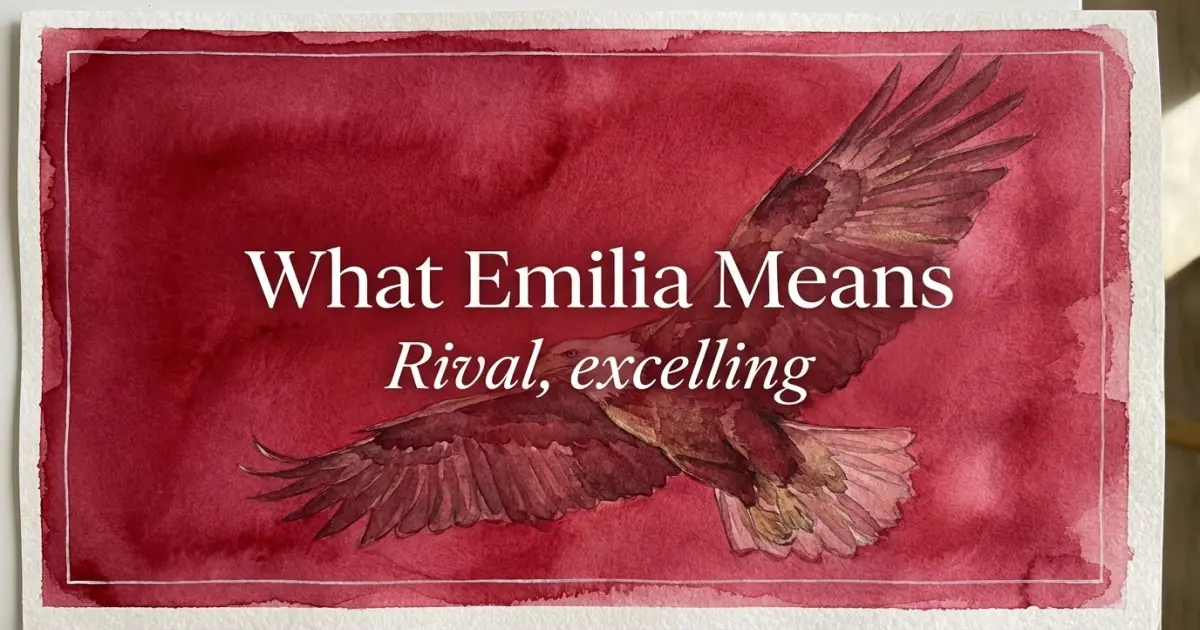
The most interesting thing about Emilia may be the way its meaning has matured over time. The older current inside the name points toward rivalry, emulation, and the will to match or exceed. That can sound sharp when translated too literally, but in naming culture it rarely lands as hostility. Instead, it reads as aspiration. Emilia is the kind of name that suggests someone who measures herself against a high standard. She is not simply busy. She is purposeful.
That is where the companion reading, industrious, becomes so useful. It translates the old competitive charge into a modern virtue that parents actively welcome. Industrious is not flashy. It implies steadiness, concentration, follow-through, and pride in work well done. In other words, Emilia does not merely mean effort in the abstract. It implies directed effort, the kind that accumulates into skill, character, and credibility.
This is why the name feels stronger than many other lyrical girls’ names in its sound range. It has softness in its vowels, but its inner message is not dreaminess or ornament. Emilia suggests a child who might be imaginative, but who is also dependable; expressive, but not scattered; refined, but not remote. The name holds up in serious adult settings because its beauty is backed by competence. That matters in an era when many parents want names that feel warm in childhood yet fully grounded in professional life.
Even the sound supports that reading. The opening syllable is gentle, the stressed middle syllable brings brightness and emphasis, and the final glide releases the name with ease. The effect is elegant, but not sleepy. There is movement in Emilia. The name seems to gather itself at the center, then carry forward. That gives it a quiet momentum, and that momentum mirrors the meaning well. Emilia does not feel static. It feels like a name that knows how to progress.

The Roman thread running through Emilia
Emilia belongs to an old and durable naming line. Its deepest roots are usually connected to the Roman name family Aemilius and Aemilia, a lineage that gives the name both antiquity and stature. That Roman inheritance matters because it helps explain why Emilia feels orderly even when it sounds tender. Names with very old roots often carry a hidden architecture, and Emilia benefits from that. It is melodic, but it is not loose. It comes from a naming tradition that prized form, continuity, and public identity. If the origin of Emilia is part of its appeal, you may also like names linked to Latin history.

As the name moved through European languages and centuries, it kept that dignity while becoming more intimate. In everyday use, Emilia came to feel warmer than a formal antique name and more textural than some of its cousins. Name books have long grouped it beside Emily and its related forms, but Emilia never feels like a mere variant on the page. It has its own atmosphere. Where Emily can feel brisk and familiar, Emilia feels wider and more atmospheric, with more visual and musical detail. Where Amelia often feels airy and fashionable, Emilia feels slightly older in its bones and more literary in its finish.
Literature helped preserve that distinction. Shakespeare gave English readers an Emilia in Othello, a character whose significance grows with the play’s moral pressure. She is not written as decorative background; she becomes one of the drama’s clearest voices of truth. Later, Gotthold Ephraim Lessing’s Emilia Galotti added another major cultural appearance, this time binding the name to seriousness, conflict, and ethical vulnerability. Those two literary anchors matter because they show a pattern: Emilia repeatedly appears in stories where conscience, dignity, and tension are close at hand.
That does not mean every parent hears Shakespeare when they say the name. Most do not. But literary history often shapes a name’s atmosphere even when the reference has faded from memory. Emilia benefits from that inheritance. It has been carried by art, drama, and European usage long enough that it now feels storied rather than manufactured. It sounds like a name that belongs somewhere larger than a single trend cycle.
Why Emilia still feels current in a crowded style era
Modern parents are surrounded by names that are soft, vowel-rich, and international in feel. Emilia lives in that world, but it does not dissolve into it. Part of the reason is visual. The spelling looks intelligent and balanced. It is familiar enough to be readable at once, yet not so commonplace that the eye skims over it. The li in the middle gives it a line of brightness, and the ending keeps it feminine without making it frilly.
Part of the reason is social tone. Emilia suggests culture without pretension. It can fit a child in a nursery, a teenager in a classroom, and an adult in a serious profession. That range is not accidental. The name has emotional softness, but it also has enough historical and structural weight to age well. Parents often worry about whether a lyrical name will still feel credible decades later. Emilia answers that worry better than many of its sound-neighbors because it has an old framework beneath its charm.
Its style neighbors help define it further. Emilia will naturally appeal to parents who like Amelia, Emma, Olivia, Sophia, or Isabella but want something with a slightly quieter glow. It is less ubiquitous in feeling than Emma, less fluttering than Amelia, and a shade more inward than Isabella. It offers romance, but not excess. It offers tradition, but not stiffness. It offers polish, but not chill. That kind of middle position is often where enduring names live.
There is also a practical advantage to Emilia’s shape. Because it is well known across different naming cultures, it tends to travel well. It does not feel trapped in one region, one accent, or one brief fashion window. Families who want a name that sounds at home in more than one cultural setting often respond to that instinctively. Emilia has reach, but it does not feel generic. It can cross borders while still sounding like itself.
A place in the Top 50 without losing delicacy
Popularity changes a name’s social meaning, and Emilia is a useful example of how that change can happen without flattening the original appeal. Its 2024 U.S. rank shows that it has moved well beyond niche use. Parents are not choosing an obscure European import anymore. They are choosing a proven contemporary favorite. But Emilia still retains a sense of curation because its rise has not stripped it of texture. The name remains visibly elegant and phonetically intact.
That matters because some names become more familiar by becoming simpler in the public imagination. Emilia has not undergone that kind of reduction. Even at a widely recognized level, it still sounds slightly literary, slightly continental, slightly more composed than casual. The name continues to feel intentional. In practical terms, that means parents can choose Emilia without feeling either too adventurous or too conventional. It occupies a particularly attractive middle ground: modern enough to feel current, rooted enough to feel lasting.
The gap between Emilia’s girls’ ranking and its much rarer boys’ usage sharpens that identity even more. In present-day American life, the name reads overwhelmingly feminine. That clarity gives it social ease. Parents do not have to explain what the name is trying to do. Emilia arrives with a clear gender impression, but it avoids the overly sugary cues that can make some feminine names feel temporally fragile. It is unmistakably a girls’ name, yet it carries itself with substance. To see how Emilia fits within this category, browse browse girl names.
For that reason, Emilia is one of the more useful kinds of popular name: a name that has entered the mainstream without becoming thin. It still gives the impression of interior life. It still sounds chosen rather than merely inherited from the crowd.
Three roads that open out from Emilia
One reason Emilia works so well as a first-name choice is that it naturally invites other naming decisions without forcing them. It has enough shape and personality to stand alone, but it also leaves room for families to build around it with care.
Middle names that steady or brighten Emilia
Because Emilia is four syllables long and vocally fluid, it often pairs best with middle names that either bring crisp contrast or quiet weight. A short middle can sharpen it; a more traditional middle can deepen its classical feel. The key is not to overcrowd the music that Emilia already carries. If you want the full pairing logic behind that contrast, see Emilia middle names.
Nicknames that make Emilia more intimate
Emilia is formal enough to feel complete, but affectionate shortening comes easily around it. That gives families flexibility: the full name can hold public space beautifully, while home life can develop its own softer, more intimate forms over time. To see how those different moods shorten in real life, explore nicknames for Emilia.
How Emilia sounds when clarity matters
The spoken rhythm of Emilia is one of its great strengths, especially the bright emphasis in the second syllable. That rhythm is a large part of why the name feels graceful rather than cumbersome, and it is worth hearing clearly before any final decision is made. For the detailed stress pattern, accent notes, and IPA, see how to pronounce Emilia.
What the name Emilia ultimately promises
At its best, Emilia is a name about cultivated strength. It does not offer power in the blunt sense. It offers something more durable: the ability to carry grace and effort at the same time. That is why the name lingers. It sounds lyrical, but it is not idle. It sounds refined, but it does not retreat from the world. Underneath the beauty is an old human drive to improve, to persevere, to become worthy of one’s gifts.
That makes Emilia especially appealing in the present moment. Many parents want names that are unmistakably beautiful, but they also want names that can hold seriousness, ambition, and adulthood. Emilia answers that wish with unusual precision. It suggests a person who can move through life with style, but who is not defined by appearance alone. She can be expressive, conscientious, articulate, and quietly formidable.
There is also something deeply satisfying about the emotional arc inside the name itself. A word once tied to rivalry has, in common use, ripened into industriousness. The harder edge has not disappeared; it has matured. Emilia no longer feels like a contest. It feels like character. And that may be the finest thing the name offers: not the promise of perfection, but the promise of effort shaped into poise.
So if Emilia keeps returning to your mind, it may be because it resolves a tension many names cannot. It gives you softness without weakness, history without heaviness, popularity without plainness, and femininity without fragility. Few names hold those balances so naturally. Emilia does, and that is why it feels less like a passing favorite than a name with lasting inner form.