
How to Pronounce Elsa: Syllable Guide and Easy Stress Tips
The true pronunciation test for Elsa rarely happens in a naming guide. It happens in ordinary public moments where a name has to stand on its own before anyone offers context: a teacher reading the first roll sheet of the year, a receptionist stepping into a waiting room, a host glancing down at a reservation list and calling the name aloud. Elsa usually passes that test well because it looks clean and familiar, yet it still has enough European shape that some speakers pause for half a second to ask themselves how soft or how sharp the ending should be. That brief hesitation is exactly where pronunciation matters.
Once spoken correctly, Elsa becomes very simple: EL-suh. The first syllable carries the stress and gives the name its full clarity. The second syllable releases gently and quietly. That balance is what keeps Elsa poised. If the ending becomes too heavy, the name loses some of its elegance. If the opening is too vague, it loses its clean outline. Elsa works because it begins with definition and ends with softness. It is a short name, but it has precise internal proportions.
What Elsa is actually clarifying every time it is said aloud
| Element | Phonetic Detail | Quick Tip |
|---|---|---|
| Everyday pronunciation | EL-suh | Say the first syllable like “else” without the final consonant, then finish with a light “suh.” |
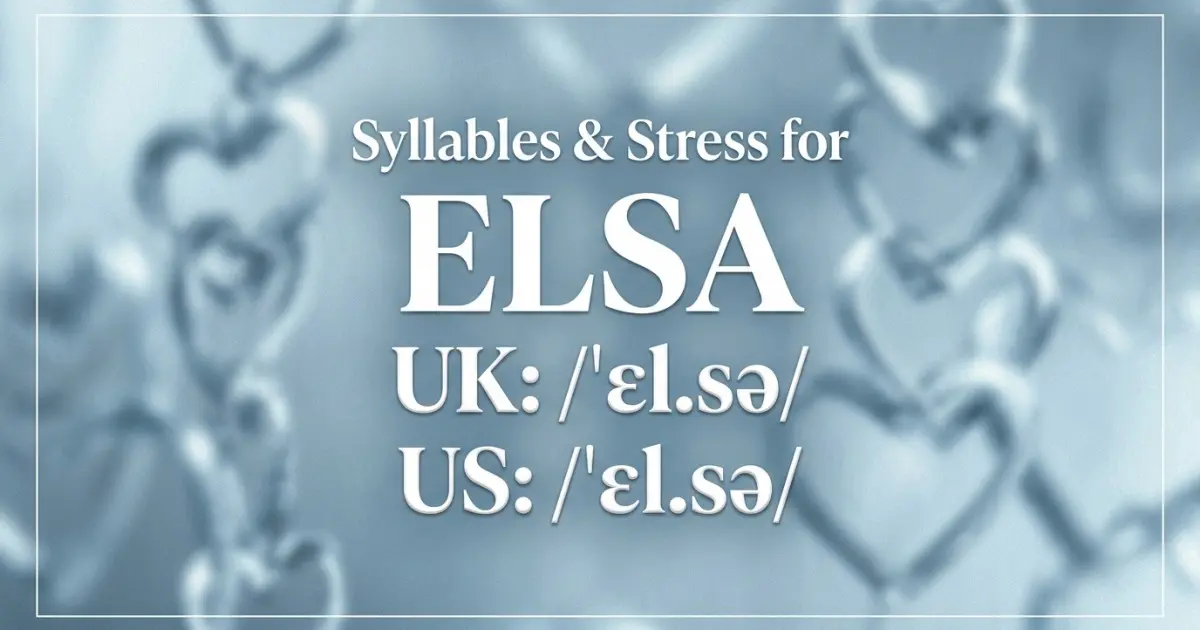
| US IPA | /ˈɛlsə/ | The first syllable uses the short e sound in “met,” and the final syllable relaxes into a schwa. |
| UK IPA | /ˈelsə/ | The British form follows the same rhythm and practical sound pattern, so the name stays highly stable across accents. |
| Syllable count | 2 syllables | Keep Elsa compact. It is a brisk two-beat name, not a stretched or ornamental one. |
| Primary stress | First syllable: EL | The opening does most of the work. If the first beat is clear, the whole name usually lands correctly. |
| Final sound | -suh /sə/ | Let the ending stay light and neutral rather than turning it into a strong “sah.” |
Elsa begins firmly and ends softly
The first syllable carries the whole profile of Elsa
In both IPA forms, the stress marker appears before the first syllable. That means Elsa should begin decisively on EL. This is important because short names depend heavily on stress placement. There is very little room in a two-syllable name for uncertainty. The opening has to establish the name at once. The sound matters more once you know what the name is meant to carry, which is why the wider frame starts in Elsa meaning.
The vowel here is the short e sound. In American English, /ɛ/ is the vowel heard in words like bed, red, and set. That gives Elsa a grounded, conversational opening. It does not begin with a long or dramatic vowel. It begins cleanly. This is one reason the name feels more composed than ornate. The sound arrives with clarity rather than flourish.
The l in Elsa is a liquid consonant, which helps the name move smoothly from the opening vowel into the middle consonant cluster. In practical terms, that means Elsa sounds polished without sounding stiff. The name is controlled, but never harsh.
The second syllable is lighter than many people first assume
The second syllable, -suh, matters because it is where the name relaxes. In ordinary English pronunciation, the final vowel is a schwa, /ə/, the soft unstressed sound heard in the final syllables of many everyday words. That means Elsa should not end in a strong, open “ah” sound. It should end more gently, almost like a quiet release.
This is one of the reasons Elsa feels elegant in speech. The name does not slam shut, and it does not sing itself out too dramatically. It lands lightly. The s in the middle is a fricative, which lets the air continue flowing, and that helps the name maintain its soft finish. In plain language, Elsa begins with definition and finishes with breath.
That sound pattern also suits the meaning well. A name meaning “pledged to God” could easily become too solemn if the pronunciation were heavier. Elsa avoids that by sounding calm rather than weighty. The promise in the meaning remains serious, but the spoken form remains human-sized.
Where people most often mishear Elsa
The most common issue is overpronouncing the ending
The main pronunciation mistake with Elsa is not usually the first syllable. Most English speakers handle the opening well. The more common issue is the ending. Some people instinctively make the second syllable stronger than it needs to be, turning it into something closer to EL-sah. But the given pronunciation and IPA both point to a lighter finish: EL-suh.
That difference matters because it changes the emotional feel of the name. A heavier ending can make Elsa sound more formal or more rigid than it really is. The correct lighter ending preserves the name’s ease and keeps the whole sound balanced.
The second mistake is making Elsa too sing-song
Because Elsa is a very recognizable and elegant-looking name, some speakers unconsciously over-style it when they say it. They may add extra softness, extra length, or too much emphasis to the second syllable. But Elsa is not meant to sound decorative. It is meant to sound clear. The strongest delivery is simple and matter-of-fact.
This is an important point for everyday use. Elsa sounds best when spoken with confidence, not performance. The name already contains enough grace in its structure. It does not need embellishment.
Accent differences barely disturb Elsa at all
One of Elsa’s practical strengths is that the U.S. and U.K. IPA forms are effectively aligned in rhythm and function. In real speech, that means major English-speaking accents do not tend to distort the name. A speaker’s voice may shade the vowel slightly, but the overall structure remains recognizably the same: stressed first syllable, light second syllable.
That stability matters because it makes Elsa easy to carry across settings. The name does not demand constant correction. It tends to remain itself, and that gives it a quiet confidence in public life.
How Elsa holds steady in real speech
Sound neighbors show how compact Elsa really is
It can help to hear Elsa near other short names with a firm first syllable and a softened close, because that confirms what the ear is already sensing: this is a name built for clarity. It is not sprawling, ornamental, or heavily stylized. It is edited. That is one reason it works so well in ordinary conversation. Elsa sounds like a name people can say quickly without making it feel casual in a careless way. Once the sound pattern is clear, some shortenings stop feeling optional and start feeling natural, and the clearest map is in nicknames for Elsa.
The sound is also memorable because it is neither too sharp nor too sweet. The consonants give it definition, and the final schwa keeps it from sounding brittle. That balance is one of Elsa’s hidden strengths.
Practice lines make Elsa’s rhythm obvious
The easiest way to internalize the name is to hear it inside normal sentences:
- “Elsa is here.”
- “This is Elsa.”
- “Can Elsa come to the front, please?”
- “Elsa, your table is ready.”
In each case, the first beat should feel strong and neat, and the second should soften immediately after it. If the name feels compact and light rather than stretched, the pronunciation is sitting correctly.
Confidence teaches Elsa faster than explanation does
For families using the name, the best pronunciation strategy is usually simple consistency. Say it clearly as EL-suh, and most people will follow the model quickly. Elsa is not a name that needs a long phonetic lesson. It needs one confident example. Once heard naturally, it usually stays easy.