
Ella Pronunciation: Quick Tips for Clearer Pronunciation
You can hear why Ella lasts in the kinds of places where nobody has time to explain a name. A teacher reaches it on the first day of school and says it without hesitation. A nurse calls it from a waiting room and the right child stands up immediately. A barista repeats it back over café noise and still gets the shape right. That is one of the quiet strengths of the name. Ella may look delicate on the page, but in real speech it is highly stable. It is short, clear, and hard to mishear once spoken naturally.
That everyday ease matters because pronunciation is where a name proves whether it can live beyond style. Official data shows Ella remains one of the most visible girls’ names in the United States, and part of that staying power comes from how little strain the name places on the speaker. Ella has two clean syllables, a first-syllable stress that English speakers catch easily, and a soft ending that feels graceful without becoming vague. The name sounds gentle, but it is structurally strong.
What Ella Is Actually Doing When People Say It Well
The guide below shows the spoken framework that keeps Ella so clear in everyday English.
| Element | Phonetic Detail | Quick Tip |
|---|---|---|
| Common spoken form | EL-uh | Put the strongest beat on EL, then let the second syllable soften naturally. |
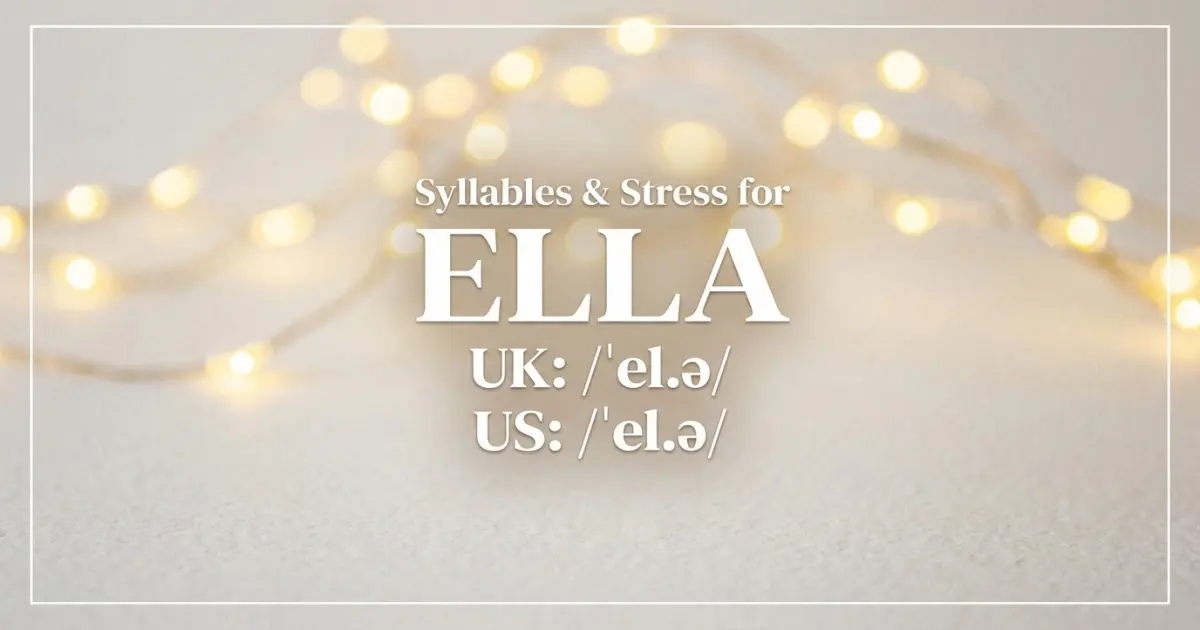
| U.S. IPA | /ˈelə/ | The stress mark shows that the voice should lean onto the first syllable. |
| U.K. IPA | /ˈɛlə/ | The sound is almost the same in practice, with only a slight vowel shading difference. |
| Syllable count | 2 syllables | Hear it as EL – uh, not as one blended sound. |
| Stress pattern | First-syllable stress | The opening carries the name. If that lands clearly, Ella sounds instantly natural. |
| Ending sound | Final schwa-like uh | Keep the ending light rather than over-pronounced or theatrical. |
Why Ella Sounds So Easy in the Mouth
Ella is a very short name, but it is not a thin one. The first syllable gives it shape, and the second gives it warmth. That balance is one reason the name feels complete even though it is only two syllables long. Many short names sound bright or efficient. Ella sounds settled. Before focusing only on syllables and stress, it helps to step back into the fuller frame of Ella meaning.
The first syllable of Ella does the important work
The opening El carries the primary stress, which is a major advantage in English. Names with first-syllable stress are often easier for listeners to catch quickly because the strongest cue arrives right away. That helps explain why Ella performs so well in public settings. The name does not make the listener wait for recognition.
The first vowel is short and familiar, and the consonant frame is simple. There is nothing crowded or unstable in the opening. Ella begins cleanly, which is why it often sounds more grounded than some other short girls’ names.
The liquid consonant helps Ella glide
The double l sound is central to Ella’s character. L is a liquid consonant, which means it allows a smoother movement of air and tongue than sharper consonants do. In practical terms, this is why Ella feels graceful in speech. The name does not snap or click. It flows.
That flow is important because it keeps the name soft without making it weak. If Ella had a harsher consonant in the middle, it would feel more abrupt. If it had only open vowels, it might feel too loose. The liquid consonant gives it a middle path: gentle, but defined.
The ending of Ella should finish softly
The second syllable usually lands in a relaxed schwa-like sound, the small unstressed vowel English uses in many everyday words and names. This is why the ending of Ella should not be forced into a full, bright vowel. It is there to complete the name, not to compete with the opening. The way the name resolves at the end often decides which short forms feel natural in speech, and that becomes clearer in Ella nicknames.
When speakers overwork the ending, Ella can start sounding more decorative than it really is. The most natural version keeps the second syllable light and lets the first syllable remain the center of gravity.
Ella Across Accents Barely Changes Its Identity
One reason Ella travels so well is that its American and British pronunciations are very close. The U.S. IPA /ˈelə/ and the U.K. IPA /ˈɛlə/ show a slight shift in the opening vowel, but the overall sound pattern remains the same: two syllables, first stress, soft ending.
What stays stable in both U.S. and U.K. speech
The rhythm stays identical. The stress stays on the first syllable. The final syllable remains unstressed and light. Those are the features that matter most in everyday recognition, and they do not move. That is why Ella remains highly understandable even when accent texture changes around it.
What may sound a little different
The opening vowel may be shaded slightly differently depending on accent. American English can sound a touch tenser or brighter. British English may sound a touch flatter or rounder, depending on the speaker. But these are small shifts in color, not in identity. Most listeners would still hear the same name immediately.
Why Ella feels natural in mixed-accent settings
Some names depend strongly on local sound habits and change more noticeably between regions. Ella does not. Its consonants are familiar, its syllables are few, and its stress pattern is obvious. That makes it useful in multilingual or international settings too. Even when a speaker’s accent changes the edges slightly, the structure remains intact.
Where Ella Gets Nudged Off Course
Ella is not often badly mispronounced, but small distortions do happen. Most of them come from rhythm or from confusing Ella with nearby names rather than from any real difficulty inside the name itself.
When both syllables are stressed too evenly
The most common mistake is making both syllables sound equally important. That can make Ella feel flatter and less natural. Standard English pronunciation wants the first syllable to lead and the second to follow. If the speaker distributes too much weight across both halves, the name loses some of its grace.
When the ending becomes too strong
Another common issue is over-pronouncing the final uh, as though it should sound fully spelled-out or dramatically separate. That can make the name feel staged. Ella sounds best when the ending is audible but relaxed. The final syllable should feel like a finish, not a second headline.
When Ella is confused with nearby names
In noisy settings, Ella can briefly blur with names such as Ellie, Emma, or Stella if only part of the word is heard. But the confusion usually disappears once the full rhythm is clear. Ellie has a brighter ending. Emma closes more firmly in the middle. Stella begins with a different consonant cluster and carries more weight at the front. Ella remains one of the cleanest and simplest shapes in the group.
Ella in Real Speech Sounds Best Inside Real Sentences
A pronunciation guide becomes most useful when the name is heard in ordinary language rather than repeated in isolation. Ella is especially good at this kind of test because its rhythm is so stable.
Practice lines that reveal the rhythm
- Ella will join us after lunch.
- Please ask Ella to come inside.
- Ella Reed is waiting in the lobby.
- I saved this seat for Ella.
- Ella said the meeting starts at noon.
What these lines help you hear
In each sentence, the first syllable takes the stress and the second syllable resolves the name softly. That is the pattern to keep. If the opening lands clearly and the ending stays relaxed, Ella will sound natural in almost any context.
That is the practical elegance of the name. Ella does not depend on rare sounds, unusual spelling habits, or complicated stress rules. It succeeds because it is economical. The name uses familiar sounds, arranges them well, and wastes almost nothing. That is one reason it continues to work so reliably in modern life: it is easy to say, easy to hear, and hard to break.