
Best Middle Names for Drew: Refined Ideas for a Better Name Flow
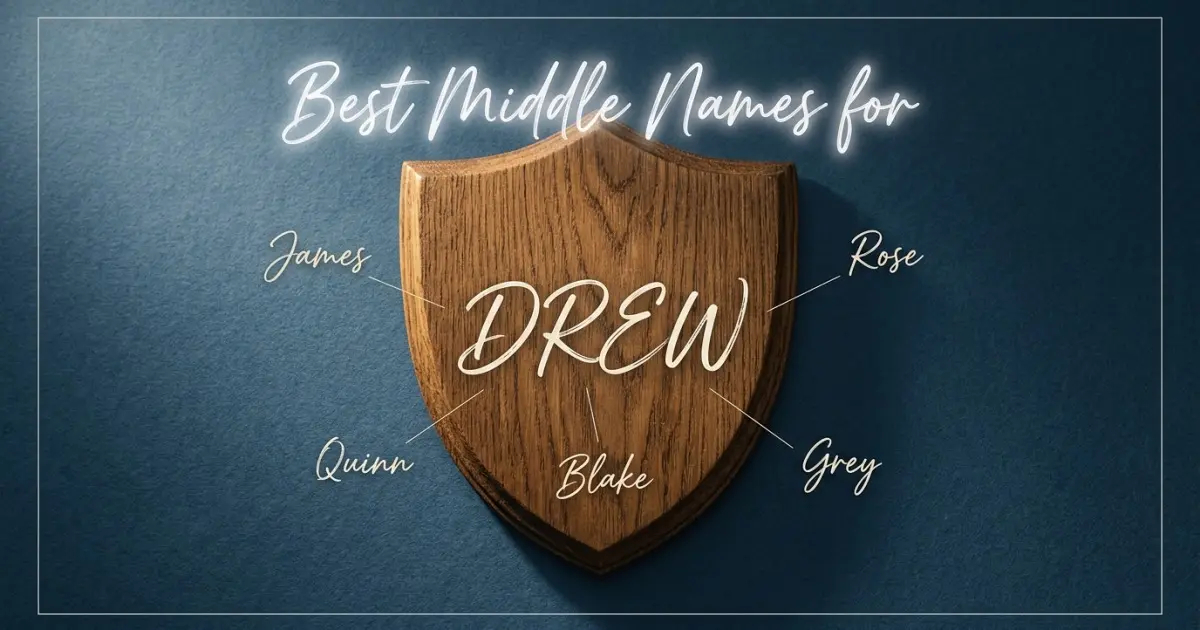
A middle name often carries the part of family identity that the first name cannot hold by itself. It is where parents place memory, smooth rough edges, settle arguments, honor a relative, or quietly steer how a short first name will be read in the world. In daily life, middle names can disappear for years at a time. Then they return at exactly the moments when a name matters most: on school forms, on diplomas, in signatures, in formal introductions, in the full-name voice a family uses when love and seriousness meet. That is why the middle name is never just filler. It is the hidden architecture of the whole name.
Drew makes that architecture unusually important. The first name is one syllable, unisex, clean-lined, and immediately self-possessed. It does not waste sound. That is part of its appeal, but it also means the middle name has real work to do. With Drew, a middle can widen the rhythm, shift the gender tone, soften the bluntness, add inheritance, or make the full name feel more literary, more polished, or more relaxed. The best middle name for Drew is not the one that merely sounds pretty in isolation. It is the one that explains what kind of Drew this is. To make sure the middle name does not pull against the first name’s roots, it helps to check the heritage and tone carried in Drew meaning.
What the best middle names reveal about Drew
Because Drew is brief and tonally flexible, the middle name often supplies the emotional and stylistic context. Some pairings keep Drew crisp and modern. Others make it warmer, more classic, or more distinctly feminine or masculine. The strongest combinations understand that Drew already provides the edge. The middle name should usually provide the contour.
| Style | Recommended Names | Why it works with Drew |
|---|---|---|
| Classic and stabilizing | Elizabeth, Catherine, Louise, Thomas | These names give Drew historical weight and keep the full combination from feeling too clipped or casual. |
| Modern and tailored | Quinn, Blair, Reese, James | They preserve Drew’s streamlined energy and make the whole name feel current without sounding flimsy. |
| Softening and lyrical | Eliana, Noelle, Amelia, Olivia | Longer, open-voweled middles add warmth and movement after Drew’s firm one-syllable start. |
| Grounded honor name | Anne, Marie, Jane, Robert | Drew carries enough style on its own, so simpler family middles often make the most believable full names. |
| Quietly distinctive | Simone, Margot, August, Everett | These pairings give Drew an editorial finish and make the full name feel deliberate rather than generic. |

Drew almost always needs a second movement
The first and most important rule with Drew is rhythmic: one-syllable first names usually sound strongest when the middle gives them room to open. Drew is compact, but it is not soft. It enters quickly, lands firmly, and then stops. If the middle name is too short or too abrupt, the full combination can sound skeletal. That is why Drew often thrives beside two-, three-, or even four-syllable middles.
Why longer middles make Drew feel complete
Drew Elizabeth, Drew Amelia, Drew Everett, and Drew Olivia work because the first name acts like a clean lead-in, while the middle carries the melodic weight. This is often the most elegant formula. Drew says something clear and modern; the middle develops it. The effect is especially useful when the surname is short. With a surname like Brooks, Lane, Price, Hart, or Wells, a longer middle name often prevents the full name from sounding too abrupt.
There is also a tonal benefit. Drew can sometimes read as cool to the point of distance if it is not paired carefully. A fuller middle name softens that impression without undoing the first name’s appeal. It helps the full name feel human, not just stylish.
When short middles work with Drew anyway
Short middles are not automatically wrong. They just need to bring either emotional familiarity or a very controlled modern sharpness. Drew Jane, Drew Anne, Drew James, and Drew Quinn can all work, but the effect is tighter. These pairings feel more distilled, more tailored, and sometimes more fashion-aware.
The key question is whether the surname can absorb that compression. Drew Jane Montgomery has enough space later in the name to balance itself. Drew Jane Price is much barer and will appeal only if the family wants that spare modern look very intentionally.
How Drew changes once the middle name chooses a direction
Because Drew is genuinely unisex in modern use, the middle name often decides how the full name will be read on first encounter. That does not mean parents must choose a gendered direction, but they should know when they are doing it. With Drew, the middle name acts almost like a lens. It brings one version of the name forward and pushes another into the background.

Drew with feminine middles feels polished, not fragile
On girls, Drew often pairs best with middles that add shape and softness without becoming sugary. Drew Eliana, Drew Noelle, Drew Louise, Drew Catherine, and Drew Simone all work because they let the first name keep its edge while giving the full combination emotional light. These names do not “rescue” Drew from being too plain. They clarify that the first name’s compactness is intentional.
This is often the smartest strategy for parents who love Drew precisely because it feels modern and self-possessed, but who also want the full legal name to carry elegance. A lyrical middle makes Drew feel like a choice with depth, not simply a clipped trend.
Drew with masculine middles feels rooted rather than overdone
On boys, Drew can either remain streamlined or reconnect more visibly to its historical backbone through the middle name. Drew Thomas, Drew Alexander, Drew Everett, Drew Bennett, and Drew Michael all work because they let Drew remain easy in daily speech while the middle adds stability and continuity. These combinations often feel less nickname-like and more complete on formal documents.
This is especially useful for families who prefer Drew to Andrew but still want a full-name structure that feels traditional enough for adulthood. A grounded middle can do that work without making the first name less modern.
Drew in the middle of the road: neutral pairings that stay balanced
If the goal is to preserve Drew’s gender-flexible identity rather than lean hard in one direction, neutral or lightly tailored middles can be excellent. Drew Quinn, Drew Blair, Drew Reese, Drew August, and Drew Ellis all maintain the first name’s modern neutrality. The result is often sleek and memorable, though parents should listen carefully to make sure the full combination still has enough warmth for their taste.
This route works particularly well for families drawn to Drew because it feels contemporary, direct, and socially versatile. The tradeoff is that overly spare neutral pairings can sound more styled than lived-in if the surname is also short. Balance still matters.
Where Drew meets the surname and the full name either works or fails
Middle-name choices always have to answer to the surname in the end. With Drew, this is even more important because the first name is so brief. The surname determines whether the full combination sounds crisp, abrupt, elegant, or underbuilt. Historically, naming advice has always stressed harmony, and Drew is a clear case where that old advice still holds. If you want the IPA, accent detail, and stress pattern behind the flow advice, the next stop is Drew pronunciation guide.
Short surnames usually want a fuller middle
If the surname is short—Reed, Shaw, Blake, Cole, Frost—Drew almost always benefits from a middle with more syllables. Drew Amelia Shaw and Drew Everett Cole feel complete because the name expands in the middle before closing quickly. Without that expansion, the whole name can sound like a pair of clipped labels rather than a finished full name.
Long surnames can handle a leaner middle
If the surname is longer—Henderson, Ramirez, Bellamy, Sullivan, Whitaker—then Drew can carry a shorter middle more successfully. Drew Jane Sullivan or Drew James Whitaker work because the surname supplies the extra rhythm. In these cases, the middle does not have to do all the widening on its own.
Initials matter more with Drew than parents expect
Because Drew is so spare, awkward initials or repetitive sound patterns tend to stand out more. Parents should write the full initials, say them aloud, and check whether the name creates accidental phrases, unfortunate monograms, or too much alliteration. A full name like Drew Daniel Dawson may feel more stylized than intended. The issue is not that repetition is always wrong. It is that with a one-syllable first name, every repetition becomes more audible.
It is also wise to test the transition from Drew into the middle name. Names beginning with a hard d, r, or oo-heavy vowel can create an awkward seam. Smooth transitions usually come from middles that either contrast gently or open more broadly.
Why Drew works best when the middle does not try to out-cool it
The biggest mistake parents make with Drew is assuming the middle name must match the first name’s clipped coolness. That can work in narrow cases, but more often it makes the full name feel too self-conscious. Drew already provides the minimalist, modern note. The middle name usually succeeds by adding depth, softness, or continuity rather than trying to be equally sharp.
Pairings that usually hold their shape
Names like Drew Elizabeth, Drew Louise, Drew Simone, Drew Thomas, Drew Everett, and Drew Noelle tend to hold up because each one gives Drew something it lacks on its own: length, warmth, inheritance, or musical flow. These combinations sound intentional without sounding overdesigned.
Practical caution notes for Drew
- Avoid pairing Drew with another very clipped one-syllable name unless the surname is long enough to carry the rhythm.
- Be cautious with middles that begin with sounds that make the transition from Drew feel sticky or repetitive.
- If you want Drew to remain clearly unisex, choose a middle that supports balance rather than strongly steering gender tone.
- If you are using a family honor name, do not worry if it is more traditional than Drew. That contrast often strengthens the full name.
- Always say the full name with the surname in ordinary speech, not just in a formal tone. Drew sounds very different when spoken quickly than when admired on paper.
In the end, the best middle name for Drew is the one that completes the sentence the first name begins. Drew brings compression, confidence, and modern edge. The middle should decide whether that edge is framed by grace, inheritance, warmth, or restraint. Once that framing is right, the full name stops sounding merely stylish and starts sounding inevitable.