
Dino Name Meaning: Short Forms, Character, and Friendly Vibes
A small sword is still a blade. It carries an edge, a point, and the disciplined shape of an object made for precision. Dino begins with that compact image. Its meaning, “little sword,” places strength inside a smaller frame, while the second meaning, “strong,” removes any doubt that size and force are not the same thing. The name’s central idea is therefore not grandeur. It is concentrated presence: something concise that does not need to be large in order to feel capable.
Pronounced DEE-noh, Dino reinforces that idea through sound. It contains only two syllables and four letters, yet its long opening vowel gives it clarity and confidence. The Italian origin adds cultural definition, while the final -o gives the name a warm, rounded finish rather than a severe one. Official US data places Dino well outside the mainstream for boys, allowing it to feel recognizable without becoming repetitive. The name carries strength, but it does so with ease, familiarity, and a distinctly human scale.
Dino's U.S. popularity rank over time, 1912–2024
Popularity statistics are based on official data from the Social Security Administration baby name records.
Dino: A Friendly and Reliable Mediterranean Classic
Dino presents a chart pattern of one dominant tradition, maintaining a steady and clear identity on the boys’ side for over a century. Reaching its highest momentum in the mid-20th century, it continues to offer a sense of reliability and friendly, honest strength parents trust for its soft sound.
The lack of meaningful crossover reinforcements its focused masculine profile. As a diminutive of names like Bernardino or Agostino, its simple structure remains both durable and widely recognized.
Dino Places Compact Strength at the Center of the Name
| Key Facts | Information | Quick Insight |
|---|---|---|
| Name | Dino | Four letters and two syllables give the name exceptional economy without making it sound incomplete. |
| Primary gender usage | Male | Its current masculine identity is supported by usage, its Italian form, and its firm opening consonant. |
| Primary origin | Italian | The origin gives Dino a clear cultural setting and helps explain its smooth vowel-rich sound. |
| Meaning | Little sword; strong | The dual meaning presents strength as something concentrated and controlled rather than oversized or theatrical. |
| Pronunciation | DEE-noh | The long opening vowel gives Dino brightness, while the rounded ending keeps the name friendly. |
| US IPA | /ˈdiːnoʊ/ | Primary stress falls on the first syllable, creating a clear and memorable American pronunciation. |
| UK IPA | /ˈdiːnəʊ/ | The British ending uses a slightly different diphthong notation, but the overall sound remains the same. |
| Syllable count | 2 | The simple strong-light rhythm makes Dino easy to pair with both short and long surnames. |
| U.S. boys’ rank (2024) | No. 2712 | Dino is established in current use but remains uncommon enough to preserve a distinct personal identity. |
“Little Sword” Gives Dino an Image of Precision
The meaning “little sword” is unusually concrete. It does not describe an emotion, moral virtue, or abstract hope. It names an object and qualifies its size. The result is visual, direct, and easy to remember.
The word “little” changes the emotional scale
Without the first word, a sword meaning could sound grand, martial, or severe. “Little sword” changes that atmosphere. The image becomes more compact and personal. It suggests something made to be carried closely rather than displayed at a great distance.
This does not mean that Dino literally signifies a warrior, fighter, soldier, or conqueror. Those roles are not part of the supported meaning. The name refers to a small sword, not to the person who uses it. That distinction keeps the interpretation honest.
For parents, the appeal may lie in the contrast between size and capability. The meaning does not assume that what is small is weak. A short object can still be sharp, carefully made, and effective. In the same way, the name Dino can feel concise without feeling slight.
The sword image is defined by shape and purpose
A sword is a designed object. Its form depends on balance, an edge, a point, and a handle that allows control. Those physical features make the image different from a broad meaning such as power or courage. “Little sword” suggests precision rather than limitless force.
Families may personally connect that image with decisiveness, protection, craftsmanship, or discipline, but those ideas remain interpretations. Dino’s literal meaning should not be expanded into unsupported promises about temperament.
The concrete definition is already rich enough. It gives the name a clear internal object—small, formed, and purposeful—without requiring an invented legend.
“Strong” Reveals the Larger Idea Inside Dino
The second meaning, “strong,” broadens the name beyond the physical image of a blade. Where “little sword” is specific, “strong” is open. It can refer to physical ability, emotional endurance, structural firmness, or the capacity to continue under pressure.
Strength does not prescribe one personality
A child named Dino does not need to be loud, athletic, dominant, or fearless in order to carry the meaning well. Strength can appear through patience, honesty, concentration, adaptability, or care for other people. The word provides a broad foundation rather than a narrow behavioral script.
This is important because names with powerful meanings can create expectations when treated too literally. Dino should not become a standard against which the child is measured. The meaning can remain part of the family story without becoming a demand for constant toughness.
The dual meaning makes strength feel concentrated
“Little sword” and “strong” work together because they approach power from different angles. The first presents a compact object; the second names the quality associated with durability or capability. Together, they make Dino feel less like a name of grand conquest and more like a name of focused readiness.
This connection also mirrors the form of Dino itself. The name is short, but its sound is not fragile. The /d/ opening gives it firmness, while the long vowel provides space and clarity. Meaning and sound reinforce the same central idea: brevity can hold substantial presence.
Dino’s Italian Origin Gives the Name Warmth Around Its Edge
Dino’s primary origin is Italian, and the name carries several qualities often associated with Italian masculine forms: clear vowels, a final -o, and an easy movement between consonants and open sounds. Its structure feels complete despite its brevity. For more names connected to this tradition, see names with Italian roots.
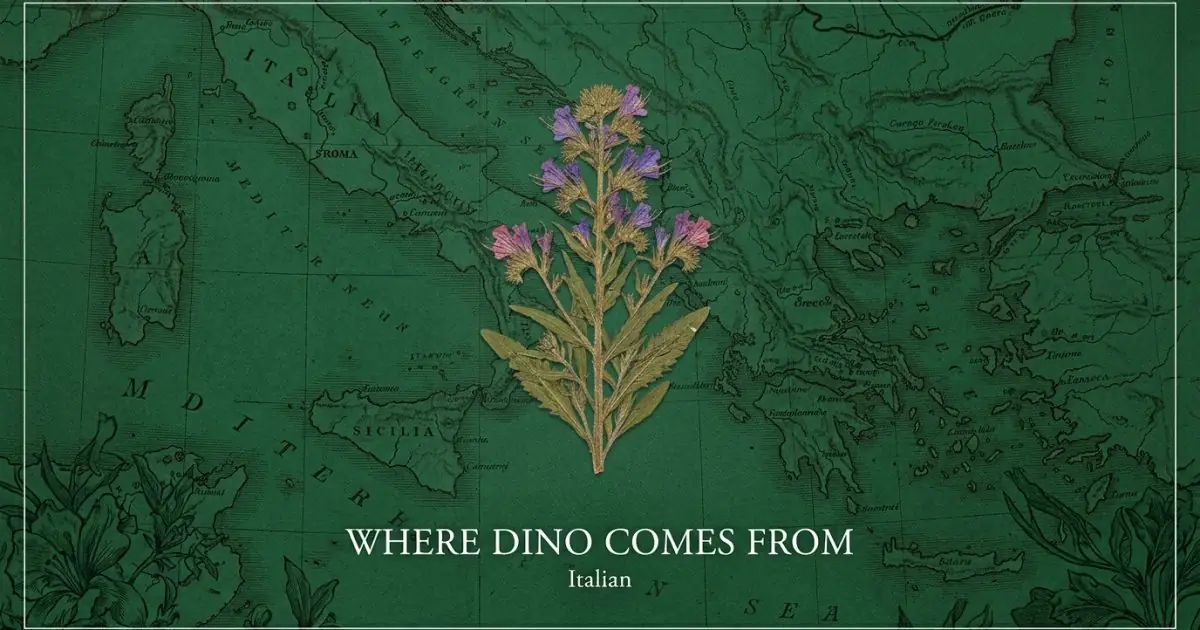
The Italian origin prevents “little sword” from feeling like an isolated English phrase turned directly into a modern name. Dino belongs to an established linguistic setting. Its spelling, pronunciation, and masculine use form a coherent whole.
The final -o is especially important. A name ending in a hard consonant might make the sword meaning feel sharper or more severe. Dino closes with a rounded vowel, giving the sound warmth and sociability. The name begins firmly but does not end abruptly.
This balance helps Dino move between formal and informal settings. It is short enough to feel familiar in a household, yet complete enough to stand alone on official documents. It does not require a longer legal form in order to feel substantial.
The origin also gives Dino a different style from recently invented four-letter names. Its compactness is not merely minimalist. It is connected to a recognizable Italian sound pattern, which gives the name cultural definition beyond its length.
Dino Makes a Weapon Meaning Feel Personal Rather Than Aggressive
Names connected with weapons can sometimes sound confrontational. Dino avoids much of that effect because the meaning is qualified by “little,” and the pronunciation is open and melodic. DEE-noh does not sound harsh, even though one of its meanings refers to a blade.
The name contains no dense consonant cluster, growling sound, or abrupt final stop. Its only two consonants, /d/ and /n/, are separated by long, clear vowels. This makes the spoken form gentler than the sword image might suggest.
The difference between meaning and sound gives the bearer useful freedom. People are unlikely to hear Dino and immediately assume a weapon reference. The definition remains beneath the surface, available when the name’s history is discussed but not imposed on every introduction.
This is different from a direct English word name that announces its object immediately. Dino functions first as a personal name. The “little sword” meaning adds depth after the fact.
Parents should still be comfortable with the literal definition. The name does not need to be softened through unsupported claims that the sword represents only protection, honor, or justice. Those may be private family associations, but the meaning itself remains direct. Dino is strong enough to carry that honesty.
Dino’s Sound Turns Strength into Approachability
Dino is pronounced DEE-noh and contains two syllables. Both the US form /ˈdiːnoʊ/ and the UK form /ˈdiːnəʊ/ place primary stress on the first syllable. The difference in notation at the end reflects ordinary accent conventions rather than two separate pronunciations.
The opening D gives Dino a clean foundation
The name begins with /d/, a voiced stop. The tongue briefly blocks the airflow before releasing it, giving Dino a clear and decisive opening. Because the consonant is voiced, the sound is firm without being sharp.
The /d/ moves directly into /iː/, the long vowel heard in see, green, and machine. This stressed vowel gives the first syllable brightness and length. “Dee” becomes the acoustic center of the name.
The middle N creates continuity
The /n/ is a nasal consonant, allowing the sound to continue rather than stopping the name abruptly. It forms a gentle bridge between the two vowels.
This contributes to Dino’s smoothness. The name does not contain a difficult consonant cluster or a point where the speaker must reset the mouth. It moves in one clean line: DEE-noh.
The final O gives Dino its warmth
In American English, the ending is represented by /oʊ/. In British English, it is written /əʊ/. Both produce the familiar rounded vowel at the end of words such as go.
The final vowel keeps Dino open and friendly. A consonant ending might make the short name feel clipped, but the -o allows it to resolve with ease. The sound carries masculine definition without becoming heavy.
Dino Sits Between a Formal Name and Nickname Energy
Dino has the warmth and immediacy often associated with nicknames, but it is complete as a given name. Its short length, repeated open vowels, and final -o make it feel conversational from the first use.
This quality can be an advantage for families who want a name that does not require shortening. Dino already sounds familiar when spoken by parents, teachers, or friends. The formal and affectionate versions can be the same.
At the same time, that informality may shape social perception. Some listeners may assume Dino is a short form of a longer name, even when it stands independently. Parents should be prepared for occasional questions about whether Dino is the complete legal name.
The answer can remain simple. Dino does not need expansion in order to age well. Its structure is no less complete than other short masculine names. Brevity is part of its identity rather than evidence that something is missing.
The full name also has professional range. Dino is easy to remember, pronounce, and write. It can appear naturally on a school register, business card, byline, or formal invitation without changing form.
Dino Belongs to a Family of Compact, Vowel-Rich Names
Dino may remind listeners of names such as Nico, Enzo, Milo, Leo, or Nino. These are style neighbors rather than claims of identical meaning or origin. They share a concise structure, open vowels, and endings that allow the name to finish warmly.
Within this broad style family, Dino feels particularly direct. The stressed “Dee” opening is clear, while the internal /n/ and final /oʊ/ keep the sound uncomplicated. It has less ornament than many longer Italian names and more softness than short names ending in hard consonants.
The resemblance to familiar compact names can help Dino feel accessible even when it is uncommon in current American use. Listeners understand its rhythm immediately. There is little uncertainty about where the syllables divide or which part receives the stress.
The name may also invite an association with the familiar shortened word for dinosaur in casual English. That association is not part of Dino’s supported origin or meaning, but some children and adults may notice it. Families should consider whether they find the connection playful, neutral, or distracting.
Because the pronunciation and spelling remain simple, such associations are unlikely to make the name difficult to use. They form part of the social environment around Dino rather than redefining its Italian origin and meanings.
Dino’s Masculine Identity Is Clear Without Feeling Severe
Dino’s primary gender usage is male. Its Italian form, firm opening consonant, and current American records all support that masculine identity. To compare tone, familiarity, and fit across similar names, explore strong boy names and meanings.
The meanings “little sword” and “strong” may also reinforce a traditionally masculine impression, though neither should be used to limit the bearer’s personality. Dino can suit someone gentle, artistic, thoughtful, sociable, scholarly, or reserved just as naturally as someone energetic or athletic.
The name’s masculinity comes through confidence rather than weight. DEE-noh is bright and open, not dark or heavily consonantal. This makes Dino useful for parents who want a clearly male name without choosing one that sounds aggressive.
Its age range is similarly broad. Dino can feel affectionate on a baby because of its open vowels, energetic on a child, and concise on an adult. It does not depend on a juvenile suffix that must later be abandoned.
The complete form allows the bearer to keep one stable identity across settings. A nickname may still develop, but it is not necessary to make Dino approachable.
Dino’s 2024 Ranking Preserves Recognition Without Repetition
Official Social Security Administration (SSA) data places Dino at No. 2712 for boys in 2024. This confirms that the name remains in active contemporary use while sitting far beyond the most frequently chosen boys’ names.
A single annual ranking cannot show whether Dino is rising, falling, or remaining stable. It does reveal the current level of use. A Dino may be the only child with the name in a class or neighborhood, but the name is established enough to appear in official national records.
The rarity is practical rather than difficult. Dino does not require an unusual spelling, a complex stress pattern, or an unfamiliar sound. Most English speakers can repeat it correctly after hearing it once.
This gives parents a useful combination: individuality without linguistic friction. The name stands apart because relatively few families choose it, not because it is challenging to understand.
Its Italian identity also remains visible despite the low ranking. Dino does not feel like a random modern invention. The form has cultural coherence, allowing it to sound familiar even when local use is limited.
Dino Creates a Friendly First Impression Before Its Meaning Is Known
Most people will hear Dino before learning that it means “little sword; strong.” The first social impression therefore comes from sound: short, warm, lively, and approachable.
The long opening vowel makes the name easy to catch in conversation, while the final -o gives it an outgoing quality. Dino may feel more informal than ceremonial, but it does not sound unfinished.
The meaning adds an unexpected second layer. Someone who hears only the name may not predict a blade image or an explicit connection to strength. This gap between sound and meaning gives Dino depth without making everyday introductions feel heavy.
Socially, the name may be perceived as Mediterranean, energetic, vintage, or friendly. These are impressions rather than fixed facts, and they will vary by community. Over time, the bearer’s own character will become more important than any initial style category.
Dino is memorable partly because it avoids excess. It is not visually elaborate, phonetically difficult, or semantically vague. The name arrives quickly and stays in the ear.
Three Ways to Carry Dino Beyond Its Meaning
The meanings provide Dino’s central story, but the complete identity of the name will also depend on its pairing, informal use, and everyday pronunciation.
Middle names for Dino can add ceremony or family depth
A longer traditional middle can balance Dino’s compact form, while an inherited name can connect its Italian identity to a specific family history. The strongest pairing will also consider the transition from the final o into the surname. If you want the full pairing logic behind that contrast, see middle names for Dino.
Nicknames for Dino can become private signs of affection
Dee, D, Di, and playful family forms can create additional intimacy, though Dino is already short enough to use comfortably in full. A nickname is likely to reflect relationship rather than practical necessity. To see how those different moods shorten in real life, explore Dino nicknames.
Pronouncing Dino correctly begins with the long first vowel
The intended form is DEE-noh. The first syllable carries the stress, and the final vowel remains rounded in both American and British English. For the detailed stress pattern, accent notes, and IPA, see Dino pronunciation guide.
Dino Proves That a Small Name Can Carry a Full Measure of Strength
Dino begins with an image of concentration: a little sword, compact but carefully formed. Its second meaning, “strong,” expands that image into a broader idea of capability. Together, the meanings create a name that does not confuse size with importance.
The Italian origin gives Dino cultural shape, while the pronunciation gives it warmth. The firm /d/ opening, long stressed vowel, gentle /n/, and rounded final o turn a potentially severe meaning into an approachable human name.
Official 2024 data places Dino outside the mainstream but securely within contemporary use. It offers rarity without complexity, masculine identity without heaviness, and historical depth without an elaborate form.
Most importantly, Dino does not ask the bearer to display strength in only one way. A small blade is defined not by spectacle but by proportion, balance, and purpose. In time, the name’s deepest meaning will come from the individual who carries it—someone who gives four letters a history, two syllables a voice, and the word “strong” a personal definition that no naming record could write in advance.