
Damien Name Meaning: Its Background, Symbolism, and Enduring Tone
Some names enter a room with warmth. Some arrive with elegance. Damien does something rarer: it arrives with control. That is the central tension inside the name, and it is what makes it more interesting than many first impressions allow. Its meaning, “to tame,” could sound harsh if read too quickly, as if the name belonged only to force or suppression. But historically, names built from verbs of restraint often survive because human beings admire discipline more than domination. They admire the person who can govern impulse, steady fear, or hold power without spilling it everywhere. In that reading, Damien is not a name about crushing. It is a name about command.
That deeper reading matters because Damien has lived several public lives at once. It has old religious roots, a French surface, and a modern pop-cultural shadow strong enough to alter how some people hear it. Yet the name has not disappeared into that shadow. It continues to circulate because its sound is beautiful, its structure is memorable, and its underlying idea is stronger than the stereotype attached to it. Damien is one of those names that proves a hard truth about naming: a good name can survive misunderstanding if its shape, history, and emotional intelligence are resilient enough. This one is.
Damien's U.S. popularity rank over time, 1936–2024
Popularity statistics are based on official data from the Social Security Administration baby name records.
Damien: A Sophisticated and Lyrical Greek Pillar
Damien functions as a name with one unmistakable center of gravity, reaching a significant peak for boys in 2013. Its modern profile suggests its momentum fits a broader taste for multi-syllabic names that carry a sense of “taming” grace and international polish.
The absence of crossover usage helps the name maintain a singular public identity. Meaning “to tame,” its rhythmic three-syllable sound gives it an elegant texture that remains distinctive in the modern era.
Where Damien Comes into Focus
| Key Facts | Information | Quick Insight |
|---|---|---|
| Name | Damien | The spelling gives the name a softer, more continental finish than some of its close variants, which helps explain its enduring stylistic appeal. |
| Primary meaning | to tame | This is a stronger and more psychologically rich meaning than it first appears, suggesting self-command, discipline, and moral control rather than brute force. |
| Primary origin | French | The French form lends the name polish and refinement, even though its deeper linguistic roots run older than modern French usage. |
| Pronunciation | DAY-mee-un | The three-syllable flow gives Damien a smooth, articulate sound, helping it feel expressive without becoming ornate. |
| IPA (U.S./U.K.) | /ˈdeɪmiən/ | The pronunciation is straightforward in English, which makes the name easier to carry than many visually elegant names with less stable sound patterns. |
| Syllable count | 3 | Three syllables give Damien enough musicality to sound distinctive, while still keeping it compact enough for everyday use. |
| Primary gender usage | Male | The name reads clearly masculine in current use, but its vowel-rich sound keeps it from feeling hard-edged or overly severe. |
| Latest U.S. year | 2024 | The name remains current in American use rather than merely historical or nostalgic. |
| U.S. boys’ rank (2024) | No. 344 | This placement suggests recognition without oversaturation: familiar enough to feel established, uncommon enough to retain personality. |
Damien Means Restraint, Not Weakness
The verb inside Damien is about mastery
The meaning of Damien becomes much more compelling once “to tame” is heard in its older human sense. Historically, verbs of taming and subduing were not only used for animals or enemies. They belonged to a broader moral vocabulary about order, training, self-command, and bringing raw energy into form. That older frame suits Damien better than any simplistic modern gloss. Read this way, the name suggests someone capable of handling intensity, not someone afraid of it. The power of Damien lies in the fact that it does not imagine strength as noise. It imagines strength as management.
That gives the name a seriousness many fashionable names lack. A great number of modern boy names sell an image of boldness through speed, aggression, or sharpness. Damien does something more subtle. It sounds composed. Even its meaning encourages an inward kind of authority, the kind that disciplines before it performs. Parents who choose names with reflective depth often respond to exactly this quality. They are not simply naming for edge or softness. They are naming for moral texture.
There is also something durable about a name whose meaning points toward self-restraint. Meanings tied to surface traits can age badly; meanings tied to inner discipline usually grow more useful with time. A toddler does not “embody” the name the way an adult might, but a person can grow into Damien. That is one of the most important distinctions in naming. Some names flatter infancy. Some accompany character. Damien belongs to the second group.
Why the meaning ages better than people expect
It is worth noticing how much the emotional tone of Damien depends on interpretation. If “to tame” is read narrowly, the name can sound austere. If it is read as the act of bringing force under wise control, the name becomes almost philosophical. It begins to suggest cultivation rather than suppression. A wild impulse becomes judgment. A dramatic temperament becomes poise. A difficult world requires not less energy, but better-governed energy. Damien carries that kind of adulthood inside it.
This is also why the name resists becoming flimsy even when trends change. It has an argument inside it. It says that dignity is not the absence of passion but the ordering of passion. In a naming culture often drawn to names that merely sound cool, Damien offers a more enduring proposition: controlled force is more impressive than uncontrolled display.
How Damien Moved from Greek Root to French Name
From older roots to a French surface
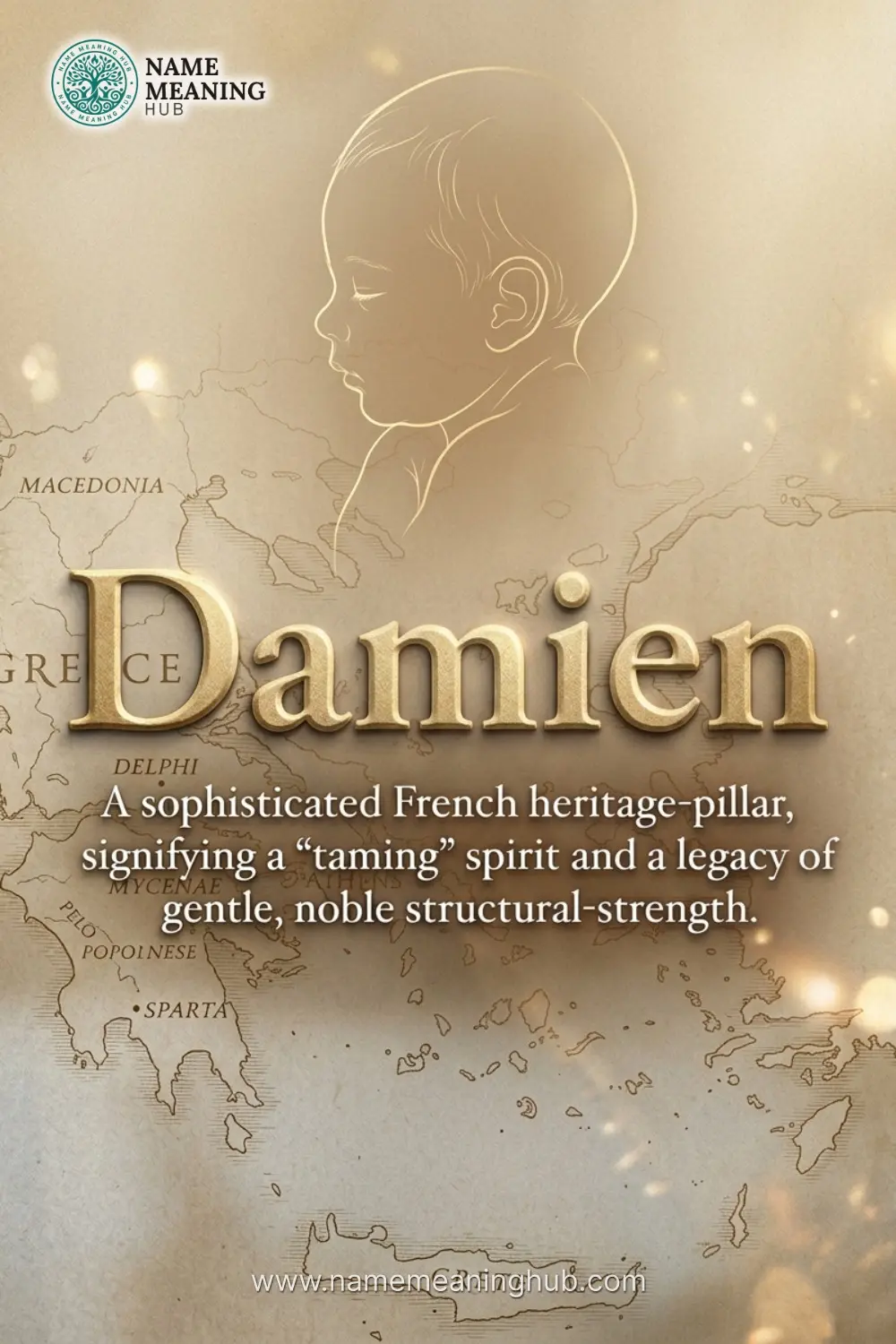
As used today, Damien is a French form, and that matters because the French spelling changes the emotional presentation of the name. But behind that refined surface stands an older linguistic history. The broader name family traces back through Damian to the Greek form Damianos, itself connected to a root meaning “to tame” or “to subdue.” This layered structure is one reason Damien feels both polished and old. Its primary social identity may be French, but the name does not begin there. It arrives in French already carrying ancient weight. To keep exploring names from the same background, see explore French names.

That journey from older Greek root to later French form is part of what gives Damien its unusual combination of elegance and depth. A purely French modern invention would not feel the same. A purely ancient classical form would not move through contemporary life in the same way. Damien sits between those worlds. It keeps the historical backbone while presenting it in a smoother, more stylish envelope.
The spelling matters more than many people realize. Compare Damien with Damian and the difference is not only visual. Damien tends to feel more fluid, more continental, and in English often slightly more expressive. Damian is firmer, more direct, and perhaps more austere. These are subtle differences, but naming is full of such subtleties. A single vowel or ending can alter the social temperature of a name. In this case, the French form gives the name more atmosphere.
The saints who kept the name alive
The survival of the name family owes a great deal to Christian history. The most important early figure here is Saint Damian, remembered alongside his twin brother Cosmas. Historically, the two were early Christian martyrs and became especially associated with healing and medicine. That reputation matters because names attached to saints do not merely remain preserved in texts; they are repeated in liturgy, calendars, art, and family custom. They stay alive because they continue to be spoken.
This is a major reason the deeper Damian/Damien line endured across Europe. Without that religious continuity, the name might have remained a historical curiosity. Instead it entered Christian naming culture and moved through multiple languages, acquiring local forms along the way. Damien therefore belongs to a familiar European pattern: an ancient-rooted name kept in circulation by religious memory, later adapted into national styles.
That history also helps explain a subtle contrast inside the name’s public image. Beneath the modern edge many people hear in Damien lies an unexpectedly charitable old association. One of the central historical carriers of the name was a healer. That does not erase the darker pop-cultural associations the name later acquired, but it does complicate them. Damien is not historically a sinister name. It is a name whose older inheritance is more generous, disciplined, and service-linked than many casual listeners assume.
Damien Had to Survive Its Own Shadow
The modern imagination and the burden of one film
No honest reading of Damien can ignore the cultural shadow cast by The Omen. The 1976 film fixed the name in the popular imagination in a way that few names ever experience. For many people, Damien became not simply a boy’s name but a symbol, shorthand for ominous beauty, danger beneath innocence, and the unsettling power of a child who seems too composed. That shadow is real, and pretending otherwise would make any serious name analysis feel incomplete.
What is interesting, though, is not that the association exists, but that the name survived it. Many names burdened by a single overwhelming cultural image become difficult to use in ordinary family life. Damien did not vanish. It remained usable because the name itself is too well-built to collapse into one reference point. Its sound is attractive. Its history is older than the film. Its French styling gives it elegance. Its meaning offers depth. All of that gave it the resilience to keep circulating even after a powerful cultural interruption.
In other words, Damien is a rare case of a name that absorbed a dark association without being fully captured by it. That makes it more complex than simpler “good reputation” names, but also more memorable. Complexity is not always a liability in naming. Sometimes it is what gives a name drama, gravity, and literary staying power.
Why the name stayed usable anyway
The answer lies partly in sound. Damien is simply a beautiful name to say. The opening Day is bright and open, while the ending softens into a more reflective finish. The result is a name that sounds articulate rather than harsh. A darker name with a blunt sound might have been permanently damaged by its strongest fictional association. Damien was protected by its music.
It also survived because modern naming culture often separates fictional association from everyday usability more easily than people expect. Parents are capable of hearing beyond a reference if the name offers enough elsewhere. In Damien’s case, it offers history, elegance, recognizability, and enough distance from the peak of the original cultural moment that the association now functions more as a footnote than a veto for many families.
There is even an argument that the name’s survival has made it stronger. Because it passed through that shadow and remained in use, Damien now carries a kind of tested durability. It has edge, but not cheap edge. It has history, but not stiffness. It has danger in its reputation and control in its meaning. Few names combine those layers without falling apart.
Why Damien Still Sounds Current
The French spelling changes the temperature
Part of Damien’s continued appeal comes from style. The French spelling gives the name a smoother visual and auditory profile than some close neighbors. It belongs in the same broad atmosphere as names like Julian, Adrian, Lucien, and Sebastian: masculine names with vowels, cadence, and a slightly cultivated finish. Damien, however, has more tension than those names. It is less airy than Julian, less saintly-soft than Adrian, and less overtly ornamental than Sebastian. It sounds controlled, and that returns us to its meaning.
This is why the name feels current without sounding especially trend-driven. It shares enough with modern preferences to remain attractive—three syllables, liquid sound, continental polish—but it is not reducible to a passing fashion. It has a proper backbone. Parents who want a name that sounds intelligent and emotionally layered often hear that immediately.
A familiar name that still keeps some distance
Official Social Security Administration (SSA) data places Damien at rank 344 for boys in the United States in 2024. That is a useful position for understanding its social life. The name is clearly known. Most people will not misread it. It does not sound obscure, invented, or socially risky. Yet it also remains outside the most crowded band of overused boys’ names. That helps Damien preserve some individuality. For more options with a similar overall profile, see familiar and rare boy names.
This middle range often produces the most satisfying name experience in practice. A child named Damien is unlikely to spend his life explaining the name, but he is also unlikely to be one of many in every room. That balance suits the personality of the name itself. Damien does not want to disappear, but it also does not need to shout.
Modern parents often want exactly that balance: a name with cultural literacy and stylistic identity, but not one flattened by popularity. Damien delivers it unusually well. Its current rank suggests that people still find it compelling, but not so commonplace that it loses mystery.
Where Damien Leads Next
Middle names that steady Damien
Damien usually pairs best with middle names that either ground its drama or extend its refinement. A classic one-syllable or historically solid middle can make the full name feel more anchored, while a lyrical middle can lean into the continental quality already present in the first name. Because Damien already carries personality, the middle name often works best when it offers structure rather than competition. If you want the full pairing logic behind that contrast, see middle names for Damien.
Nicknames that soften or sharpen Damien
The nickname world around Damien is revealing because the full name is already expressive. Short forms can make it warmer, more casual, or more athletic, but they rarely erase the sophistication of the original. That means the nickname question is less about necessity and more about relationship: what part of Damien a family or friend group wants to bring to the surface. To see how those different moods shorten in real life, explore nicknames for Damien.
Pronunciation and the music of DAY-mee-un
The sound of Damien is one of its great strengths. The opening syllable gives brightness, the middle softens the movement, and the ending lets the name close without abruptness. It is a controlled name acoustically as well as semantically. That harmony between meaning and sound is part of why Damien feels so complete when spoken aloud. If you want the full sound pattern behind that rhythm, read how to pronounce Damien.
What Damien Finally Says About Strength
In the end, Damien is a name about force under governance. That is its oldest promise and its most modern appeal. It is not the name of chaos, no matter how culture sometimes dramatized it. Nor is it the name of passive gentleness. It lives in the more difficult middle space where energy becomes discipline and charisma becomes control. That is why the meaning “to tame” deserves to be read with more respect than it often receives. Taming, in the most human sense, is what civilization asks of appetite, fear, anger, talent, ambition, and even grief. It is the work of form.
That makes Damien unusually literary as a name. It contains conflict, but not confusion. It contains polish, but not emptiness. It contains an old saintly inheritance, a French elegance, a darker modern shadow, and a meaning that outlasts them all. The person called Damien may never know every layer of that history, but he will still carry its shape: composed, memorable, and quietly charged.
Few names manage to sound as if they know themselves. Damien does. It knows that discipline is more lasting than spectacle, that beauty can survive distortion, and that strength is most convincing when it has learned restraint. That is why Damien remains not just usable, but compelling.