Best Middle Names for Daisy: Easy Matches for a Stronger Full Name
A middle name is the quiet room inside a full name. It does not usually carry the everyday labor of introductions, attendance sheets, and shouted calls across a playground. Instead, it works behind the scenes. It steadies the first name, changes its temperature, and gives the child a second register of identity to grow into. Parents often discover this instinctively. They may choose a first name because it feels vivid and alive, then choose a middle name because they want ballast, inheritance, softness, restraint, or a private family note that will not have to perform in public all day. In that sense, a middle name is not filler. It is the architectural beam that can make the whole structure feel finished.
Daisy especially benefits from that second layer because it is already such a complete first name. It is bright, clear, and emotionally legible in a split second. Official data shows Daisy remains a familiar modern choice in the United States, which means many parents are not trying to make it more usable so much as more dimensional. The right middle name can make Daisy feel crisp and classic, romantic and literary, grounded and capable, or airy and vintage. The wrong one can tip it too far toward sing-song sweetness. That is why choosing a middle for Daisy is really an exercise in social design: you are deciding whether the full name should sound brisk, elegant, rooted, playful, or quietly formal once it is spoken in one breath. Pairing is practical, but it still rests on the first name’s deeper frame, so the best place to begin is Daisy meaning.
How Daisy Changes When the Second Name Enters the Room
| Style | Recommended Names | Why it works with Daisy |
|---|---|---|
| Crisp classic | Jane, Claire, Ruth, Grace | These names keep the full combination clean and poised. They give Daisy a firmer landing and prevent the overall sound from drifting into nursery sweetness. |
| Vintage elegance | Eleanor, Josephine, Catherine, Louise | Longer, established middles widen Daisy into something more adult and enduring. The contrast makes the first name feel brighter rather than lighter. |
| Soft literary | Eloise, Matilda, Beatrice, Juliet | These pairings preserve Daisy’s charm but add intelligence and texture, which works well for parents who want warmth without plainness. |
| Modern tailored | Morgan, Quinn, Blair, Sutton | A sharper middle name gives Daisy contemporary edges and can balance a surname that already sounds traditional or ornate. |
| Family-honor style | Margaret, Anne, Elizabeth, Marie | Daisy can carry a heritage middle beautifully because its everyday brightness leaves room for something weightier and more ancestral in the center. |
Daisy Needs a Middle Name That Grounds Its Brightness
Why Daisy rarely needs more sweetness
Daisy already brings color to the combination. It is vivid, approachable, and visually easy to picture. Because of that, the best middle names for Daisy often do not try to compete with its charm. They answer it. A name like Daisy Grace works because Grace is calm and almost architectural; Daisy Claire works because Claire is clear, cool, and compact. Even Daisy Jane, one of the simplest combinations, succeeds because Jane introduces plainspoken steadiness. The first name smiles; the middle name straightens its posture.
This is the central pairing principle for Daisy: let the middle do the grounding work. Parents sometimes assume a bright first name needs an equally whimsical partner, but Daisy usually sounds stronger when the second name adds gravity, lineage, or restraint. That can mean a classic one-syllable middle, a longer formal name, or a family honor name with historical weight.
Why the full rhythm matters more than the individual parts
Because Daisy has two syllables and ends in a bright -ee sound, rhythm matters immediately. The ear tends to prefer a middle that either ends more firmly or opens into a longer, more stately cadence. Daisy Ruth, Daisy Claire, and Daisy Jane all work because they close decisively. Daisy Eleanor and Daisy Josephine work for the opposite reason: they extend the music rather than echo it. Both strategies are effective because they create contrast.
Where pairings start to wobble is when the middle repeats too much of Daisy’s own energy. Another bouncy two-syllable name ending in -ee or -y can make the full name feel juvenile or overdecorated. Daisy Lily, Daisy Ellie, and Daisy Poppy are not unusable, but they lean hard into one narrow mood. Unless that is the exact effect you want, contrast will usually serve Daisy better than repetition.
Daisy and One-Syllable Middles Make a Calm, Confident Full Name
The short middle as a stabilizer
One-syllable middles are often the cleanest answer for Daisy because they let the first name keep its natural brightness while giving it a crisp finish. Daisy Jane feels timeless and unfussy. Daisy Claire has polish and air. Daisy Ruth carries quiet seriousness. Daisy Grace remains popular for a reason: it sounds balanced, familiar, and easy to imagine at every age.
These combinations also perform well in real life. They are easy to say aloud, easy to monogram, and easy to pair with many surnames. If the surname is long, multi-syllabic, or double-barrelled, a short middle is usually the safest and smartest choice. It prevents the full name from sounding overpacked.
Full-name combinations that sound especially strong
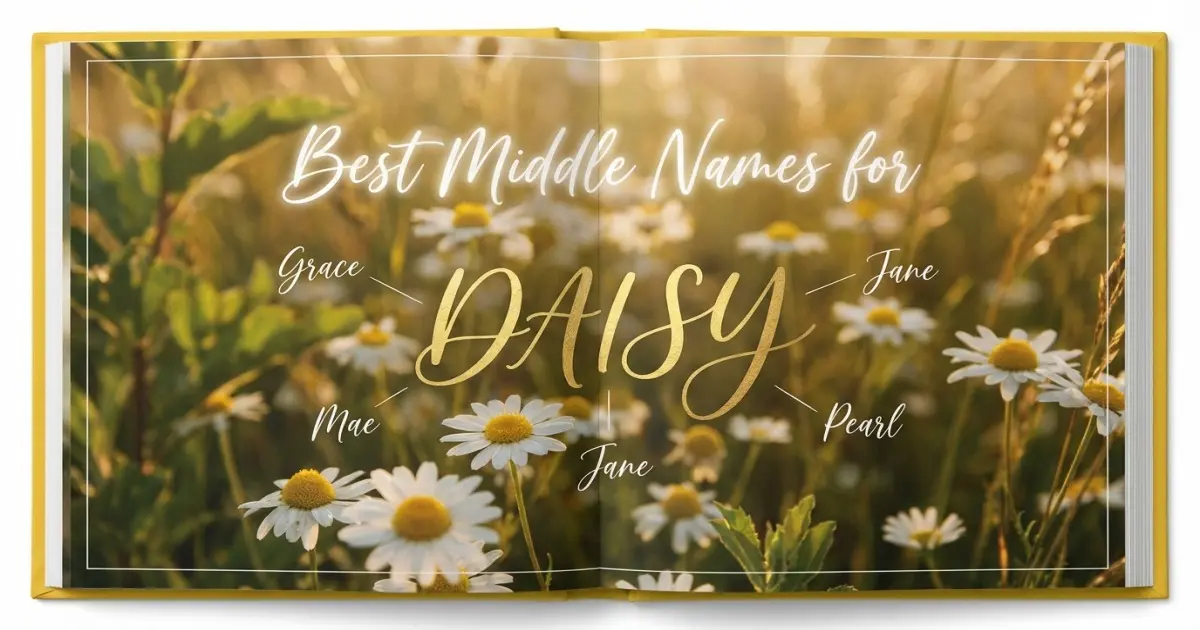
Daisy Jane works for parents who want a name that feels traditional without becoming formal. Daisy Claire sounds a touch more polished and modern. Daisy Ruth gives the first name moral gravity and a quieter, older center. Daisy Grace is soft but orderly, especially good if the surname is more angular or consonant-heavy. Daisy Pearl introduces vintage texture and feels particularly strong with plain surnames. Pairing is not just visual; it is rhythmic, and the next useful step is how to pronounce Daisy.
The advantage of this category is precision. None of these middles tries to outshine Daisy. They simply frame it well.
Longer Middle Names Let Daisy Grow Up Without Losing Its Personality
Formal middles that give Daisy stature
Some parents love Daisy but worry that it may sound too light on official documents, in professional life, or beside a serious surname. A longer middle name is often the best answer. Daisy Eleanor feels literary and composed. Daisy Josephine sounds generous and grown-up. Daisy Catherine has classic spine. Daisy Louise is graceful without being elaborate. Daisy Margaret introduces inheritance and depth, and for parents who know the old nickname links around Margaret, it can create an especially layered pairing.
What these middles do is not erase Daisy’s charm but frame it inside something more durable. The full name gains options. On paper it sounds substantial; in daily life it still feels bright and easy.
Names that add texture without becoming fussy
Daisy Matilda, Daisy Beatrice, Daisy Juliet, and Daisy Eloise all work because they give the name a second note that is intelligent rather than merely decorative. They are useful choices for parents who want warmth but not plainness. Daisy Matilda, for example, has a lovely contrast between playfulness and bookish strength. Daisy Beatrice feels vintage and articulate. Daisy Juliet is romantic, though slightly softer and more lyrical. Daisy Eloise has flow, but enough structure to avoid sounding overly cute.
This is often the most satisfying category for Daisy because it lets the first name remain emotionally open while the middle carries some of the family’s aspirational tone.
Daisy Can Also Take a Sharper Middle if the Surname Is Soft
Not every Daisy needs a purely classic or antique partner. If the surname is already soft, flowing, or distinctly traditional, a more tailored middle can prevent the full name from sounding too pastel. Daisy Quinn, Daisy Blair, Daisy Morgan, and Daisy Sutton all pull the name slightly forward. The effect is contemporary rather than whimsical.
This kind of pairing is especially useful when parents want Daisy to feel less cottage-garden and more current. The contrast works because Daisy is familiar enough to absorb a sharper center without losing itself. That said, this strategy depends heavily on the surname. A clipped middle beside a clipped surname can make the full name feel overly abrupt. It works best when there is something softer after it to reopen the sound.
What to Check Before You Settle on a Daisy Combination
- Watch the initials. Middle names often appear most visibly in initials, school forms, and signatures, so make sure the full set does not create an awkward abbreviation.
- Say it with the surname, not just on its own. Daisy pairs beautifully in theory with many names, but the surname decides whether the combination sounds elegant, rushed, or overly sweet.
- Avoid too many botanical signals unless that is intentional. Daisy Rose can work, but it creates a very overt floral theme. Some families will love that; others will find it limiting.
- Be careful with repeated endings. Middles ending in -y, -ie, or another breezy two-syllable pattern can make Daisy sound sing-song unless the surname is strong enough to absorb it.
- Think about family harmony. Research suggests names feel more convincing when they sound like they belong in the same household register, even if they are not matched by theme or initial.
The Best Daisy Middle Name Depends on What You Want Daisy to Become
If you want Daisy to sound timeless, choose a short classic such as Jane, Claire, or Ruth. If you want it to feel more expansive and adult, turn toward Eleanor, Josephine, Catherine, or Louise. If you want a little literary warmth, names like Matilda, Beatrice, or Eloise offer a beautiful counterweight. And if you want to give Daisy a more tailored modern outline, Quinn or Blair can do that work.
The important thing is not whether the middle name is trendy, formal, inherited, or unexpected in isolation. It is whether it changes Daisy in the right direction. A good middle name does not merely “go with” Daisy. It reveals which version of Daisy you most want to hear: the poised Daisy, the romantic Daisy, the grounded Daisy, the modern Daisy, or the family-rooted Daisy. Once you know that, the shortlist becomes much clearer.
Common Questions About Matching Middle Names with Daisy
Does Daisy need a formal middle name to age well?
Are floral middle names too much with Daisy?