
Dahlia Name Meaning: A Deeper Look at Its Meaning and Roots

In Official Social Security Administration (SSA) data for 2024, Dahlia stands at No. 240 for girls. That is a useful place to begin, because it tells you almost everything about the name’s current social position without turning the page into a chart lesson. Dahlia is known, but not overhandled. Most people will recognize it on sight. Most will also feel that someone chose it on purpose. It is not a default name, not a family-hand-me-down that drifted into another generation, and not a novelty invention asking to be explained. It belongs to that narrower category of names that feel edited: familiar enough to move easily through school, work, and introductions, but selective enough to leave an impression of taste.
That balance becomes even more interesting when you look at what the name actually means. Dahlia does not offer the direct emotional instruction of a virtue name, nor the overt grandeur of a title-name, nor the biblical weight of a long-inherited classic. Its meaning, “Dahl’s flower,” is both specific and restrained. It is floral, but not flimsy. It is beautiful, but not vague. Even its sound helps it hold that line. DAL-yuh opens with a firm, grounded first syllable and then relaxes into something softer. The effect is one of poise rather than prettiness alone. That is why Dahlia often appeals to parents who want a floral name without choosing one that feels either too antique or too sugary. It carries bloom, but it also carries structure.
Dahlia's U.S. popularity rank over time, 1890–2024
Popularity statistics are based on official data from the Social Security Administration baby name records.
Dahlia: A Sophisticated and Singular Floral
Dahlia functions as a name with one unmistakable center of gravity, where its visibility is concentrated entirely in its primary lane. Reaching a record peak in 2024, its rise often reflects a preference for “vintage revivals” that feel grand and nature-inspired .
The lack of a secondary track reinforces its strong default feminine identity. Named after a Swedish botanist and meaning “Dahl’s flower,” its simple two-syllable structure carries a sense of character and refined charm.
Dahlia arrives with recognition, not overexposure
Before Dahlia becomes an aesthetic choice, it works as a practical one. Modern naming guides consistently treat floral names as part of a broader nature-name current, and that matters here. Nature names often succeed when they are vivid enough to be memorable but established enough not to feel improvised. Dahlia fits that lane especially well. It shares the immediate recognizability of names such as Rose, Daisy, Violet, and Camellia, but it does not behave exactly like any of them. Rose can read timeless and compressed. Daisy can feel bright and informal. Violet often carries a more vintage-literary edge. Dahlia lands somewhere else: more sculpted than Daisy, less inherited than Rose, less overtly retro than Violet.
| Key Facts | Information | Quick Insight |
|---|---|---|
| Name | Dahlia | The name feels visually complete and emotionally legible at first glance, which is one reason it travels well across age groups. |
| Primary gender usage | Female | Dahlia sits comfortably in a contemporary girls’ naming space without sounding flimsy or trend-chasing. |
| Primary origin | Swedish | The origin gives Dahlia a clean European backbone, which helps keep the name refined rather than decorative. |
| Primary meaning | Dahl’s flower | This is a floral meaning with unusual specificity, giving the name definition and shape instead of generic sweetness. |
| Pronunciation | DAL-yuh | The strong opening syllable gives the name weight; the softer ending prevents that weight from becoming severity. |
| IPA (US / UK) | /ˈdæljə/ / /ˈdɑːliə/ | The slight accent shift changes color more than identity. In both forms, the name stays elegant and recognizable. |
| Syllable count | 2 | Two syllables make Dahlia feel efficient in daily life, even though the spelling still looks lush and expressive. |
| U.S. girls’ rank (2024) | No. 240 | That rank suggests visibility without crowding: current enough to feel modern, rare enough to feel chosen. |
What Dahlia says before anyone meets the child
A floral meaning with more backbone than softness
Some names tell the listener exactly how to feel. Grace, Faith, Joy, and Hope arrive already carrying a moral or emotional instruction. Dahlia works differently. Its appeal is not that it tells a story outright, but that it frames an atmosphere. Because the name belongs to a flower, people instinctively register beauty, cultivation, and natural form. Yet because the meaning is not simply “flower” but “Dahl’s flower,” the name has a slight intellectual distance to it. That distance is useful. It prevents the name from dissolving into sentiment.
This is one reason Dahlia can feel surprisingly strong in adult life. Many floral names are beloved in theory but become difficult for some parents when they picture a résumé, a byline, a physician’s badge, or a courtroom introduction. Dahlia tends to pass that test better than expected. The opening consonant is decisive. The written form has symmetry and weight. And the meaning, while botanical, is not vague. The name feels cultivated rather than merely cute.
Why Dahlia often attracts deliberate parents
Names like Dahlia are usually chosen by people who enjoy precision. They do not want the emotional flatness of a purely fashionable choice, but they also do not want a name so obscure that it requires lifelong explanation. Dahlia offers a middle path. It has the literary polish people often want from more elaborate girls’ names, yet it remains pronounceable, spellable, and socially familiar. It sounds like a name someone arrived at after comparison, not because it was the only name available but because it survived the shortlist. If this is the kind of name you are drawn to, you can explore more in girl names and meanings.
That distinction matters in how the name is received. A good given name does not merely decorate a child; it helps create first assumptions. Dahlia often suggests that the family values style, but not showiness. It sounds thoughtful, but not severe. It is feminine without being fragile. In a naming climate where many parents are trying to balance individuality with usability, that combination gives Dahlia unusual staying power.
How Dahlia moved from flower-word to given name
A surname quietly hidden inside the bloom
The most revealing thing about Dahlia may be the fact that its meaning contains a surname. “Dahl’s flower” is not the same kind of meaning as Lily, Rose, or Violet. Those names feel immediate because the plant and the given name are nearly identical in public imagination. Dahlia is a little more layered. Even when most people do not stop to analyze it, the name carries the impression of something named, shaped, and passed through culture before it reached the nursery. That layered quality is part of its refinement.
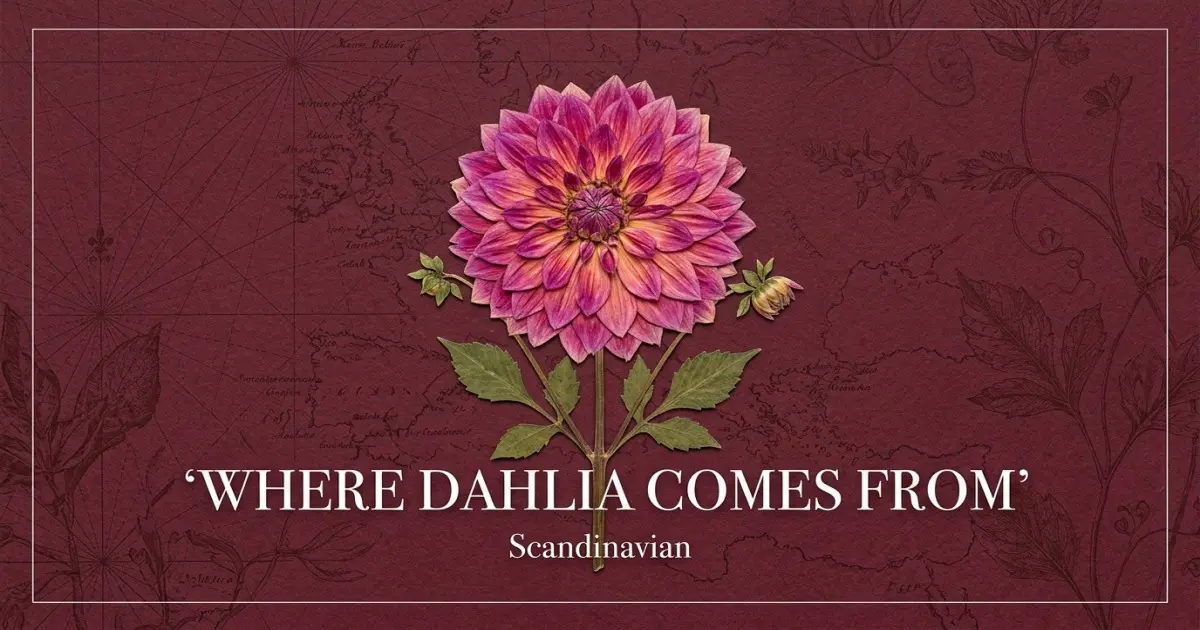
It also explains why Dahlia never sounds entirely rustic, even though it is botanical. The name belongs to the natural world, but it arrives filtered through language, classification, and memory. In that sense, Dahlia is less like a field-flower name and more like a garden name: selected, tended, intentional. That is a subtle distinction, but it affects how the name lives in the ear. It feels arranged rather than accidental.
Dahlia’s floral identity is vivid, but not overly symbolic
Because this page is not about symbolic folklore, it is worth saying plainly that Dahlia does not need a cargo of borrowed meanings to justify itself. The name already has enough shape. Historically, the flower itself is associated with strong visual presence, and modern baby-name guides place Dahlia alongside other recognizable flower names in the wider nature-name revival. That is the useful cultural fact here: Dahlia belongs to a naming stream people immediately understand, but it is not one of the most overused representatives of that stream.
The bloom’s association with Mexico adds another layer of reality. In naming terms, that matters because it keeps Dahlia from feeling abstract. It is not a made-up floral effect. It names a real flower with real cultural presence. Yet as a given name it still feels more tailored than blunt flower-word choices such as Petal or Peony. That tension—real bloom, refined delivery—is where much of the name’s charm lives.
Historically, modern naming books have also framed recent baby naming as increasingly open to nature, place, color, and culture-crossing inspiration. Dahlia belongs comfortably within that modern openness. It benefits from the broader acceptance of distinctive names, but it does not depend on shock value. That is an important difference. Some names require a trend to survive. Dahlia merely benefits from one.
Dahlia in classrooms, signatures, and introductions
The sound profile gives Dahlia unusual range
Phonetically, Dahlia is an excellent example of a name whose softness is disciplined by its structure. The first syllable, Dal, is compact and anchored. It keeps the name from floating away. The second part, -ia or the softer spoken -yuh, adds glide and openness. This balance is what makes Dahlia work on both a child and an adult. Many names either stay clipped and efficient or become airy and ornamental. Dahlia manages to do both things at once.
That matters in everyday life more than parents often realize. Names are heard far more often than they are analyzed. On a playground, in a meeting, in a doctor’s waiting room, in a graduation ceremony, the name has to land cleanly. Dahlia usually does. It is also helped by its spelling. Although the letter pattern is distinctive, it is not cryptic. Most readers can get close to the intended pronunciation on the first attempt, and the name is established enough that many will get it exactly right. In a culture increasingly comfortable with a wide range of names, Dahlia benefits from being distinctive without being difficult.
Popularity helps Dahlia stay special without becoming strange
Official SSA data placing Dahlia at No. 240 for girls in 2024 tells a useful social story. The name is not obscure. It is also not saturated. That means a girl named Dahlia is likely to move through life without constantly spelling or defending her name, while still retaining the pleasure of not sharing it with multiple classmates every year. This is one of the healthiest popularity zones a name can occupy. It gives a family evidence that the name works in the real world, without flattening its individuality.
There is another benefit to this middle-rank position: it protects the name from looking opportunistic. Very high-ranking names can sometimes feel adopted under the pressure of the current wave, while extremely rare names can raise questions about whether the parents prioritized distinctiveness over ease. Dahlia escapes both traps. It looks intentional, not trendy; confident, not obscure.
That is also why Dahlia tends to age well. It does not belong only to infancy. The sound is graceful enough for childhood, serious enough for professional adulthood, and warm enough to remain personable. If you test it in different scenes—a preschool cubby, a school register, a conference badge, a wedding invitation—the name remains itself. It does not need to become something else later to keep functioning.
Dahlia asks for thought, not anxiety
Good naming advice often comes down to a few grounded questions: Does the name work with the surname? Are the initials harmless? Is the most likely nickname acceptable? Does the name invite awkward rhymes or unwanted associations? Dahlia is strong precisely because it performs well under those questions. Parents should still say it aloud with the surname, check for clumsy alliteration or rhyming, and notice how it appears on paper. But Dahlia starts from an advantageous position. It is long enough to feel substantial, short enough to stay usable, and familiar enough not to need constant repair.
Its potential associations are also manageable. Unlike some names tied almost entirely to one film franchise, celebrity, or fictional heroine, Dahlia arrives with a broader identity than any single reference point. That gives the child more room to own the name for herself. Over time, that may be the most important quality a name can have. It should not overshadow the person carrying it. It should simply give her a strong opening line.

Where Dahlia naturally opens next
Middle names after Dahlia
Dahlia often benefits from middle names that either simplify the rhythm or deepen the elegance. Because the first name already has texture, many parents prefer a middle name that is clear, steady, and uncluttered rather than equally ornate.
Nicknames inside Dahlia
Dahlia offers nickname room without demanding that the child live in a shortened form. That is usually a strength. Families can keep the full name intact in formal settings while allowing softer, closer versions to emerge naturally at home or among friends.
How Dahlia is best pronounced
Dahlia is one of those names whose beauty increases when the family decides early how they want to say it and keeps that version consistent. The standard American form, DAL-yuh, is clear and efficient, while the U.K. form gives the opening vowel more breadth without changing the name’s identity.
Why Dahlia stays in the mind
Dahlia lasts because it solves a problem that many modern parents quietly share. They want a name that feels beautiful without becoming decorative, feminine without becoming fragile, distinctive without becoming labor-intensive. Dahlia answers that brief with unusual discipline. Its Swedish origin gives it clarity. Its meaning, “Dahl’s flower,” gives it definition. Its sound gives it balance. Its popularity position gives it social ease. None of those qualities alone would be enough. Together, they make the name memorable. To explore the wider naming world around Dahlia, visit more Swedish names.
There is also something quietly adult about Dahlia’s beauty. It is not the beauty of a name trying to charm the room from the moment it enters. It is the beauty of a name that reveals its proportions over time. First you notice the bloom. Then you notice the structure underneath it. That is why Dahlia can feel at home in such different settings: a birth announcement, a classroom register, a book dedication, a business card. It does not have to become plainer to grow up.
In the end, Dahlia offers one of the most satisfying kinds of modern naming success: it feels curated, not manufactured. It belongs to the living tradition of flower names, yet keeps enough edge and composure to stand apart within that tradition. For parents who want a name with grace, shape, and a clear sense of self, Dahlia does not merely look lovely on the page. It reads like a choice that will still feel intelligent years later. That is a rare achievement, and it is the reason Dahlia keeps blooming without ever feeling overpicked.