
How to Pronounce Cormac: A Simple Pronunciation Guide
The real test of a name’s pronunciation rarely happens in theory. It happens when a teacher reaches the class list and pauses for one beat before saying it aloud. It happens in a waiting room when a nurse steps into the doorway and tries to turn a printed name into a spoken one without embarrassment. It happens at check-in desks, in introductions, on sports rosters, and at graduation rehearsals. Cormac is exactly the kind of name that performs well in those moments once it has been heard once. It looks old, compact, and distinctly Irish, so some people may hesitate the first time they meet it on paper. But the spoken form is cleaner and more direct than the eye first expects.
That is one reason Cormac travels so well outside Ireland. The standard pronunciation is not elaborate. It is KOR-mak: two syllables, strong stress at the front, and a clipped ending that gives the name firmness without harshness. The name sounds grounded, memorable, and highly speakable in everyday English. In practical terms, Cormac is one of those names that can look culturally rich on the page while still behaving efficiently in the mouth. That balance is part of its appeal.
What the Sound of Cormac Clarifies at First Hearing
| Element | Phonetic Detail | Quick Tip |
|---|---|---|
| Everyday pronunciation | KOR-mak | Think of a strong first beat followed by a short, grounded second syllable. |
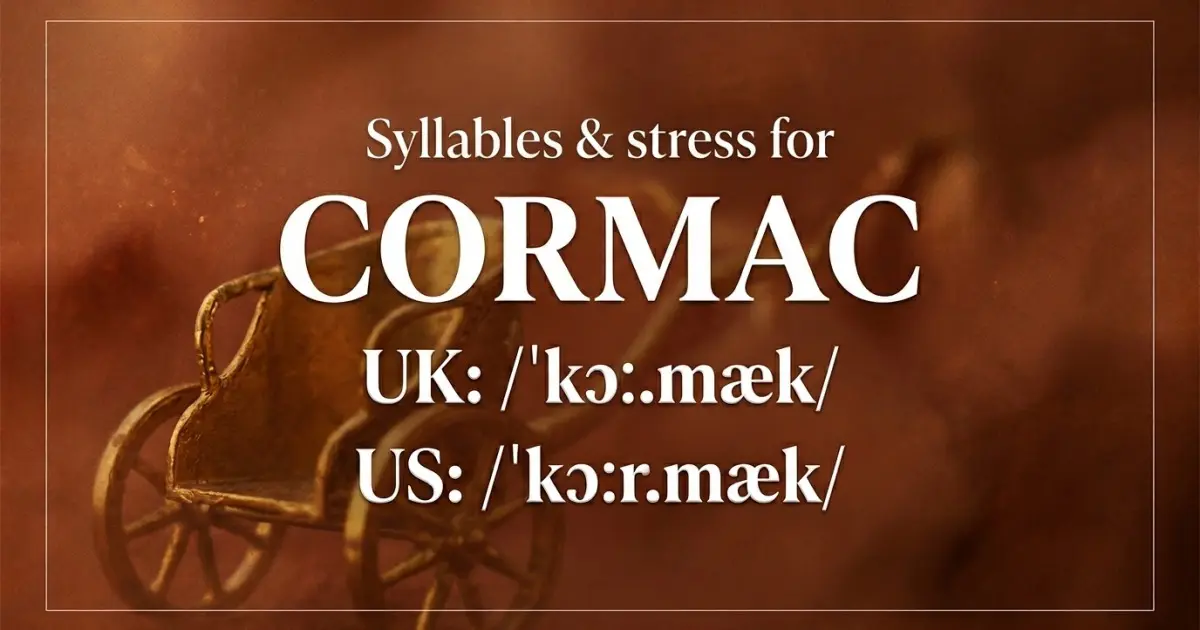
| IPA (U.S.) | /ˈkɔːrmæk/ | The first syllable carries the stress, and the r is clearly heard in most American accents. |
| IPA (U.K.) | /ˈkɔːmæk/ | The structure stays the same, even if the r becomes lighter or disappears in non-rhotic speech. |
| Syllable count | 2 syllables | Do not stretch it into three parts. The name works because it stays compact. |
| Stress pattern | Primary stress on KOR | If the stress moves to the second syllable, the whole name loses its natural shape. |
| Ending sound | mak | Keep the ending short and firm, not drawn out into mack-uh or softened into mock. |
How Cormac Moves Through the Mouth So Efficiently
Cormac works because its sound pattern is economical. The name starts with a hard k sound, opens into a broad rounded vowel, moves through an r in rhotic accents, and lands on mak. That makes the name feel firm from beginning to end. There is no decorative middle. No unstable extra syllable. No softened tail. The structure is one strong opening unit followed by one neat closing unit. The sound matters more once you know what the name is meant to carry, which is why the wider frame starts in Cormac meaning.
The first syllable gives Cormac its authority
The stressed first syllable, KOR, is the center of gravity. This is why Cormac sounds decisive from the very start. English speakers tend to hear first-syllable stress as direct and grounded, especially in short names. That is exactly the effect here. The name does not drift toward its meaning. It arrives with weight immediately.
This opening also explains why Cormac is easy to hear across distance. In practical speech, names with a strong front edge often perform well in classrooms and on playing fields because the ear catches them quickly. Cormac benefits from that. It is compact enough to project and distinctive enough not to blur into a crowd of softer names.
The ending keeps Cormac earthy rather than polished
The second syllable, mak, is short and grounded. It closes with a hard k, a stop consonant that gives the name definition. That hard close is important. Without it, Cormac could start to sound more delicate than it really is. Instead, the ending gives the name traction. It lands.
Phonetically, this helps the name feel balanced. The broad stressed opening could have made it too stately. The clipped ending prevents that. Together they create a sound that is memorable, sturdy, and more practical than ornate.
Where Cormac Commonly Gets Misread by First-Time Readers
Most pronunciation mistakes with Cormac come from the spelling looking more culturally specific than the spoken form actually is. Readers see an Irish name and sometimes assume there must be more complication than there really is.
Mistake pattern one: softening the first syllable too much
One common slip is turning the first syllable into something flatter or duller than KOR. That usually happens when a speaker hesitates and undercommits to the vowel. But Cormac needs a clear rounded opening. The first syllable should sound substantial, not vague.
The easiest correction is to think of the opening as rhyming with the first part of core in many English accents. That gives the name the weight it needs.
Mistake pattern two: adding too much after the final consonant
Because some unfamiliar names tempt speakers to over-articulate, a few people may add a trailing vowel and produce something like KOR-ma-kuh or KOR-mack-uh. That is not the target. Cormac is a two-syllable name. The final k closes it cleanly. No extra release is needed.
Mistake pattern three: treating the ending like “mock” instead of “mak”
Another small drift is to darken the second syllable too much, making it sound closer to mock. In standard English-friendly pronunciation, the final vowel is lighter and flatter: mak. Keeping that vowel clear helps the name stay aligned with the standard pronunciation model and preserves the crispness that makes it sound so usable.
How Cormac Changes Slightly Across Accents but Keeps Its Shape
One of the practical strengths of Cormac is that its pronunciation remains stable across major English-speaking accents. The U.S. and U.K. forms share the same overall rhythm and stress pattern. The main difference appears in whether the r in the first syllable is heard strongly.
Rhotic and non-rhotic speech make only a small difference
In many American accents, the r is fully pronounced, which gives the first syllable a slightly heavier center: KOR. In many British accents, especially non-rhotic ones, that r may not be pronounced unless followed by another vowel sound in connected speech. Even so, the name does not become a different name. It simply takes on the local color of the accent around it.
This is useful because it means Cormac does not become unstable as it travels. Some names change dramatically from one accent system to another. Cormac does not. It remains recognizably itself.
The name stays highly teachable
That stability makes Cormac easier to teach than many people assume. One clear spoken model is usually enough. Once heard, the name tends to stick because it is short, strongly stressed, and made of familiar English sounds arranged in a direct way.
How to Practice Cormac Until It Feels Automatic
The best way to learn Cormac is not to stare at the spelling but to say it in natural lines. Names live in sentences. Practicing them in isolation is less helpful than hearing how they behave in real speech.
Sound neighbors that help the ear
The first syllable resembles core, and the second resembles mack. That simple comparison gets most speakers very close very quickly. You are not learning an unusual sound system here. You are learning how two familiar pieces lock together. Once the sound pattern is clear, some shortenings stop feeling optional and start feeling natural, and the clearest map is in Cormac nicknames.
Practice lines for everyday use
Try these aloud: Cormac is here. This is Cormac Lee. Have you met Cormac? Cormac, your table is ready. These help the ear hear the name at normal speed and make it easier to notice if you are overextending the ending or weakening the opening too much.
Another useful drill is contrast practice: Core, Cormac. Mack, Cormac. Cormac James. Cormac Patrick. This helps the rhythm settle into the body, not just the eye.
Why the Pronunciation of Cormac Helps the Name Travel So Well
A culturally rooted name succeeds most easily outside its home tradition when it rewards people for learning it. Cormac does exactly that. It looks unmistakably Irish, which gives it atmosphere and identity, but it sounds clean and manageable in English. The pronunciation is direct, the stress is obvious once heard, and the syllable count stays lean.
That balance is rare and valuable. Some names preserve cultural texture at the cost of daily confusion. Others become so flattened for convenience that they lose character. Cormac avoids both problems. It keeps its Irish depth and still functions beautifully in ordinary speech. In pronunciation, as in style, it offers something many parents want but do not always find: rootedness without friction.
Pronouncing Cormac: Common Questions
How do you pronounce Cormac correctly?
Cormac is commonly pronounced KOR-mak, with two syllables and the main stress on the first.
What is the IPA for Cormac in the U.S. and the U.K.?
The U.S. form is commonly given as /ˈkɔːrmæk/ and the U.K. form as /ˈkɔːmæk/. The overall rhythm remains the same.
Is Cormac difficult for non-Irish speakers to say?
Not usually. It may prompt a first glance of hesitation because it is distinctly Irish, but the spoken form is short, direct, and easy to remember once heard.
What is the most common pronunciation mistake with Cormac?
The most common issues are softening the first syllable too much, stretching the ending into an extra syllable, or darkening the final vowel so the name loses its crisp finish.