
Conan Name Meaning: Meaning, Mood, and Why It Endures
Some names make wildness sound ornamental. Conan does something more interesting: it makes wildness intimate. That is the hidden force of a name meaning little wolf. The wolf is one of the oldest symbols of ferocity, instinct, hunger, and survival. But the diminutive changes everything. It does not erase the animal. It brings it close enough to be carried. The result is a name that feels untamed, yet personal; ancient, yet strangely portable. Conan does not simply borrow strength from the wolf. It turns the wolf into something small enough to become human.
That is why the name has remained memorable even when it has never been truly ordinary. Historically, Conan belongs to Irish tradition and to a wider Gaelic landscape where hounds, wolves, and warriors often blur symbolically into one another. In folklore, the name attaches itself to rough-edged, vivid figures rather than polished saints or courtly princes. In modern life, the name has traveled through literature, entertainment, and screen myth until it now carries several recognizable shadows at once. Official data shows it remains uncommon in the United States, and that rarity actually helps the name. It leaves the old animal charge intact. Conan still sounds like a name with teeth, but the sound is brief and controlled enough to keep it from becoming costume.
Conan's U.S. popularity rank over time, 1923–2024
Popularity statistics are based on official data from the Social Security Administration baby name records.
Conan: A Fierce and Legendary Irish Choice
Conan reads as a name with one unmistakable center of gravity, where the boys’ side of the chart provides its overwhelming visibility. Its profile likely reflects a naming culture interest in “strong and legendary” names that carry a sense of “little wolf” character .
The absence of crossover usage helps the name maintain a singular public identity. Its simple two-syllable rhythm provides a sense of historical range and ancient resonance.
What Conan tells you before the legend begins
| Key Facts | Information | Quick Insight |
|---|---|---|
| Name | Conan | The form is short, striking, and immediately memorable, which helps the name feel vivid even at low usage. |
| Primary meaning | Little wolf | The diminutive matters: the name carries animal force, but in a scaled, intimate, almost personal way rather than as pure threat. |
| Primary origin | Irish | Irish origin places the name inside a tradition where animal imagery often carries warrior, clan, and legendary undertones. |
| Pronunciation | KOH-nuhn | The broad opening vowel gives the name weight, but the softened second syllable keeps it usable and human-sized. |
| Syllable count | 2 | Its compact rhythm helps a mythic meaning feel wearable in everyday life. |
| U.S. boys’ rank (2024) | No. 2010 | The name sits well outside the crowded center of naming fashion, which preserves its edge and individuality. |
| Style position | Irish-rooted rare classic with mythic masculine tone | Conan sounds less like a trend choice and more like a name that arrives already carrying story. |
Conan turns the wolf into something close enough to carry
Why “little wolf” is more emotionally complex than it first appears
The meaning little wolf matters because it is not simply a power image. If the name meant only wolf, it might lean too easily toward dominance or theatrical aggression. But the smallness inside Conan changes the emotional scale. The name does not present the animal as a distant emblem carved on a shield. It presents it in miniature, as something near at hand. That makes the image more intimate and, paradoxically, more psychologically vivid.
Names built from animal imagery often survive because they carry condensed forms of human aspiration: speed, cunning, vision, courage, endurance. The wolf adds something slightly darker and more self-directed. It suggests instinct, independence, loyalty to one’s own circle, and a refusal to become tame. In Conan, those qualities are pulled inward rather than projected outward. The name does not sound like conquest. It sounds like contained wildness.
That is one reason the name feels richer than many overtly martial boys’ names. It does not depend on titles, weapons, or triumph. It depends on the presence of an animal whose power is social and instinctive at once. The wolf survives through alertness, intelligence, and group loyalty as much as through force. That makes the name feel more layered than a simple “strong” name. If you want to branch out from Conan without leaving this category, explore masculine baby names.
How the hound-and-wolf tradition deepens the name
Several of the attached naming guides widen the meaning field around Conan by linking it not only to wolf, but also to hound or wolfhound. This is important because older Gaelic naming traditions often treated the hound as a figure of warrior energy, loyalty, and ferocious skill. In that setting, the wolf and the hound are not opposites. They occupy overlapping symbolic territory: wildness on one side, disciplined fighting instinct on the other.
That overlap helps explain why Conan can sound both feral and heroic without contradiction. It carries the atmosphere of the hunt, the pack, the battlefield, and the borderland between civilization and wilderness. Yet because the name remains brief and intimate, those larger symbolic layers never become too unwieldy. Conan still sounds like a person, not merely an emblem.

Conan in Irish legend is not polished heroism, but vivid roughness
Conán of the Fianna gives the name a sharper folklore edge
The attached Irish names book gives Conán one of the most memorable folkloric profiles in the project’s materials. Rather than presenting a noble saint or a spotless king, it describes a troublesome, rough-tongued member of the Fianna, the warrior band led by Fionn Mac Cumhaill. He is remembered as mischievous, nasty, loud, and dangerous, with scurrilous language and a reputation for destructive power. This matters because it places the name inside a more unruly and vivid kind of Irish memory.

That roughness is actually central to the name’s identity. Conan is not a smooth courtly name. Even when modern people encounter it through polished culture, there is still something ragged and mythic beneath the surface. The folklore preserves that. The name does not come to us cleansed into perfect respectability. It comes with noise, story, and a bit of menace still clinging to it.
This is one reason Conan feels more alive than many rare heritage names. It carries not just pedigree, but personality. The old stories give the name movement, quarrelsomeness, and appetite. That can make the name feel less formally noble than some parents expect, but more memorable too.
Why warrior symbolism keeps appearing around the name
The same Irish source also reminds readers that in older usage the word for hound could carry a figurative sense close to warrior. That matters because it clarifies why so many names from this linguistic neighborhood feel charged with masculine energy. The animal is not there only for zoological description. It points toward a social role: fighter, hunter, protector, aggressive survivor.
With Conan, that association intensifies the meaning without replacing it. The name remains “little wolf,” but the cultural field around it starts to include courage, danger, and combat-readiness. That is why the name can feel both literary and physical at once. It belongs to language, but it also belongs to bodies moving through rough terrain.
In modern use, this layered inheritance keeps Conan from feeling merely cute or merely symbolic. There is history behind its bite.
Conan sounds cleaner and more controlled than its mythic atmosphere would predict
Why the phonetics make the name wearable
The pronunciation KOH-nuhn does a great deal of hidden work. A name so strongly attached to wolves, hounds, warriors, and folklore could easily sound overdone if the spoken form were heavier or more elaborate. But Conan is compact. The first syllable lands with breadth. The second softens immediately. That two-step rhythm keeps the name grounded and usable.
This is one of the great strengths of the name. The meaning and folklore give it wildness, but the sound gives it restraint. The broad first vowel suggests weight and oldness. The light second syllable prevents that weight from turning into drag. The whole result feels balanced in a way many overtly “mythic” names do not.
How Conan differs from louder masculine names
There are many names that try to sound powerful through sheer hardness. Conan does not need to. It is strong, but not blunt. The opening consonant is firm, yet the rest of the name is rounded enough to keep it from sounding shouted. That matters because it allows the name to carry an aggressive image without becoming socially exhausting.
In other words, the sound profile gives the name just enough civility to function. That is why Conan can survive in real life despite its mythic overtones. The name is not trying to be louder than the person who bears it. It simply arrives with built-in atmosphere.
Conan in modern culture proves that the name knows how to hold a persona
Why Arthur Conan Doyle matters to the name’s literary afterlife
The project’s naming books note that Conan is the middle name of Arthur Conan Doyle. That is a meaningful cultural anchor because it attaches the name not merely to folklore, but to literary modernity. It enters the public mind not only as an old Irish form, but as part of the authorial identity behind one of the most famous detective traditions in English literature.
This matters because it broadens the name’s image. Conan is not only physical or mythic. It also becomes intellectual, authorial, and unmistakably literary. That gives the name more range than a purely warrior-bound interpretation would allow. It can belong to force and imagination at once.
That combination is part of why the name still feels usable. A name tied only to raw strength can become narrow. A name that also touches literature becomes harder to reduce to stereotype.
Why Conan the Barbarian changed the public temperature of the name
The Irish names book also notes the cultural importance of Conan the Barbarian. This is perhaps the strongest modern reason many people hear the name as more overtly forceful than its etymology alone would require. The character gave the name a huge public silhouette: muscular, mythic, hyper-masculine, almost operatically physical. For more names connected to this tradition, see names from the Irish naming tradition.
That influence cannot be ignored. It made the name louder in public imagination. But it did not erase the older layers beneath it. In fact, it may have strengthened the wolfish undertone, because it taught modern audiences to hear Conan as a name built for raw survival and action. That reading is narrower than the full history of the name, but it is undeniably part of its atmosphere now.
Interestingly, the name survives even this exaggeration because it was already strong enough to hold it. Conan does not collapse under a larger-than-life association. It absorbs it and keeps going.
Conan in current American life feels rare enough to keep its edge
What the 2024 ranking suggests about Conan now
Official Social Security Administration (SSA) data places Conan at No. 2010 for boys in the United States in 2024. That ranking tells an important story. The name is very far from saturation. It sits well outside the crowded central band of American boys’ naming, which means it still feels unusual whenever it appears.
This rarity matters because a name like Conan depends on some degree of distance. If it were extremely common, its mythic and animal charge might flatten into mere familiarity. But at a lower frequency, the name keeps its edge. It still sounds selected, not automatic. That makes it especially appealing to parents who want something memorable, masculine, and culturally legible without sounding like every other choice in the room.
Why Conan feels older than fashion and rarer than trend
Because Conan has roots in Irish tradition and folklore, it does not feel invented by contemporary taste, even when modern media associations amplify it. At the same time, it is too rare to feel like a current trend choice. This places it in an unusual social position: deeply recognizable, but not standardized; culturally charged, but not crowded.
That position gives the name real staying power. It is easier for very common names to become dated and easier for purely trendy names to burn out. Conan avoids both problems by being too old for trend and too uncommon for fatigue. It remains available in a different way: not mainstream, but waiting.
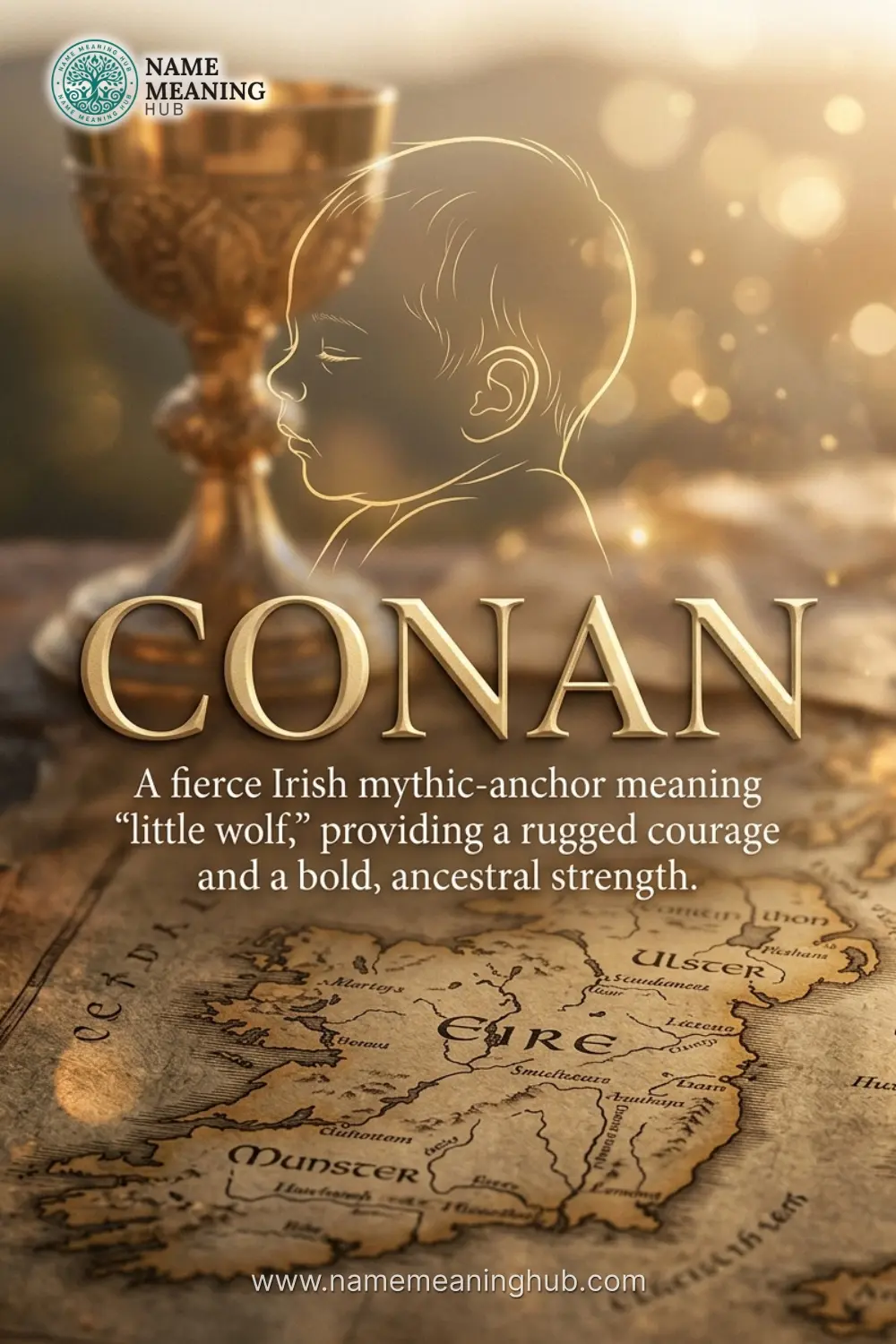
Where Conan opens next
Middle names that steady or widen Conan
Because Conan already has a strong mythic and animal charge, the middle name behind it can do especially visible balancing work. A classic middle can ground it, while a longer or gentler one can widen the atmosphere and prevent the full name from sounding too narrow or theatrical. If you want the full pairing logic behind that contrast, see middle names for Conan.
Nicknames that soften Conan without erasing the edge
Conan has a compact but workable nickname life. Familiar forms and short social cuts can make the name warmer or more casual while preserving its natural strength and memorability. To see how those different moods shorten in real life, explore nicknames for Conan.
Pronunciation cues that keep Conan clear and natural
The pronunciation KOH-nuhn is one of the name’s quiet strengths. It gives the name enough breadth to feel old and resonant, but enough softness at the end to remain fully wearable in modern speech. For the detailed stress pattern, accent notes, and IPA, see how to pronounce Conan.
Why Conan still sounds like instinct made human-sized
Conan endures because it does something very few names do so cleanly. It takes an animal image associated with ferocity and gives it a human scale. It lets the wolf remain present, but not monstrous. It keeps the wilderness, but makes it personal. The folklore around the name adds roughness and danger. Literature adds intelligence. Modern media adds scale. Yet beneath all of those layers, the name still rests on a simple, memorable core: something wild, brought close.
That is why Conan remains so persuasive. It is not a polished name pretending to be powerful. It is a powerful name kept portable by brevity, rhythm, and intimacy. In the end, Conan feels memorable because it refuses to choose between myth and personhood. It carries the wolf, but carries it in miniature, and that makes all the difference.