
Collins Name Meaning: Meaning, Heritage, and Gentle Strength
Collins is the kind of name that looks tailored before it is explained. On the page, it feels crisp, polished, almost architectural: a surname carried forward into first-name territory, neat enough for a business card and light enough for a nursery wall. Then the meaning arrives—“cub; whelp”—and the name suddenly becomes more interesting. Under the clean, modern surface is something older and wilder: not power in its finished form, but life at the beginning of it. Collins does not mean lion, king, or warrior. It means the young creature before the myth hardens around it. That shift matters. It gives the name a different emotional profile from many other surname-style choices. It sounds composed, but its core image is still moving, growing, and not yet fully trained.
That tension between polish and instinct is what makes Collins persuasive. Official Social Security Administration (SSA) data places Collins at No. 257 for girls in 2024 and No. 2524 for boys, while the name remains fundamentally unisex in structure. This is exactly the kind of modern pattern that helps explain the name’s rise. Collins belongs to a naming era that has grown increasingly comfortable with family-name forms, gender-flexible sounds, and names that feel established without being old-fashioned. Yet unlike some surname names that are all surface and no center, Collins still carries a vivid old meaning. It is tidy on the outside, alive on the inside. That is a rarer combination than it first appears.
Collins's U.S. popularity rank over time, 1881–2024
Popularity statistics are based on official data from the Social Security Administration baby name records.
Collins: A Professional Surname with Shared Visibility
Collins behaves as a name with shared visibility without full balance, maintaining a clear lead in the girls’ lane while showing meaningful continuity on the boys’ side. This “cub” choice likely travels well due to its professional sound and surname-style structure .
The chart indicates that while one side is dominant, the other adds a layer of texture rather than a broad identity shift. Originally an Irish surname, its two-syllable rhythm provides a sense of confident clarity.
Collins looks polished, but the meaning keeps it young and alive
Some names promise grandeur. Others promise sweetness. Collins does something subtler. Its meaning, “cub; whelp,” is not a grand adult symbol. It belongs to early life, to animal youth, to the stage before maturity becomes identity. That gives the name a surprising charge. Beneath the surname styling and contemporary confidence is a word-picture of movement, alertness, and beginnings. The name feels socially finished while semantically pointing toward growth.
| Key Facts | Information | Quick Insight |
|---|---|---|
| Name | Collins | The name feels tailored and surname-forward, which helps it sound modern without seeming invented. |
| Primary gender usage | Unisex | Collins has structural flexibility, but current usage shows that the modern ear is hearing it more strongly as feminine than masculine. |
| Primary origin | Irish | The Irish origin gives the name lineage and cultural grounding, preventing the surname style from feeling empty or purely aesthetic. |
| Primary meaning | Cub; whelp | This meaning gives Collins youthful energy and instinctive life rather than grandeur, which is part of its unusual charm. |
| Pronunciation | KOL-inz | The clipped first syllable and clean final -z sound help the name feel brisk, social, and contemporary. |
| IPA (US / UK) | /ˈkɒlɪnz/ / /ˈkɒlɪnz/ | The shared pronunciation across major English accents makes Collins unusually stable and easy to carry in public life. |
| Syllable count | 2 | Two syllables keep the name efficient and memorable, which suits its surname-like structure extremely well. |
| U.S. girls’ rank (2024) | No. 257 | This suggests a name that is visible, accepted, and chosen with intention, but not yet flattened by overuse. |
| U.S. boys’ rank (2024) | No. 2524 | The name remains technically unisex, but current usage gives it a clearly stronger social life for girls. |

Collins belongs to an Irish root, but modern ears hear it as a surname first
Why the Irish meaning matters more than the polished surface suggests
The controlling origin here is Irish, and the controlling meaning is “cub; whelp.” Those details matter because they give Collins a center of gravity deeper than style. It would be easy to dismiss the name as one more modern surname-name, chosen because it sounds crisp and put-together. But names with durable appeal usually have something older working underneath them. In Collins, that older layer is not ornamental at all. It is vivid, animal, and young. If this origin is what attracts you most, browse Irish-origin names.
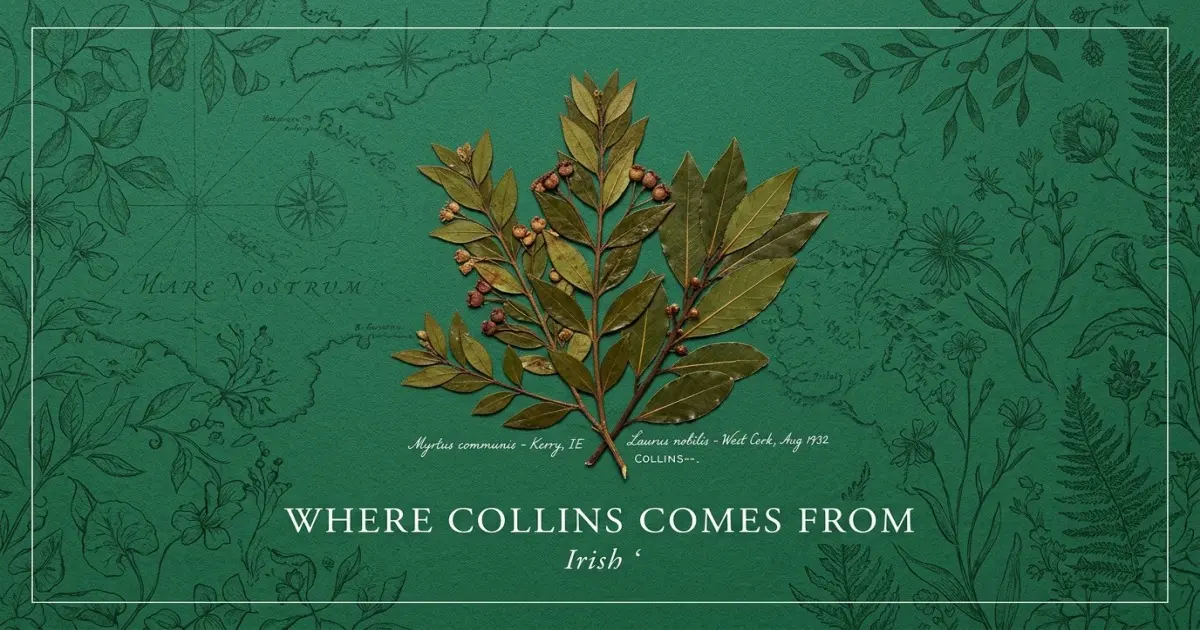
That meaning also changes how the name should be read. “Whelp” in older usage is not a casual insult. It belongs to an older vocabulary of young animals and offspring, a word tied to early, not-yet-finished life. In naming terms, that makes Collins less about dominance than potential. The name does not project completed authority. It projects alertness, growth, and the kind of vitality that is not fully disciplined yet. That can feel especially attractive in a contemporary naming climate that often values energy and individuality more than inherited hierarchy.
Why Collins sounds more like a first name now than it might have a generation ago
Modern naming guides increasingly note two related shifts: the rise of family names as first names and the widening comfort around gender-neutral options. Those larger trends help explain why Collins can now function so naturally in first position. A generation or two ago, many listeners would have heard the name almost exclusively as a surname. Today the ear is far more prepared for exactly this kind of structure.
That shift is important because Collins does not have to fight its form anymore. The name arrives with enough social precedent to sound plausible, but still enough freshness to feel deliberate. This is often the best place for a name to live. It is neither so new that it feels experimental, nor so ordinary that it becomes invisible.

Collins turns a family-name style into something more intimate than expected
Why surname names often feel stronger in public life
Surname-style first names do something interesting in the culture. They often sound established even when their first-name usage is relatively new. That is because surnames already come into the room carrying formality, lineage, and a certain public-facing finish. Collins benefits from all of that. It sounds competent. It sounds crisp. It sounds as though it already knows how to live on a school roster, a conference badge, or the cover of a book.
But Collins is gentler than many surname names. It does not have the hard edges of some occupational or place-name choices. It begins with a rounded Kol- sound and closes with the familiar -ins pattern, which many English speakers already associate with easy surnames and approachable public identities. That softens the frame. The name sounds orderly, but not cold.
Why Collins feels less severe than some other unisex surname choices
Compare Collins with other surname-forward unisex names and the distinction becomes clearer. Some names of this type lean heavily into sharpness or prestige. Others feel intentionally preppy. Collins has some of that social polish, but the old meaning and gentler sound keep it from becoming purely managerial or decorative. It feels more alive than that. The image of a cub or whelp works quietly in the background, giving the name a hint of youthfulness that balances the tailored exterior.
This makes Collins especially appealing to families who want a modern unisex name but do not want something emotionally flat. The name carries style, but not only style. It has a pulse underneath it.
Collins is unisex in form, but the current data tells a more specific story
What the rank difference actually suggests
Official SSA data shows Collins at No. 257 for girls and No. 2524 for boys in 2024. That gap matters. It suggests that while the structure of the name remains unisex, present-day social use is not evenly balanced. The modern American ear is hearing Collins much more readily as a girls’ name than as a boys’ name. That does not erase its unisex framework. It simply tells families what the name is likely to signal in practice. For related naming ideas in the same category, visit gender-neutral baby names.
This is a useful distinction. A name can remain open in theory while becoming asymmetrical in lived use. Collins appears to be in exactly that position. It retains the crisp neutrality that makes surname names attractive, but its strongest current identity is female. For many parents, that may actually be part of the draw: a girls’ name that does not rely on softness or obvious ornament to communicate femininity.
Why Collins feels contemporary in exactly the way modern parents often want
The broader naming climate has made room for names that are not tightly hemmed in by old gender categories, especially when those names are short, surname-based, and socially efficient. Collins fits that pattern well. It offers a kind of polished neutrality while still being legible as feminine in current usage. That combination can feel ideal for parents who want modernity without novelty and strength without aggression.
It is also part of why the name does not feel temporary. Collins sounds aligned with current taste, but not dependent on a single aesthetic moment. Its social profile is contemporary, yet its structure and meaning are sturdy enough to outlast trend language.
Collins sounds brisk because the phonetics are doing exactly the right work
The two-syllable form keeps Collins efficient
Phonetically, Collins is a well-made name. It has only two syllables, which means it is easy to say, easy to hear, and hard to distort. The stress falls at the front: KOL-inz. That gives the name a strong start, while the softer second syllable keeps it from sounding overly hard. The final z sound closes the name cleanly, giving it social neatness without a sharp stop.
This is one reason Collins works so well as a first name. Its sound has the quick efficiency people often like in surnames, but it still has enough fluidity to feel personable. It is clipped without being harsh. That matters, because a name meaning “cub; whelp” needs some social polish to stay wearable. Collins has exactly that.
Why Collins feels stronger than many names with gentle meanings
Meanings associated with youth or young creatures can sometimes lead to names that sound overtly cute or soft. Collins avoids that completely. The surname frame and consonant structure keep the name upright. This is another example of the tension that makes it interesting: the meaning is young, but the sound is composed. The result is a name that feels energetic without sounding childish.
That tension may be the name’s greatest strength. Collins does not announce its meaning. It carries it underneath a more controlled outer form. That lets the name feel both grounded and alive at once.
Stable pronunciation helps the name travel well
The fact that U.S. and U.K. IPA are effectively the same is also useful. It means Collins remains highly stable across major English-speaking settings. A name that already sounds like a surname has a practical advantage when its pronunciation is equally straightforward. The bearer is unlikely to spend much time correcting people. That kind of ease has real value in daily life.
Where Collins sits now: familiar enough to work, distinct enough to feel chosen
Its current position gives Collins breathing room
Official SSA data placing Collins at No. 257 for girls means the name has entered visible public use without becoming saturated. That is a particularly attractive position for a surname-style choice. If it were much rarer, it might feel too dependent on novelty. If it were much more common, some of its crisp individuality might dissolve. At its current level, Collins still sounds curated.
This matters because names of this kind depend heavily on proportion. Collins needs to feel intentional, not accidental. The current rank preserves exactly that effect. It is known, but it still has edge.
Why Collins does not sound like a passing novelty
Some modern names rise because they surprise. Others rise because they fit a wider cultural movement toward surname names, family-name preservation, or gender-neutral style. Collins belongs more to the second group. It is not strange. It is part of a broader shift. That often gives a name more staying power, because it means the name is riding a durable change in taste rather than a brief aesthetic wave.
At the same time, the Irish origin and the older meaning keep Collins from sounding hollow. It is not only a format. It is a name with an older center. That is usually a good sign for long-term durability.

The smaller roads that open out from Collins
Middle names after Collins
Because Collins is so crisp and surname-forward, middle names often do important balancing work. Softer middles can warm the full name, while more classic middles can deepen its dignity and keep the first name from sounding too casual.
Nicknames inside Collins
Collins has a useful nickname field despite its tailored sound. Shortened forms can soften the public polish or make the name feel more intimate and child-centered without losing its structure.
How Collins is best pronounced
The steady form KOL-inz is one reason the name remains so practical. It sounds contemporary and surname-like, but it does not ask for constant correction or special explanation.
Why Collins keeps its polish without losing the creature inside it
Many names built from surnames offer social finish but little emotional surprise. Many names built on animal or youthful meanings offer life but not much public shape. Collins does something rarer. It combines the two. The outer form is orderly, modern, and highly wearable. The inner meaning is young, instinctive, and still in motion. That makes the name feel richer than its clean surface first suggests.
It also explains why Collins has become so persuasive in the present moment. The culture has made room for family-name first names, for gender-flexible structures, and for names that sound capable without sounding cold. Collins meets all of those demands. But it also brings something extra: a meaning that is not grand, not abstract, and not sentimental. It is a meaning of beginnings, of youthful animal life, of something not fully grown but already alive and alert.
In the end, Collins works because it holds those two truths together. It is tailored, but not sterile. Young in meaning, but not childish in sound. Unisex in structure, but currently and clearly shaped by modern feminine use. That is why Collins lingers in the mind. It sounds finished, yet its core image is still becoming. Very few names manage that balance so cleanly. Collins does.