
How to Say Clover Correctly: Tips for Saying It Smoothly in Conversation
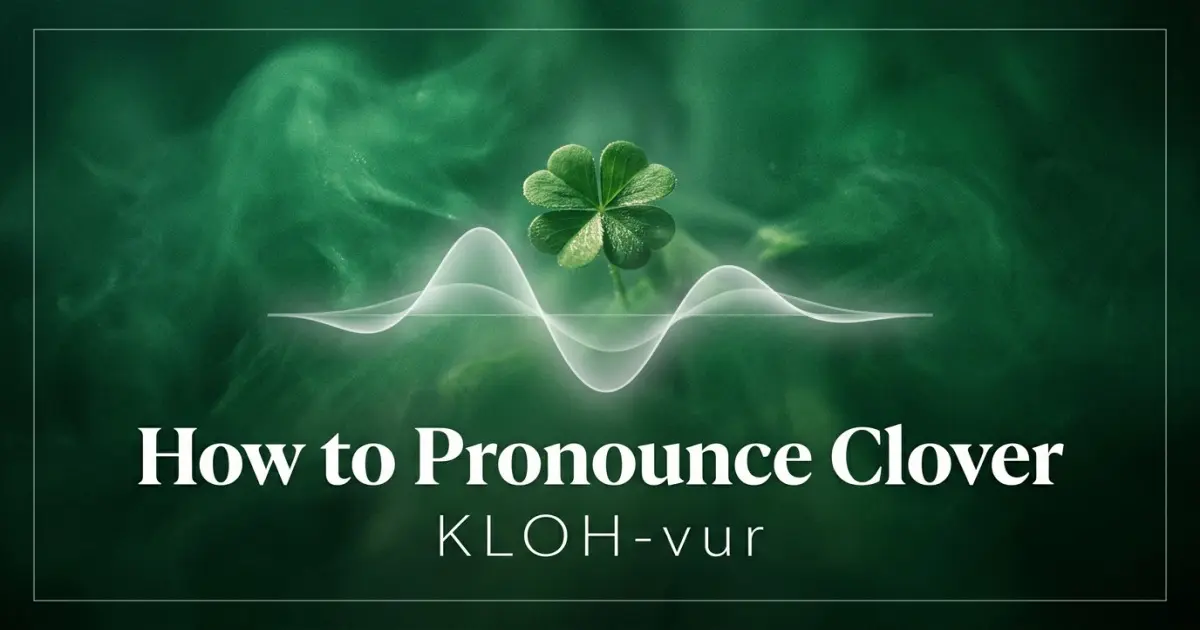
Clover is the sort of name that proves itself in ordinary public moments. A kindergarten teacher pauses for half a beat over the attendance sheet. A nurse calls a child in from the waiting room. A barista repeats the name back over the hiss of a coffee machine. A graduation announcer reaches it after a run of harder names and says it cleanly on the first try. That is where pronunciation stops being abstract and becomes part of a person’s daily life. Clover usually performs very well there. It looks exactly like the word people already know, and that familiarity does most of the heavy lifting.
Still, easy names have their own kind of structure, and Clover is more carefully balanced than it first appears. It begins with a crisp consonant cluster, opens into a broad rounded vowel, and then softens into a second syllable that makes the whole name feel friendly rather than sharp. In practice, that means Clover sounds bright but not brittle, distinctive but not difficult. Once you understand where the stress falls and how the two syllables work together, the whole name becomes easy to carry across classrooms, introductions, and everyday speech.
What the sound of Clover is actually clarifying
| Element | Phonetic Detail | Quick Tip |
|---|---|---|
| Everyday pronunciation | KLOH-ver | Say it in two beats, with the first syllable carrying the emphasis. |
| IPA (US) | /ˈkloʊvər/ | The American form uses a broad long vowel in the first syllable and a relaxed ending. |
| IPA (UK) | /ˈkləʊvə/ | The British form is very close, with the same stress pattern and nearly the same overall shape. |
| Syllable count | 2 syllables | Think of it as CLO + ver, not as a one-syllable blend and not as clo-VER. |
| Stress pattern | Strong-weak | The first syllable leads clearly; the second should stay lighter. |
| Opening sound | /kl/ consonant cluster | Start cleanly with the hard K and let the L glide right after it. |
| Main vowel | /oʊ/ in the U.S., /əʊ/ in the U.K. | The first syllable rhymes broadly with “glow,” not with “claw” or “club.” |
| Ending | Light unstressed /vər/ or /və/ sound | Keep the second syllable relaxed; do not give it equal weight with the first. |

How Clover is said in everyday English speech
In everyday use, Clover is pronounced KLOH-ver. The first syllable is where the name lives. The second syllable is where it softens. This is one reason the name feels so wearable: it begins with confidence and ends with ease. The sound matters more once you know what the name is meant to carry, which is why the wider frame starts in Clover meaning.
Clover starts with a sharp cluster and then opens quickly
The name begins with /kl/, a consonant cluster that English speakers handle naturally because it appears in many familiar words: clean, clear, close, climb. The opening /k/ is a hard stop consonant, which gives Clover its clean start. Immediately after that comes /l/, a liquid consonant that smooths the transition into the vowel. That pairing matters. Without the l, the name might sound harder. With it, Clover keeps its brightness but loses any harshness.
After the cluster comes the rounded vowel that makes the first syllable feel warm and full. In American English it is usually /oʊ/, while in British English it is /əʊ/. In practical terms, both land close to the sound most English speakers hear in words like “glow” or “slow.” That is why the first syllable feels open and luminous rather than clipped.
The second syllable keeps Clover from sounding too abrupt
The ending -ver matters more than people think. The /v/ is a voiced fricative, which means the sound is made with friction but also with the voice engaged. It adds softness without making the name fuzzy. Then the final unstressed vowel relaxes the whole shape. In American English that often sounds like /vər/, while in many British pronunciations it lands closer to /və/.
This is why Clover feels friendlier than some other short nature names. The opening is crisp, but the ending is gentle. The name moves from definition into softness. That is a very useful sound pattern in daily life because it makes the name memorable without making it severe.
Why Clover’s stress pattern makes the name easy to hear
The standard stress pattern for Clover is strong-weak. The voice lands on the first syllable: CLO-ver. This is the most natural pattern for English speakers and one of the reasons the name feels so readable at first glance. Many successful everyday names follow this same rhythm. The listener catches the important part immediately, and the second syllable finishes the thought.
CLO-ver is right, clo-VER is not
The most important thing to remember is that the emphasis belongs at the front. Some names look as though they might tilt toward the second syllable, especially when they end in -er or -ver, but Clover does not. Stressing the second syllable would make the name sound unnatural in English. CLO-ver is smooth and familiar. clo-VER sounds forced and out of step with how the word already lives in the language.
Because Clover is also a common noun, this first-syllable stress is already built into most speakers’ instincts. That helps enormously. Unlike borrowed place names or rare surname-style names, Clover does not need much explanation once it is heard once.
The second syllable should finish the name, not compete with it
The last syllable is not meant to perform. It is meant to soften. If someone says the ending too heavily, the name starts sounding choppier and less natural. A good way to hear the balance is to compare it with other familiar strong-weak names. The first beat is where identity arrives. The second beat is where the name relaxes into ordinary speech.
That relaxed ending also helps Clover function well in affectionate speech. Names with a softer second syllable often feel easier to call across a room, easier to say to a child, and easier to repeat without strain.
Where Clover stays stable across accents, and where it shifts slightly
Clover travels well across English accents because both the American and British pronunciations keep the same rhythm and almost the same vowel contour. The main difference is not the stress or the basic identity of the name. It is the fine texture of the vowel and the ending.
American and British Clover mostly agree
In American English, Clover is typically /ˈkloʊvər/. In British English, it is commonly /ˈkləʊvə/. In practice, both versions begin with the same crisp /kl/ opening and place the stress on the first syllable. The difference lies mostly in how the diphthong is shaped and how strongly the final r is heard.
This means the name keeps its identity extremely well. It does not become a different name when it crosses the Atlantic. That is a quiet advantage for a modern given name, especially one drawn from an ordinary English word.
The biggest accent difference is the final R sound
American English is usually rhotic, which means the final r in the second syllable tends to be heard: /vər/. Many British accents are non-rhotic, so the r drops unless followed by another vowel, leaving something closer to /və/. Neither is more correct in everyday speech. They are just accent-specific ways of completing the same name.
The first vowel may also sound slightly broader or tighter depending on region, but not enough to cause confusion. In real life, Clover remains very stable and highly recognizable in both systems.
What people get wrong with Clover, and how to keep it clear
Clover is not a high-risk name for pronunciation trouble, but a few predictable mistakes can appear. Most are small and easy to correct because the base word is so familiar.
The most common mistake is flattening the first vowel
Sometimes speakers rush the first syllable and let it drift toward something flatter or shorter than it should be. Clover works best when the opening vowel has room. It should sound closer to “glow” than to “claw” or “cluh.” That fuller vowel is what gives the name its warmth and brightness.
Another mistake is over-pronouncing the second syllable
Because the ending contains a voiced fricative and, in American speech, an r, some speakers may over-articulate the second syllable and make the whole name sound heavier than it needs to. Keep the ending light. Clover is not a name that should feel weighed down at the back.
Sound neighbors can also shape expectations
Names and words nearby in sound, such as Chloe, Cleo, or even surnames ending in -ver, may sometimes influence how people expect Clover to sound. But the familiar noun usually corrects that quickly. As soon as someone hears the ordinary English word inside it, the pronunciation settles into place. The way the name resolves at the end often decides which short forms feel natural in speech, and that becomes clearer in nicknames for Clover.
A helpful practice line is to say the name in living speech: “Clover is here.” “Have you met Clover?” “Clover, dinner’s ready.” “Thank you, Clover.” These phrases let the strong-weak rhythm and light ending happen naturally. The best pronunciation of Clover should feel like ordinary speech, not like a performance.