
How to Say Clara Correctly: A Quick Guide to Saying It Well

The real pronunciation test for Clara does not happen in a dictionary. It happens in that tiny public pause before a teacher reads a class list aloud, when everyone in the room is waiting to hear whether the name will arrive as its family knows it. With Clara, that moment is unusually revealing because the name looks simple, yet it carries one of the most interesting accent shifts in common English use. In one voice, it opens bright and airy as KLAIR-uh. In another, it opens broader and more classical, closer to KLAHR-uh. Both forms are elegant. Both are established. And both tell you something about how English turns the same letters into different shades of meaning.
That is part of what makes Clara such a compelling pronunciation name. It is not difficult, but it is not flat either. Official data shows Clara remained a well-established girls’ name in the United States in 2024, which means many English speakers already recognize it on sight. Yet the supplied pronunciations remind us that recognition is not the same as uniformity. Clara is one of those names whose identity stays stable even when its vowel color changes. It remains unmistakably itself while sounding slightly brighter in one accent and slightly more old-world in another.
What Clara Clarifies About How the Name Is Actually Said
| Element | Phonetic Detail | Quick Tip |
|---|---|---|
| Everyday pronunciation | KLAIR-uh | In the supplied U.S. form, stress the first syllable and let the second syllable stay light. |
| US IPA | /ˈklærə/ | The first vowel is the same broad a-type sound heard in words like cat, but stretched into the name’s smoother flow. |
| UK IPA | /ˈklɑːrə/ | The British version opens more broadly, giving Clara a slightly more classical, open vowel sound. |
| Syllable count | 2 syllables | Think of the name as one strong opening beat plus one softer landing. |
| Stress pattern | Stress on the first syllable | The second syllable should support the name, not compete with it. |
| Key consonants | Opening /kl/ cluster, liquid /r/ in the middle | The crisp beginning gives Clara structure, while the r softens the movement into the ending. |
| Most common confusion | Switching between KLAIR-uh and KLAHR-uh without noticing the accent difference | Choose the pronunciation that matches your linguistic context and family preference, then keep it consistent. |
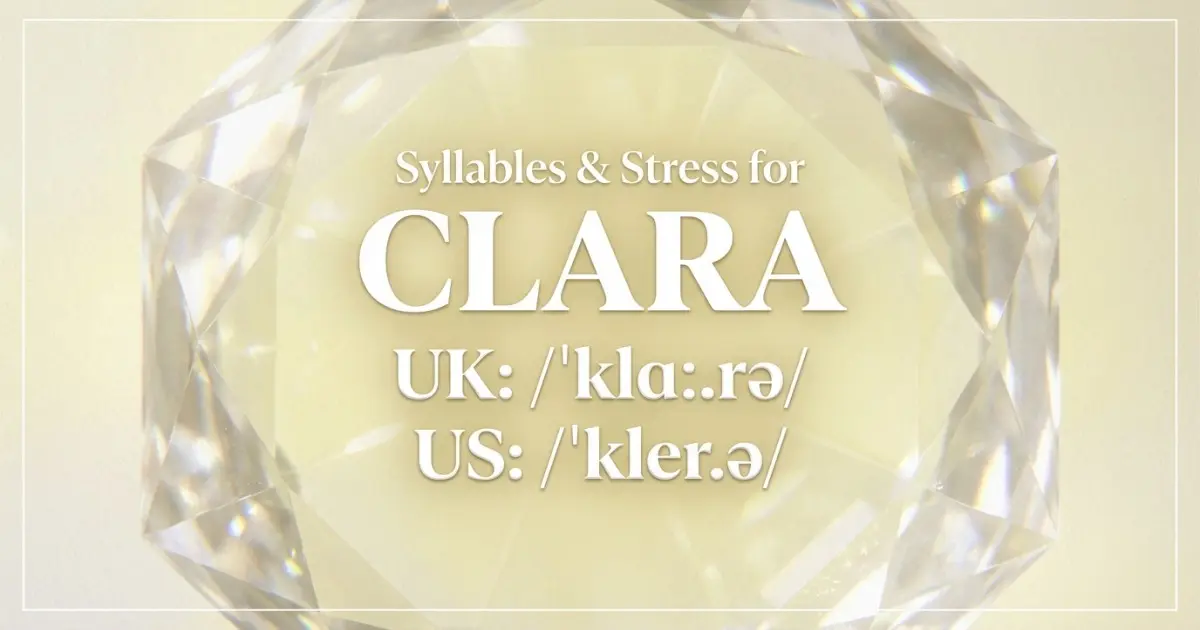
How Clara Moves Through the Mouth in Everyday Speech
Clara works because it balances a crisp opening with a gentle finish. The name begins with the /kl/ consonant cluster, which gives it shape immediately. That opening matters. A name that means “bright; clear” would lose something if it drifted into the ear without edges. Clara does not drift. It arrives cleanly. Then the vowel opens the name outward, and the final syllable lets it settle without becoming abrupt. The sound matters more once you know what the name is meant to carry, which is why the wider frame starts in Clara meaning.
Why the opening cluster gives Clara its clarity
The first sound sequence, /kl/, is doing a great deal of work. The /k/ gives the name a clean start, and the /l/ that follows is a liquid consonant, meaning it lets the voice continue smoothly rather than stopping sharply. In practical terms, that makes Clara sound both precise and graceful. It begins with definition, but it does not sound hard.
This is one reason Clara feels more substantial than some other elegant girls’ names of similar length. The beginning has enough structure to keep the name from floating away into softness.
Why the first vowel changes the whole mood of Clara
The central pronunciation difference between the supplied American and British forms is the first vowel. In the U.S. form, /ˈklærə/, the opening feels brighter and slightly lighter in color. In the U.K. form, /ˈklɑːrə/, the opening feels broader and more classical. This is not a minor stylistic detail. It changes the atmosphere around the name.
KLAIR-uh tends to sound more sparkling and immediate. KLAHR-uh tends to sound more stately and more old-world. Neither is more “true” in a general sense here, because both are already part of the supplied pronunciation landscape. What matters is recognizing that Clara is one of those names whose accent choice slightly changes its emotional texture.
Why the ending keeps Clara warm
The second syllable in Clara is unstressed and much lighter than the first. That light ending prevents the name from sounding overbuilt. If both syllables were equally strong, the name would lose its elegance. Instead, Clara opens clearly and then releases. This release is what keeps the name warm, approachable, and easy to say in normal conversation.
That is part of the name’s spoken charm. Clara is not merely beautiful in print. It is mechanically well balanced in speech.
Where Clara Changes Across Accents Without Losing Its Identity
Clara is an excellent example of a name that shifts color across accents while remaining fully recognizable. The supplied American pronunciation is /ˈklærə/. The supplied British pronunciation is /ˈklɑːrə/. The consonants remain stable. The stress remains stable. The number of syllables remains stable. What changes is the vowel color in the first syllable, and with it, the overall emotional feel of the name.
US Clara: brighter and slightly brisker
In the American form, Clara tends to sound more immediate. The first vowel gives the name a brighter front edge, which can make it feel a touch more modern and conversational. This version often aligns well with the supplied pronunciation display KLAIR-uh, which many American speakers will find intuitive and natural.
UK Clara: broader and more classical
In the British form, the broad vowel in /ˈklɑːrə/ gives Clara a more spacious opening. Many listeners hear this version as more traditional, slightly more literary, or more classically elegant. The name feels less sparkling and more spacious. It is still Clara, but with a different texture in the light.
This flexibility is one of the reasons the name travels so well. A family may use one form at home and still find the name immediately understandable in a different English-speaking environment. Clara bends without breaking.
Why Clara Sometimes Gets Misread in Real Life
Clara is not a difficult name, but it does invite one predictable kind of uncertainty: people may hesitate over which accepted vowel pattern the family intends. This is not the same as the name being hard to pronounce. It simply means the name carries two familiar English realizations, and the speaker may need a social cue to know which one is preferred.
Mistake pattern one: treating the accent difference as an error
The first and most common issue is assuming that one of the two supplied forms must be wrong. But the more accurate way to think about it here is that the name has accent-based variation. A family may strongly prefer KLAIR-uh, and another may strongly prefer KLAHR-uh, while both remain speaking recognized forms. The important thing in everyday use is consistency and respect for the bearer’s chosen pronunciation.
Mistake pattern two: overemphasizing the second syllable
Another problem is giving too much weight to the ending. Clara should not sound like two equally stressed parts glued together. The second syllable matters, but it is lighter. If the speaker leans too hard on it, the name can begin to sound more deliberate and less graceful than it naturally is.
Sound neighbors that help anchor Clara correctly
For the supplied American pronunciation, it may help to think of the first part as rhyming loosely with air, then add a soft uh. For the supplied British pronunciation, it may help to think of a broader ah opening before the same relaxed ending. Either way, the name should feel like one clear opening followed by a lighter release. Because the strongest energy lands early, the shorter forms often grow from the opening of the name, and that pattern is easier to see in nicknames for Clara.
It may also help to remember what Clara is not. It is not muddled, and it is not heavily stressed on both syllables. Its elegance depends on the first syllable carrying the identity of the name.
How to Practice Clara Until It Sounds Natural
The best way to learn Clara is not by repeating it in isolation too many times, but by placing it in ordinary sentences. The name settles into speech quickly once the stress and vowel choice are clear. That is because Clara’s rhythm is inherently balanced.
Simple practice lines for Clara
- Clara is waiting by the door.
- I saved a seat for Clara.
- Did Clara call this morning?
- Clara will be here after lunch.
Read those aloud using the version you prefer. The first syllable should carry the name. The second should trail lightly behind it. If that pattern stays stable, Clara will sound exactly as it should: clear, poised, and natural.
How to know you are saying Clara well
You are probably pronouncing Clara correctly if three things happen at once: the opening consonant cluster sounds crisp, the first syllable clearly carries the stress, and the second syllable remains lighter than the first. Once those pieces are in place, the name does what it was built to do. It sounds bright, but not brittle. Elegant, but not overworked.
That is the real strength of Clara as a spoken name. It proves that pronunciation can shape character. The sound is not only pretty. It is organized. And because the name’s meaning points to brightness and clarity, that organization becomes part of the charm.