
How to Pronounce Cian: How the Rhythm of the Name Really Works

The real pronunciation test for a name rarely happens in theory. It happens in a doorway, with a clipboard in hand and no time to overthink it. A teacher reaches a new student’s name on the first morning of school. A nurse steps into a waiting room. A coach scans a roster before practice. A graduation marshal whispers each name once before saying it into the microphone. Cian is exactly the kind of name that can produce a half-second pause in those moments, not because it is difficult, but because its Irish spelling does not immediately reveal its sound to every English-speaking reader. The eye may hesitate. The ear usually does not, once it has heard the name properly even once.
That is why the pronunciation matters so much with Cian. This is a short name, but not a blunt one. It carries an old Irish history and a meaning connected to age and endurance, yet in speech it feels light, quick, and unexpectedly bright. The standard guide is KEE-un. Two syllables. Strong opening. Soft landing. Once that rhythm is understood, the name becomes easy to carry in everyday life. In fact, the pronunciation is one of the reasons Cian works so well now: it looks ancient, but it sounds fresh.
What the Sound of Cian Clarifies Before the Spelling Does
| Element | Phonetic Detail | Quick Tip |
|---|---|---|
| Everyday pronunciation | KEE-un | Say it in two beats, with the first syllable clearly stressed and the second one lighter. |
| IPA (U.S.) | /ˈkiːən/ | The long ee sound is the heart of the name, so do not shorten or flatten it. |
| IPA (U.K.) | /ˈkiːən/ | The U.S. and U.K. forms match here, which makes Cian unusually stable across accents. |
| Syllable count | 2 syllables | Do not compress Cian into one beat or overbuild it into three. It works because it stays compact. |
| Stress pattern | Primary stress on KEE | The first syllable carries the whole name. If the stress shifts later, the name loses its natural Irish shape. |
| Final syllable | Light -un | Let the ending stay soft and reduced rather than turning it into a heavy ANN sound. |
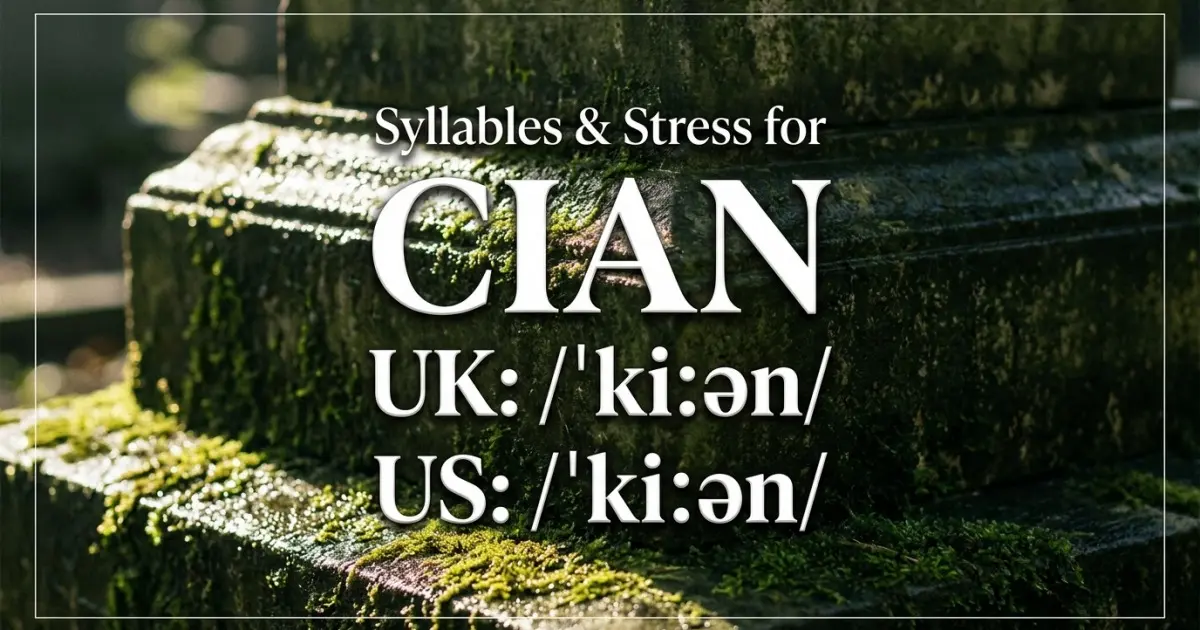
How Cian Is Actually Built in the Mouth
Cian is more straightforward in speech than its spelling may first suggest. Phonetically, it begins with a long ee vowel and ends with a light unstressed syllable. That makes the name feel bright from the start and gentle at the finish. It is a very efficient design. There are no dense consonant clusters, no abrupt final stop, and no extra decorative syllables. The name moves cleanly from a strong opening into a soft close. Before focusing only on syllables and stress, it helps to step back into the fuller frame of Cian meaning.
The first syllable gives Cian its brightness
The opening KEE is where the identity of the name lives. This is the stressed syllable, and it should sound clear, open, and confident. Because it uses a long vowel, the name feels lighter than many short boys’ names. It does not punch forward with force. It opens. That is one reason Cian can sound modern even though the name itself is deeply old.
This bright first syllable also makes the name easy to hear in a room. In practical terms, names with a strong front-loaded vowel often carry well in classrooms, on sports fields, and in public introductions. Cian benefits from that. It is brief, but it is not swallowed by noise.
The ending keeps Cian gentle rather than abrupt
The second syllable is much lighter. In accessible linguistic terms, it behaves a little like a reduced ending in ordinary English speech. That softness matters. If the name ended with a harder stop, Cian would sound much sharper. Instead, the final syllable tapers the name, which gives it warmth and keeps the whole thing from feeling severe.
This is one of the hidden strengths of the pronunciation. A name meaning “ancient” could easily sound heavy if the phonetics reinforced weight at every turn. Cian does the opposite. The bright opening and soft ending make the name feel agile.
Where Cian Usually Gets Mispronounced
Most pronunciation problems with Cian come from the spelling, not from the sound. Readers unfamiliar with Irish orthography often try to force the letters into more familiar English patterns. Once that happens, the name can drift away from its real shape very quickly.
Mistake pattern one: reading the opening like “see” or “sigh”
Because English readers are used to the letter c shifting its sound depending on what follows, some people may initially guess something closer to SEE-un or SIGH-an. That is understandable from the page, but it is not the standard spoken form. Cian begins with a hard k sound, not an s sound, and the vowel remains a long ee.
The simplest correction is mental: treat the opening of Cian like the word key. That usually fixes the name immediately.
Mistake pattern two: making the ending too heavy
Another common issue is turning the second syllable into a strong an or ANN sound. That makes the name sound heavier and more segmented than it should. In natural pronunciation, the ending is lighter than that. It should feel more like a soft un, not a full separate spotlight syllable.
This mistake often comes from people trying to be extra careful. Ironically, over-pronouncing the ending usually makes the name less accurate, not more.
Mistake pattern three: flattening the whole name into one syllable
Because Cian is short, some speakers try to compress it too far. That can produce a clipped single-beat sound that loses the graceful taper of the real pronunciation. Cian needs its second syllable, even though that syllable is light. The name should feel compact, not crushed.
How Cian Sounds Across Accents Without Losing Itself
One practical advantage of Cian is that its U.S. and U.K. IPA forms are the same: /ˈkiːən/. That is not always the case with Irish names, and it helps explain why Cian travels well in English-speaking settings. The structure remains stable. The stress stays on the first syllable. The second remains light.
The accent differences are small, not structural
Some speakers may keep the second syllable a little clearer, while others reduce it more. Some may make the opening vowel slightly brighter or flatter depending on local accent habits. But those are minor variations. They do not change the identity of the name. Cian remains recognizably itself across them.
This stability helps the name live internationally
That matters more than it first seems. Some culturally rooted names are beautiful but unstable once they travel. Cian is not like that. It may need one first explanation if a listener has only seen it written, but after that the sound is easy to reproduce. That makes it unusually practical for a name with such deep Irish roots.
How to Practice Cian Until It Feels Natural
The easiest way to learn Cian is not to repeat it as an isolated puzzle. It is to say it inside normal phrases, because that is how the name will actually live.
Sound neighbors that help the ear
The most useful anchor is the opening. If you can say key, you already have the heart of the name. After that, you only need the light second syllable. Thinking of Cian as key + un usually makes the structure click very quickly. The way the name resolves at the end often decides which short forms feel natural in speech, and that becomes clearer in nicknames for Cian.
Practice lines that make the rhythm settle
Try these aloud: Cian is here. This is Cian Thomas. Have you met Cian? Cian, your table is ready. These short lines help the body feel where the stress belongs and how lightly the name should close. Another useful contrast drill is: Key, Cian. Kian, Cian. Cian James. The goal is not to slow the name down forever. It is to help its natural rhythm settle into speech.
Why Pronouncing Cian Well Protects What Cian Is
A name can lose much of its character if its pronunciation is guessed badly. Cian is a good example. If the opening becomes an s sound, the name loses its Irish shape. If the ending becomes too heavy, it loses its brightness. If the whole thing is flattened into one beat, it loses the graceful tension that makes it memorable. But when the pronunciation is right—KEE-un, with a strong bright front and a light finish—the name sounds exactly as it should: old in meaning, fresh in air.
That balance is one of Cian’s greatest strengths. It proves that a name can carry antiquity without sounding burdened by it. Good pronunciation does more than avoid embarrassment. It protects the whole emotional architecture of the name.
Pronouncing Cian: Common Questions
How do you pronounce Cian correctly?
Cian is commonly pronounced KEE-un, with two syllables and the main stress on the first syllable.
Is Cian pronounced the same in the U.S. and the U.K.?
Generally, yes. The commonly given U.S. and U.K. forms are the same, with only minor accent differences in how lightly the final syllable is handled.
What is the most common pronunciation mistake with Cian?
The most common mistake is guessing the opening from English spelling rules and saying it with an s sound or turning the ending into a heavy ANN sound. The standard form stays KEE-un.
Is Cian difficult for English speakers to say?
Not once it has been heard. The spelling may invite a first question, but the spoken form is short, bright, and easy to remember after a single clear model.