
How to Pronounce Charlotte: Where People Hesitate and Why
Charlotte is the kind of name people often think they know before they say it aloud. It appears on class lists, birthday invitations, pediatric waiting-room clipboards, and graduation programs so often now that many speakers assume the pronunciation will take care of itself. Official data shows Charlotte ranked No. 4 for girls in the United States in 2024, which means the name is no longer rare enough to require explanation every time it appears. But familiarity can create its own problem. People see the elegant French-looking spelling, notice the final -otte, and briefly wonder whether the name should sound more formal, more European, or more stretched out than it actually does. In real life, Charlotte succeeds because it is simpler in the mouth than it looks on the page.
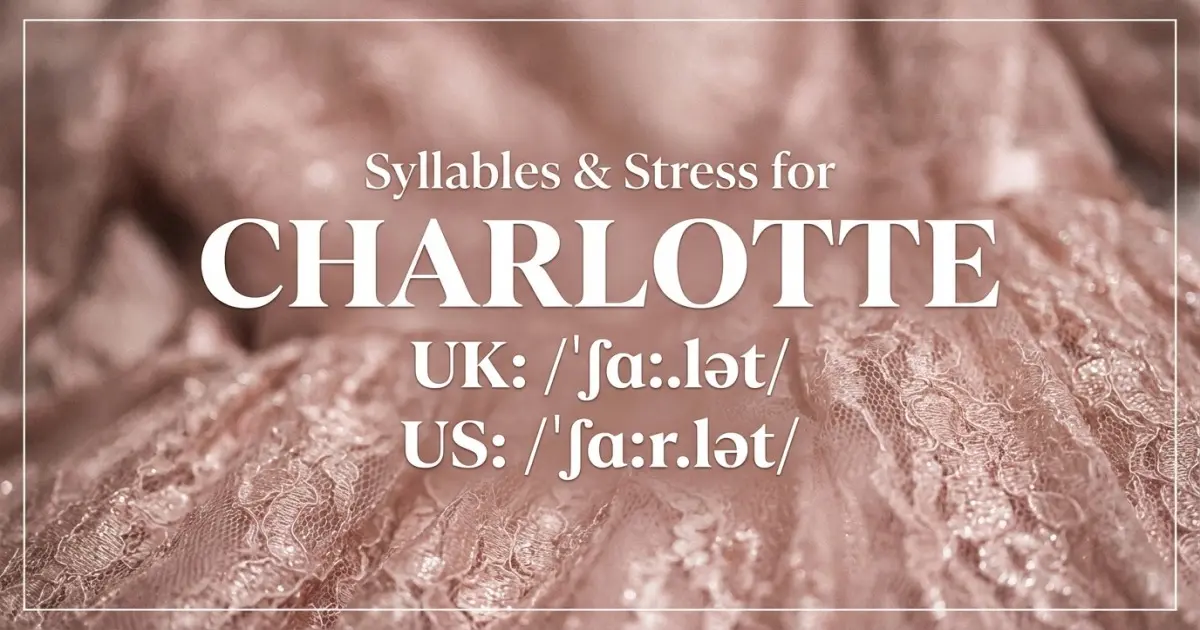
The standard everyday form is SHAR-luht. It has two syllables, with the stress placed clearly on the first. In American IPA that is /ˈʃɑːrlət/. In British IPA it is commonly given as /ˈʃɑːlət/. The difference is modest, but worth understanding. American speech often keeps a clearer r sound in the middle, while many British accents soften or reduce it. Either way, the name remains recognizably Charlotte. The important point is that the spoken form is compact, not ornate. Charlotte may look like a long literary name, but it is carried in speech by a direct, efficient rhythm.
How Charlotte Is Actually Said When It Leaves the Page
| Element | Phonetic Detail | Quick Tip |
|---|---|---|
| Everyday pronunciation | SHAR-luht | Keep it to two syllables and let the first one carry the weight. |
| US IPA | /ˈʃɑːrlət/ | In American speech, the middle r is usually audible and helps anchor the name. |
| UK IPA | /ˈʃɑːlət/ | Many British accents lighten or drop the r, but the rhythm stays the same. |
| Syllable count | 2 syllables | Do not over-expand the spelling into three beats. Charlotte is more compact than it looks. |
| Stress pattern | First syllable stressed | The strong opening is what keeps the name poised rather than fussy. |
| Opening sound | /ʃ/ as in “sh” | Start with a soft fricative, not a hard ch sound. |
| Ending | Light unstressed -luht | Finish gently. The last syllable should sound relaxed, not theatrical. |
The table clarifies the practical reality: Charlotte sounds polished not because it is elaborate, but because it is controlled. The spelling carries visual richness. The pronunciation keeps that richness from becoming cumbersome.
Charlotte Finds Its Authority in the First Syllable
Why the stress belongs at the front
The first syllable of Charlotte does most of the name’s public work. SHAR is where the name announces itself, and that front-loaded stress gives Charlotte its authority. If the first syllable is weak, the name begins to sound uncertain. If the second syllable is overemphasized, the name can turn stagey. The ordinary English pattern is firm and simple: SHAR-luht, not shar-LOTTE and not char-LOT. The sound matters more once you know what the name is meant to carry, which is why the wider frame starts in Charlotte meaning.
This stress pattern matters because Charlotte is visually larger than it is phonetically. The spelling might tempt some speakers to treat it like a more ceremonial French form, but everyday English use has already settled the rhythm. The name begins strong and ends lightly. That is one reason it feels so balanced across age groups. A child’s name must be easy to call quickly, and Charlotte succeeds because the sound gets to its center of gravity immediately.
What the consonants are doing inside Charlotte
Charlotte begins with /ʃ/, the sh sound, which is a fricative. That means the air passes through a narrow channel rather than being stopped completely. It gives the opening a soft, brushed texture. This is part of why Charlotte sounds graceful rather than blunt. The name does not hit the ear with a hard attack. It arrives smoothly.
In many American pronunciations, the following r acts as a liquid consonant. Liquid consonants help speech flow, and Charlotte benefits from that. The r keeps the name from sounding flat. In British speech, the r may be reduced or not fully pronounced, but the shape still holds because the stress and vowel pattern remain stable. The final syllable ends in a relaxed schwa-like sound, which is the reason the name tapers so naturally. Charlotte does not slam shut. It settles.
Charlotte in American and British Speech Is More Similar Than Different
Where the accent difference really lives
The most noticeable difference between the American and British forms of Charlotte is not the stress or the number of syllables. It is the treatment of the middle r. American English is usually rhotic, which means speakers often pronounce the r clearly, giving the name a sound closer to SHAR-luht. Many British accents are non-rhotic, so the name can sound smoother through the middle, closer to SHAH-luht. The rhythm, however, remains the same.
This is why Charlotte travels well. The accent shifts are real, but they do not change the name’s identity. A good internationally usable name can survive small regional differences without requiring a new pronunciation lesson in every room. Charlotte does that well. Its first syllable still carries the stress, and the second still lands lightly. The structure survives the accent change.
Why the spelling can mislead some speakers
Because Charlotte has French roots, some people briefly wonder whether the final letters should be pronounced more fully, almost as though the name were ending in a stressed lot or even a more French-sounding lotte. In standard everyday English, that is not how the name is usually handled. The final syllable is lighter and more reduced. The elegance of Charlotte comes partly from that reduction. It stops the name from becoming overperformed.
Historically influenced spellings often create this effect. The page preserves more complexity than the spoken form does. Charlotte is a good example of the difference between visual elegance and spoken ease. Parents often love it for exactly that reason.
Charlotte’s Most Common Mistakes Are About Weight, Not About Sounding Wildly Wrong
Over-pronouncing the ending
The most common mistake is not dramatic mispronunciation. It is giving the final syllable too much emphasis. When speakers over-articulate the ending, Charlotte can sound overformal or almost performative. The fix is simple: keep the last syllable audible, but relaxed. It should feel like a gentle landing, not a second spotlight. Once the sound pattern is clear, some shortenings stop feeling optional and start feeling natural, and the clearest map is in Charlotte nicknames.
Starting with a hard ch
Another occasional issue is reading the opening as a hard ch sound rather than sh. In current English usage, Charlotte begins with sh, not with the sound heard at the beginning of words like chair. Once that opening is corrected, the rest of the name usually falls into place quickly.
Letting the spelling create a third syllable
Because the name looks long, some speakers are tempted to stretch it. Charlotte should remain a two-syllable name in the standard pronunciation given here. Once a third beat is introduced, the name begins to lose the efficient grace that makes it so usable in real life.
Sound neighbors can help. Compare Charlotte with Scarlett, which also opens with a strong stressed syllable and ends in a lighter one, though with a firmer stop. Compare it also with Lottie, one of Charlotte’s best-known nickname forms, which makes the second half of the name more obvious. These comparisons help the ear notice what Charlotte is doing: a strong front, a softened close, and no extra flourish in the middle.
Practicing Charlotte Until It Sounds Natural at Family Speed
Break Charlotte into two clean beats
The easiest practice method is to say the name as two clear parts: SHAR + luht. Once that feels comfortable, speed it up without adding extra weight to the end. The first syllable should still remain stronger than the second.
It also helps to use the name in ordinary sentences rather than in isolation. That is where pronunciation proves itself. Try these practice lines:
- Charlotte, your turn.
- This is Charlotte from preschool.
- Charlotte will be here at noon.
- Have you met Charlotte yet?
What correct pronunciation should feel like
When Charlotte is being said naturally, it should feel composed rather than effortful. The mouth should move through the opening sh smoothly, land the stressed first syllable clearly, and then relax into the unstressed ending without drama. If the name feels too long, too fussy, or too theatrical, the speaker is probably doing too much. Charlotte sounds best when treated as a highly familiar classic, not as a linguistic performance.
That is the final lesson of the name’s pronunciation. Charlotte looks decorated, but it speaks plainly. It carries history in the spelling and efficiency in the mouth. That balance is one reason it remains so successful: parents get the visual richness of a classic name without having to manage a difficult spoken form. Say it with two syllables, give the first one the authority it deserves, and let the second fall away softly. That is where Charlotte sounds most like itself.
Common Questions About Saying Charlotte
Is Charlotte usually pronounced with two syllables or three?
Charlotte is usually pronounced with two syllables in everyday English: SHAR-luht. The spelling looks longer than the spoken form.
Where does the stress go in Charlotte?
The stress goes on the first syllable. The strongest part of the name is SHAR, while the ending is lighter and unstressed.
Do Americans and Britons pronounce Charlotte very differently?
Not very differently. The main change is usually the middle r, which is more audible in many American accents and softer in many British ones. The overall rhythm stays the same.
What pronunciation mistake happens most often with Charlotte?
The most common issue is over-pronouncing the ending or making the name sound more formal than it needs to. Charlotte usually sounds best when the final syllable stays light and relaxed.