
Catalina Name Meaning: Origin, Character, and Quiet Strength
Catalina is one of those names that changes its own meaning as soon as you hear it spoken aloud. On paper, “pure” can look like a quiet, almost fragile definition—something pale, static, or overly idealized. But Catalina does not sound fragile. It arrives in four syllables, each one opening the next, and by the time the name reaches its final -lee-nuh, purity has become something else entirely: clarity, steadiness, a clean line of identity carried with confidence. That is the first important truth about Catalina. Its meaning may begin in the language of purity, but its sound turns that idea into motion.
That helps explain why Catalina feels richer than a simple translation might suggest. Official Social Security Administration (SSA) data shows the name at No. 128 for girls in the latest U.S. year provided here, a position that says a great deal about where Catalina now lives socially. It is known, but not tired. Recognizable, but still vivid. Its primary form is Spanish, and historically it belongs to the much larger Catherine family, which has long been associated with “pure” across languages. But Catalina does not merely borrow that legacy. It reframes it. In this form, purity does not sound severe or withdrawn. It sounds luminous, expansive, and self-possessed.
Catalina's U.S. popularity rank over time, 1893–2024
Popularity statistics are based on official data from the Social Security Administration baby name records.
Catalina: A Lyrical and Radiant Spanish Choice
Catalina reads as a name with one unmistakable center of gravity, with its primary visibility anchored firmly in its primary lane. Its rise to a peak in 2024 often reflects a naming-culture interest in vowel-rich names that carry a sense of “pure” charm and island association .
The absence of crossover usage reinforced a clear and focused feminine profile. As a lyrical Spanish variant, its melodic four-syllable sound provides an elegant and modern texture.
Catalina in one clear frame before the deeper story begins
| Key Facts | Information | Quick Insight |
|---|---|---|
| Name | Catalina | Distinctive without being obscure, Catalina feels established and expressive at the same time. |
| Primary gender usage | Female | The name reads clearly feminine, but with enough substance and structure to avoid sounding delicate or ornamental. |
| Primary origin | Spanish | The Spanish form gives the name warmth, movement, and a sense of cultural continuity rather than borrowed trendiness. |
| Primary meaning | Pure | In Catalina, purity feels less like innocence alone and more like clarity, integrity, and internal coherence. |
| Pronunciation | kat-uh-LEE-nuh | The long, open rhythm helps the name sound energetic and graceful rather than restrained. |
| IPA (US / UK) | /ˌkætəˈliːnə/ / /ˌkætəˈliːnə/ | The same IPA in both major English standards makes Catalina unusually easy to carry across accents. |
| Syllable count | 4 | Four syllables give Catalina drama and sweep, but the stress pattern keeps it manageable in daily speech. |
| Latest U.S. year | 2024 | This is a current name, not a purely archival or nostalgic revival. |
| U.S. girls’ rank (2024) | No. 128 | Catalina sits in a useful middle space: visible enough to feel familiar, selective enough to feel intentional. |
Catalina takes a traditional meaning and gives it more air
Why “pure” does not sound passive in Catalina
“Pure” is one of the oldest and most durable name meanings in the European tradition, yet it can easily be misunderstood by modern ears. In everyday speech, purity can sound moralizing, decorative, or too abstract to feel alive. Catalina changes that impression because the sound of the name refuses stillness. It unfolds. The movement matters. Instead of a clipped or tightly managed form, Catalina gives the idea of purity breadth. It sounds like something lived, not merely preserved.
That shift is central to the name’s appeal. In Catalina, purity does not feel like absence. It feels like intactness. A person who is pure in this older naming sense is not necessarily naïve or sheltered. She is clear, unspoiled in intention, internally consistent, and difficult to confuse with anyone else. That is a much more powerful idea, and Catalina carries it unusually well. The sound supports the meaning by giving it openness rather than austerity.
Catalina makes the meaning feel social rather than cloistered
Another reason the meaning lands differently here is that Catalina is such a public-sounding name. It does not retreat into itself. It has four syllables, a strong central stress, and a generous melodic line. That makes the name feel sociable and worldly. The result is important: the idea of purity is not trapped in private spirituality or personal innocence. It enters the world. Catalina sounds like a name that can belong in conversation, travel, work, art, family life, and public identity without shrinking.
This is a rare balance. Some names with “pure” behind them feel prim. Some feel antique. Some feel prettified. Catalina avoids all three. It carries the meaning with confidence, not self-consciousness. That is one reason it remains attractive in a naming culture that often wants depth without heaviness.
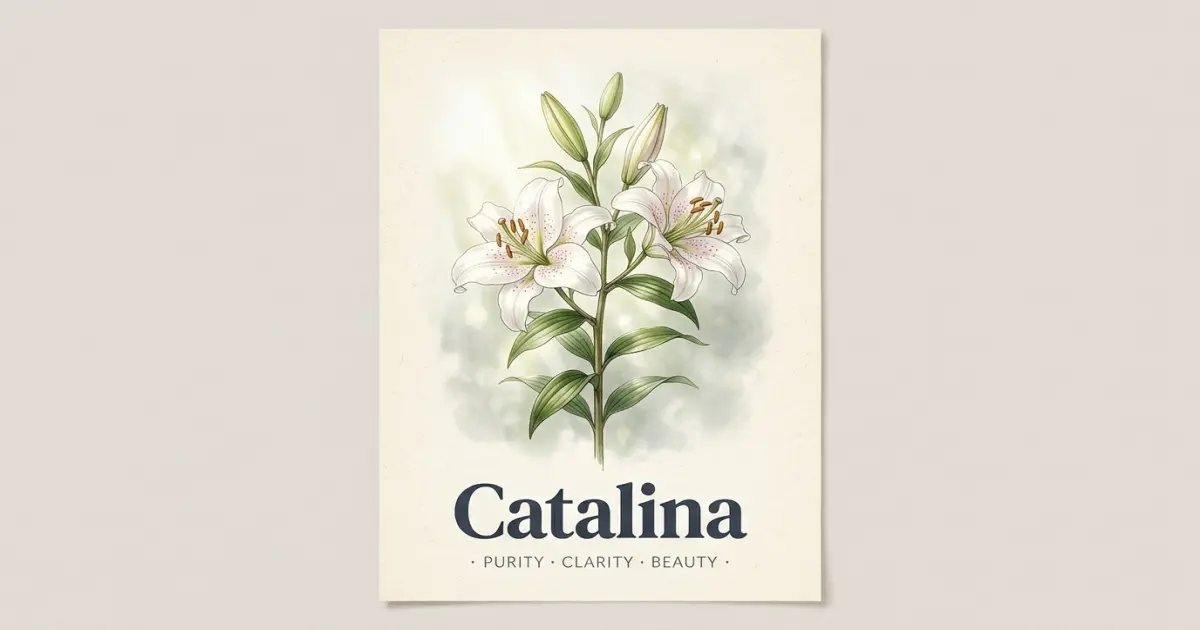
Catalina belongs to the Catherine family, but it is not only a variant
The larger family behind the name
Historically, Catalina belongs to the same broad lineage as Katherine, Catherine, Catarina, Caterina, Catrin, Catriona, and many other forms that have traveled through Greek-rooted naming traditions into different languages. Naming references consistently connect Catalina to that wider family and describe it as a Spanish form of Katherine or Catherine. That matters because it places Catalina inside one of the most resilient naming networks in Western naming history. It is not a freestanding invention. It comes with ancestral depth already built in.
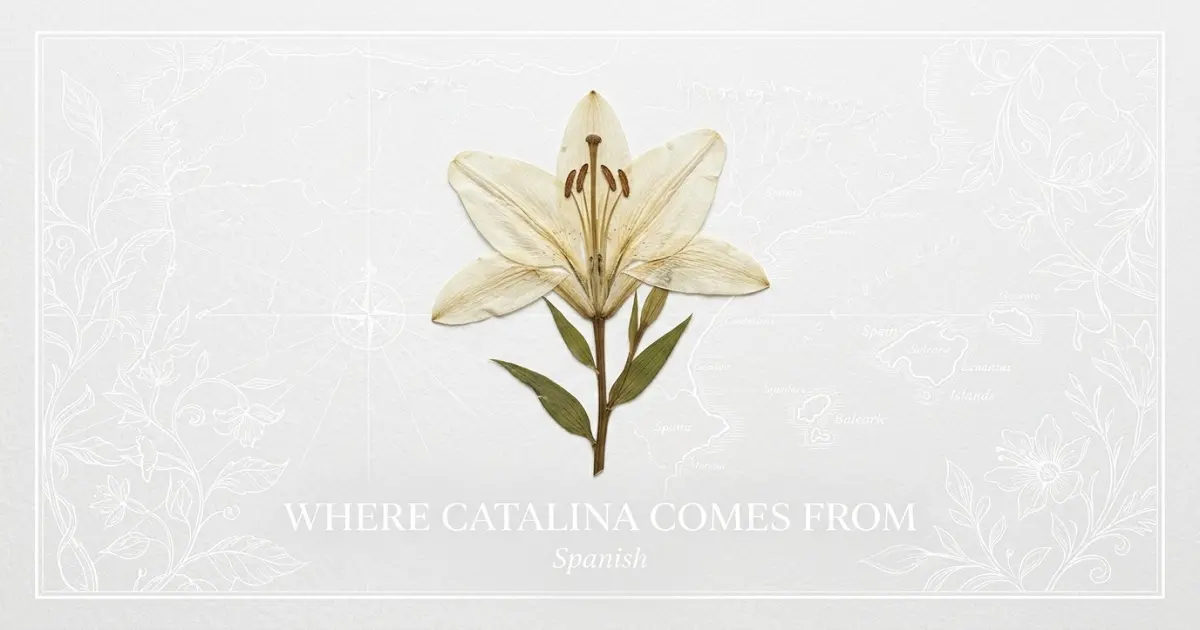
Yet family connection is not the same thing as sameness. Catalina does not merely function as Spanish Catherine. It has its own social effect. Where Catherine can sound crisp and Anglo-classic, and Katherine can sound more direct and familiar, Catalina sounds more expansive and luminous. The lineage gives it legitimacy, but the Spanish form gives it atmosphere.
Why the Spanish form changes the emotional register
Form matters. A name may share root and meaning with another, while sounding emotionally different in practice. Catalina is a perfect example. The Spanish shape softens and elongates the older material. Instead of the clipped firmness of Catherine, Catalina brings warmth and sweep. Instead of the more neutral English public sound, it introduces a stronger melodic pattern and a more obviously international identity.
That change in register is one reason many parents are drawn to Catalina even when they are already familiar with the Catherine family. They are not just choosing the same name in another language. They are choosing a different social mood. Catalina feels more spacious, more romantic, and often more vivid, while still carrying the same rooted meaning of purity.
Catalina as inheritance rather than novelty
This larger naming family also protects Catalina from feeling like a fashion experiment. Even when the name sounds fresh in a given community, it is not structurally new. It has older relatives everywhere. That allows parents to choose it for distinctiveness without sacrificing continuity. Catalina stands out, but it does not stand alone.
That distinction matters in modern naming culture. Many families want names that feel uncommon without seeming manufactured. Catalina answers that need very well. It is memorable, but historically legible. It is beautiful, but backed by a durable naming lineage rather than a short-lived trend cycle.
Catalina sounds longer than Catherine, but more fluid than many long names
The four-syllable architecture of Catalina
Phonetically, Catalina succeeds because its length is intelligently organized. The pronunciation kat-uh-LEE-nuh gives the name four syllables, but the stress falls on the third, which keeps the line moving forward. The first two syllables prepare the ear. The stressed LEE opens the name fully. The final -nuh lets it settle without becoming abrupt. That is why Catalina sounds graceful rather than cumbersome.
Longer names often fail when their rhythm becomes muddy or overdecorated. Catalina does not. Its syllables are distinct, and its internal movement is easy to hear. This makes the name both formal and usable. It has enough length to feel special, but enough clarity to function naturally in ordinary life.
Why the matching U.S. and U.K. IPA matters
The fact that the U.S. and U.K. IPA are the same here is more important than it looks. Names with four syllables can often drift across accents or acquire awkward reductions. Catalina remains relatively stable. That stability supports the name’s social portability. Teachers, friends, relatives, and colleagues in different English-speaking environments are more likely to say it in recognizably the same way.
This helps Catalina feel less risky than some of its visual complexity might suggest. The spelling looks elegant and slightly elaborate, but the pronunciation settles quickly once heard aloud. That is part of the name’s success: it looks richer than it is difficult.
The sound keeps purity from sounding severe
Sound also changes the meaning. If Catalina were shorter, sharper, or more austere, “pure” might land as moral restraint alone. But because the name is open and melodic, the meaning feels softened into radiance, clarity, and composure. The name sounds generous. That generosity lets the meaning breathe. Instead of purity as refusal, Catalina suggests purity as presence—something clear and intact moving through the world without apology.
Catalina is having a modern life without giving up its older identity
What the current rank tells us
Official SSA data places Catalina at No. 128 for girls in the latest U.S. year provided here. That is a revealing rank. It places the name well within public visibility, yet not in the most saturated part of the chart. In practice, that means Catalina is familiar enough that many people have already heard it, but not so common that it loses its edges. This is often the sweet spot for names with strong cultural character. They remain accessible while preserving their individuality. If you want a wider view beyond Catalina, browse more girl names and meanings.
The current rank also suggests that Catalina is not depending on old-world charm alone. It is not simply being admired at a distance as a beautiful heritage form. It is being used. That matters because some names feel attractive in theory but never quite enter ordinary naming life at scale. Catalina has crossed that threshold. It is active, modern, and fully available as a present-tense choice.
Why Catalina feels fresher than many names with older roots
Catalina benefits from a useful paradox. It is historically rooted, but in many English-speaking communities it still feels more vivid and less overprocessed than more familiar cousins like Catherine, Katherine, or Katie-based forms. That freshness does not come from novelty. It comes from perspective. Catalina sounds like inherited material heard from a new angle. For more names shaped by the same tradition, explore related names from Spanish heritage.
That makes the name attractive to parents who want cultural depth without antique heaviness. Catalina has history, but it does not sound burdened by history. It has elegance, but not stiffness. It has clarity, but not plainness. Few names manage all three at once.
What people hear in Catalina before they know its meaning
Catalina projects warmth and polish at once
Socially, Catalina tends to communicate something many names struggle to balance: polish without distance. It sounds refined, but not cold. It sounds feminine, but not fragile. It sounds expressive, but not chaotic. The name’s Spanish shape gives it warmth, while its older root family gives it seriousness. That is a highly effective combination in modern naming culture, where families often want names that feel sophisticated without sounding inaccessible.
Because of that, Catalina can sit comfortably in many different environments. It can sound natural in multilingual families, in artistic circles, in professional life, and in ordinary daily use. It has enough structure to age well and enough melody to feel alive early on. That breadth is one of its most practical strengths.
Its style neighbors show what kind of beauty it carries
Catalina belongs among names that are elaborate without being fussy, international without becoming difficult, and historically grounded without seeming old. Its beauty is not the clipped minimalism of ultra-short modern names, nor the lacework of highly ornamental vintage revivals. It occupies a middle field: flowing, bright, and self-possessed. That gives it unusual versatility. It can be glamorous, but it does not depend on glamour. It can be scholarly, but it does not feel severe. It can be romantic, but it does not lose its clarity.
This is where the meaning “pure” returns again in a deeper way. Catalina sounds coherent. Everything in the name pulls in the same direction: the lineage, the rhythm, the vowel flow, the cultural form, the current rank, the social impression. It is a name of internal alignment, and that may be the deepest sense in which it deserves its meaning.
Three practical paths that open naturally out of Catalina
Catalina and the middle-name question
Because Catalina is already four syllables and strongly melodic, middle names usually work best when they either add crispness or deepen the line with something calm and classic. If you want the full pairing logic behind that contrast, see Catalina middle names.
What nicknames Catalina quietly invites
Catalina offers more nickname room than many elegant names do, from clipped forms like Cat and Lina to softer family options that draw on its full melodic structure. To see how those different moods shorten in real life, explore Catalina nicknames.
Why Catalina is easier to pronounce than it first looks
The name appears elaborate on paper, but its stress pattern and matching U.S./U.K. IPA make it far more straightforward in speech than many parents assume. If you want the full sound pattern behind that rhythm, read Catalina pronunciation guide.
Why Catalina keeps its clarity
Catalina is a name that demonstrates how a very old meaning can survive by changing its soundscape. “Pure” in another form might feel too static, too austere, or too heavily inherited. In Catalina, it becomes luminous and kinetic. The Spanish form gives the name breadth. The Catherine family gives it history. The four-syllable rhythm gives it drama without excess. The current U.S. rank places it in a strong modern position: seen, heard, and still distinct.
That is why Catalina endures in the imagination after it is spoken. It sounds like a name that knows exactly what it is doing. It is not minimal, but it is clear. It is not old-fashioned, but it is rooted. It is not fragile, but it is refined. In the end, Catalina makes one of the oldest naming ideas feel newly credible. Purity here is not smallness. It is a clean and radiant sense of self. And that is why Catalina continues to feel both inherited and alive.