
How to Pronounce Cassidy: A Simple Way to Get the Stress Right
The real pronunciation test for Cassidy does not happen in a linguistics classroom. It happens in ordinary rooms. A teacher pauses over the attendance sheet on the first day of school. A coach reads a roster aloud at practice. A receptionist looks up from a clipboard and has one chance to say the name naturally. Cassidy usually passes that test well because it looks almost exactly like the way English speakers expect it to sound. The eye sees three syllables, a strong opening, and a familiar ending. The mouth follows without much resistance. That matters more than many parents realize. A name that can survive first contact with strangers often becomes much easier to live with over the years.
Cassidy also benefits from an important modern advantage: it sounds friendlier and simpler than its surname history might suggest. It is Irish in origin, but in present-day English speech it does not feel difficult, ceremonial, or phonologically dense. The standard spoken form is direct: KAS-i-dee. The first syllable carries the weight, the middle syllable stays brief, and the ending lifts lightly without turning fragile. That balance is a major part of the name’s appeal. Cassidy sounds polished, but not stiff. It sounds easy, but not bland. Pronunciation is where that social ease begins.
What Cassidy is really asking your mouth to do
This quick guide clarifies why Cassidy sounds straightforward in daily life even though it has older roots and a surname structure behind it.
| Element | Phonetic Detail | Quick Tip |
|---|---|---|
| Common spoken form | KAS-i-dee | Say it in three beats, with the first beat clearly strongest. |
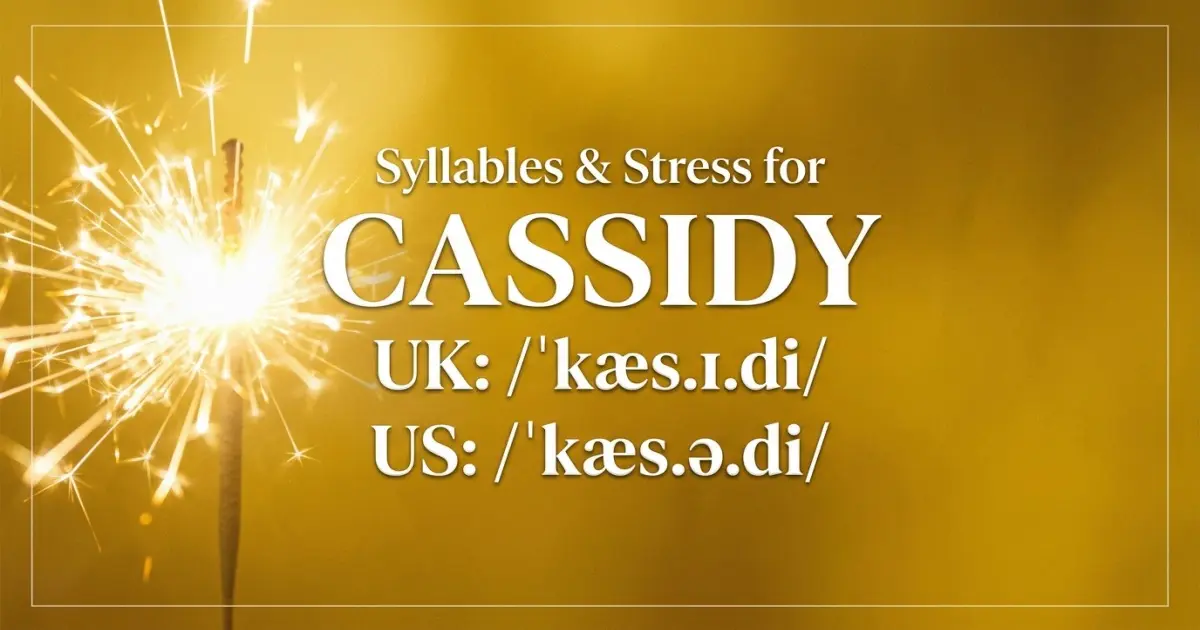
| IPA (US) | /ˈkæsɪdi/ | Keep the opening short and bright, not stretched or softened. |
| IPA (UK) | /ˈkæsɪdi/ | The standard UK form matches the same pattern, which makes the name very stable across accents. |
| Syllable count | 3 syllables | Think KAS + i + dee, not a two-syllable shortcut and not an overlong four-syllable version. |
| Stress pattern | Primary stress on the first syllable | If the last syllable gets too much emphasis, the name loses its natural English rhythm. |
| Opening consonant | /k/ | Start with a clean hard k sound, not a softened or blurred beginning. |
| Middle vowel | /ɪ/ | The middle syllable stays short and light, almost like the i in “sit.” |
| Ending sound | /di/ | Finish lightly with dee; do not over-stretch it or make it too singsong. |
Cassidy sounds easiest when the stress stays where English expects it
The most important thing about pronouncing Cassidy is stress. English listeners rely heavily on stress to identify familiar name shapes, and Cassidy has a very stable one. The first syllable is the anchor: KAS-i-dee. Once that opening stress is clear, the name usually settles into place without much effort. Before focusing only on syllables and stress, it helps to step back into the fuller frame of Cassidy meaning.
Why the first syllable in Cassidy carries the name
The opening sound begins with /k/, a voiceless stop made at the back of the mouth. It gives Cassidy a firm, clean entry. After that comes the short front vowel /æ/, the same broad short vowel English speakers know from words like “cat.” That vowel keeps the opening lively and bright. It is not dark, heavy, or rounded. Cassidy therefore begins with more energy than softness, which is one reason the name never feels limp or overly delicate.
That first syllable is also what makes the name memorable. If the KAS sound is clear, listeners can usually recognize and repeat the name immediately. This is why Cassidy works so well in public settings. The strongest identifying sound arrives first, not at the end.
How the second and third syllables keep Cassidy social
After the opening, the name relaxes. The middle syllable, /ɪ/, is quick and light. It should not sound heavy or prolonged. The final dee lifts the name with a bright ending, but because it arrives after the stressed first syllable and the reduced middle, it feels graceful rather than overly sweet. That three-part movement is important: strong opening, brief middle, light finish.
Linguistically, Cassidy benefits from this alternation. The name does not pile pressure onto every syllable. It lets one syllable lead and the others follow. That makes the full pronunciation sound natural in conversational English, where rhythm often matters as much as individual sounds.
Where Cassidy usually goes wrong in real speech
Cassidy is not a difficult name, but a few predictable mistakes still appear. Most of them happen when speakers either overcorrect toward something more elaborate or flatten the internal rhythm until the name loses shape.
The most common mistake patterns around Cassidy
The first mistake is shifting too much emphasis away from the opening. If someone says the name too evenly, or starts to lean heavily on the final -dee, Cassidy can begin to sound less settled. The second common mistake is stretching the middle so the name feels longer than it is. Cassidy should move briskly through the second syllable. It is three syllables, yes, but not three equally weighted ones.
Another mistake is softening the opening too much. Cassidy begins with a hard k sound. It should sound decisive at the front. If that edge is blurred, the name can lose some of its clarity. Parents do not need to make it harsh, but they do want it clean.
Why the spelling can mislead people only slightly
Unlike names with silent letters, unstable vowels, or imported spelling conventions, Cassidy is mostly cooperative on the page. The eye can already see the likely rhythm. That is why mistakes tend to be small rather than dramatic. People are not usually bewildered by Cassidy. At most, they may flatten the stress or over-sweeten the ending. In practical terms, that means the name requires little ongoing correction, which is one of its strongest real-world advantages.
Cassidy travels well across accents because its structure is compact and stable
Some names are easy in one accent and suddenly awkward in another. Cassidy is not one of them. The standard American and British IPA forms are the same: /ˈkæsɪdi/. That does not mean every speaker sounds identical, but it does mean the core structure remains remarkably steady.
US and UK Cassidy stay very close
In both standard forms, the opening vowel remains the same short front sound, the stress stays on the first syllable, and the ending remains a light dee. That consistency gives Cassidy a practical portability. It can move through different English-speaking environments without picking up major pronunciation instability. For parents, this matters. A name that travels cleanly is easier for a child to carry in school, work, and international settings.
The name’s lack of liquid consonants such as l or r also helps. Liquid consonants often shift noticeably between accents. Cassidy avoids that challenge. Its consonants are simpler, cleaner, and less accent-sensitive.
Sound neighbors that help people say Cassidy correctly
If someone hesitates, the easiest way to guide them is by rhythm rather than by etymology. Tell them to think KAS-i-dee. The name belongs to a very familiar English pattern: a stressed first syllable followed by two lighter ones. Once people hear that pattern, the pronunciation usually locks in immediately. Cassidy does not need a history lesson to be spoken well. It needs one clear model. The way the name resolves at the end often decides which short forms feel natural in speech, and that becomes clearer in Cassidy nicknames.
How to practice Cassidy until it sounds natural instead of rehearsed
The best way to test any name is inside real phrases. Names do not live as isolated dictionary items. They live in sentences, greetings, corrections, and everyday calls across a room.
Practice lines that make Cassidy feel automatic
- “Cassidy, it’s your turn.”
- “Have you met Cassidy yet?”
- “Cassidy is on the list.”
- “I’m looking for Cassidy.”
- “Cassidy did a great job today.”
These lines reveal the name’s natural rhythm very quickly. The first syllable takes the stress, the second stays light, and the last finishes cleanly. If the name sounds smooth in ordinary phrases like these, it will almost always work in daily life.
A final Cassidy pronunciation check
If you want one fast self-test, listen for three things. First, is the opening clearly KAS? Second, is the middle syllable brief rather than heavy? Third, does the ending sound like a light dee rather than an exaggerated sing-song finish? If the answer is yes to all three, you are almost certainly pronouncing Cassidy well.
That is the quiet strength of this name. Cassidy looks approachable, and it sounds approachable too. The pronunciation is clear enough for strangers, stable enough across accents, and lively enough to give the name character. In everyday life, that combination matters more than many parents expect. It is one of the reasons Cassidy remains so wearable.