
Carlos Name Meaning: A Timeless Choice with Meaningful Roots
At first hearing, Carlos sounds effortless. It is one of those names that enters a room already assembled: warm, clear, social, and fully adult without losing its ease on a child. But the reason it carries that ease is older than style. Its central meaning, “free man,” belongs to a vocabulary that once described status, dignity, and standing in the world. Before freedom became a purely emotional ideal, it was also a condition of life: to be free rather than bound, self-directed rather than owned, publicly recognized rather than socially diminished. That older seriousness still lingers inside Carlos. The name sounds relaxed, but its core idea is not casual. It is about personhood with weight.
That is what makes Carlos more interesting than a simple Spanish classic. It turns freedom into something civil rather than rebellious. This is not the lonely freedom of escape, nor the loud freedom of performance. Carlos suggests a freedom that can live among other people: cultured, named, accountable, and visible. Official Social Security Administration (SSA) data places Carlos at No. 135 for boys in the United States in 2024, which helps explain why the name still feels so alive. It is recognized at once, but it has not been flattened by overuse. Add the strength of its two-syllable sound, the long history of its connection to the Charles family of names, and its visibility across music, literature, and everyday bilingual life, and Carlos begins to look like what it really is: a name that makes liberty sound social, fluent, and enduring.
Carlos's U.S. popularity rank over time, 1880–2024
Popularity statistics are based on official data from the Social Security Administration baby name records.
Carlos: A Sturdy and Noble Spanish Classic
Carlos functions as a name with one unmistakable center of gravity, sustained by a clear identity on the boys’ side for generations. This “legacy classic” reached its height in the late 1990s and continues to offer a sense of reliability and cultural familiarity parents already trust.
The lack of meaningful crossover into other tracks reinforces its focused masculine profile. Meaning “free man,” its simple two-syllable rhythm remains both professional and widely trusted across generations.
What Carlos tells you before the deeper story begins
Some names need a long explanation before they reveal their shape. Carlos does not. Its facts are unusually coherent. The Spanish form, the meaning “free man,” the brisk two-syllable rhythm, and its continued U.S. familiarity all point in the same direction: this is a name with cultural reach and stable dignity.
| Key Facts | Information | Quick Insight |
|---|---|---|
| Name | Carlos | Compact and social in sound, Carlos feels established without becoming stiff or distant. |
| Primary origin | Spanish | The name reads immediately as Spanish, which gives it both cultural specificity and wide international recognizability. |
| Meaning | Free man | This is a meaning with civic and personal force, suggesting dignity, independence, and adulthood. |
| Pronunciation | KAR-lohs | The strong first beat and open second syllable give the name warmth without softness. |
| Syllable count | 2 | Two syllables make Carlos efficient in daily life, which helps it travel well across ages and settings. |
| Name family | Charles / Carl / Carlo / Carlos | Carlos belongs to a deep European naming family, so it feels inherited rather than newly assembled. |
| U.S. boys’ rank (2024) | No. 135 | The name remains visible enough to feel familiar, but not so crowded that it loses individual shape. |
| Style impression | Cross-cultural classic | Carlos manages something many names fail at: it sounds worldly and ordinary at the same time. |

Carlos and the weight hidden inside “free man”
“Free man” is one of the most durable meanings in the Western naming tradition because it ages well. A great many name meanings are lovely on infants and decorative on adults. Carlos works in the opposite direction. The older the bearer becomes, the more the meaning seems to fit. That is because freedom, in this context, is not a vague ideal. It implies standing, agency, and personal shape. Research across naming traditions often shows that parents are drawn to meanings that sound aspirational without becoming sentimental. Carlos does exactly that. It gives a boy a name that can be affectionate in childhood but never leaves adulthood out of the picture.
The phrase also has historical density. In the wider Charles and Carl family of names, reference works have long moved among related ideas such as “free man,” “man,” “adult,” and “full-grown man.” That variation is revealing. It suggests that the real center of the name has always been human status rather than ornament: a person standing in his own social and moral frame. Modern usage has preserved the noblest and most resonant version of that cluster, which is why “free man” remains the clearest reading now.
What matters most, though, is how Carlos refines the meaning. Some liberty-themed names can sound ideological or abstract. Carlos does not. It gives freedom a face, a voice, and a social setting. The name feels less like a slogan and more like a presence. That may be why it has held on across centuries and across languages. Carlos does not promise rebellion. It promises self-possession. It is a name that suggests a man who belongs to himself, and therefore can belong well in the world around him.
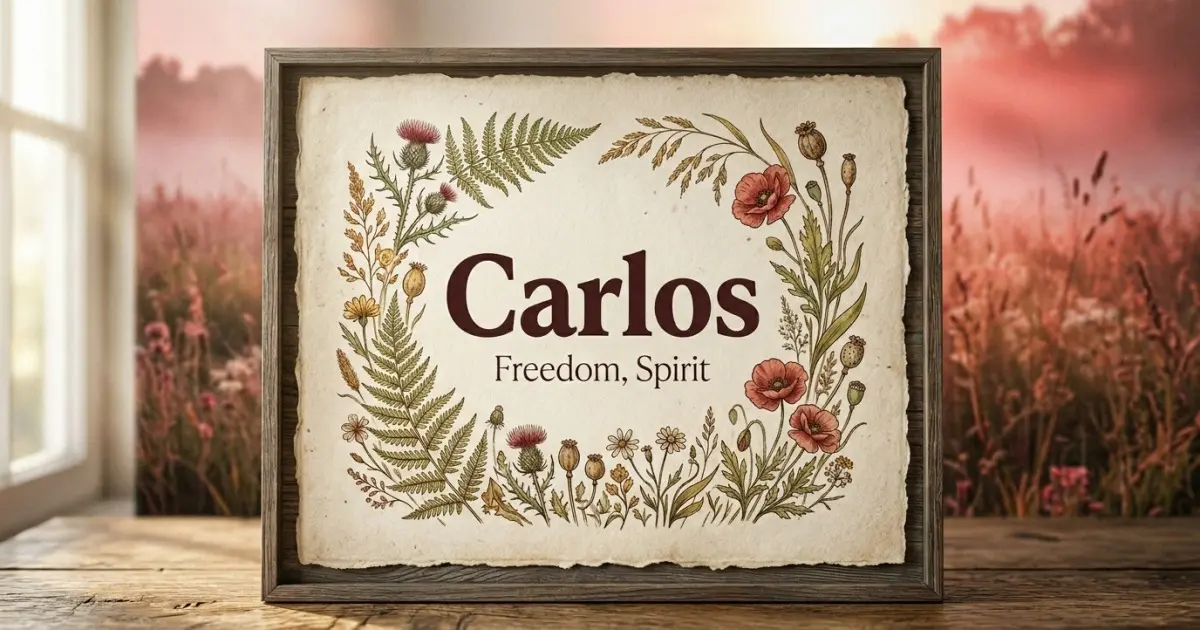
How Carlos carried the Charles family into Spanish-speaking life
Carlos is not an isolated invention. Naming references consistently place it inside the large and influential Charles family of names. That lineage matters because it explains why Carlos feels both specific and familiar. It is distinctly Spanish in form, yet it is also part of a broader European network that includes Charles, Carl, and Carlo. Some baby-name books describe Carlos directly as the Spanish equivalent of Charles; others describe it as the Spanish and Portuguese form of Carl or as a shortened relation within the same family. Whatever route the etymology takes through those variants, the effect is the same: Carlos inherits depth.
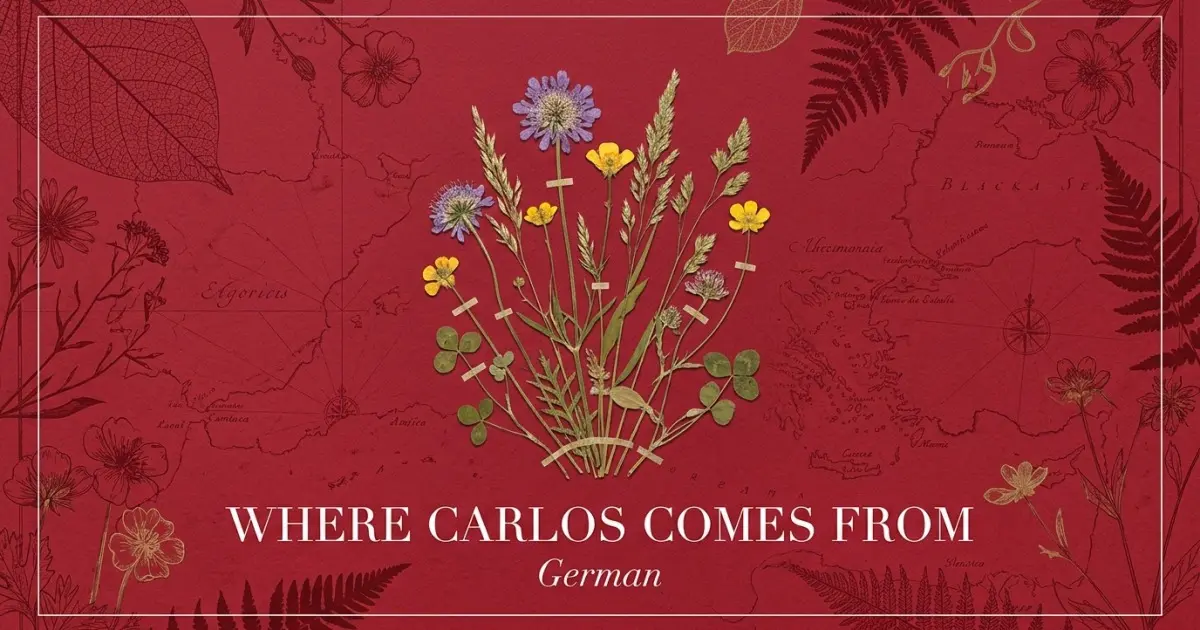
The family resemblance behind Carlos
This relationship to Charles is not merely technical. It helps shape the emotional identity of the name. Charles in English often feels formal, historical, and slightly reserved. Carl can feel sturdy and pared down. Carlo feels Mediterranean, polished, and somewhat theatrical. Carlos stands apart by sounding fuller socially than Charles and more expansive than Carl, while retaining more everyday gravity than some of its romance-language cousins. In other words, Carlos takes the old root and gives it public warmth.
That warmth is one reason the name has traveled so well. A name like Carlos can stand firmly inside Spanish-speaking tradition while still remaining immediately intelligible to English speakers. This is not true of every culturally specific name. Some require explanation. Carlos usually does not. It arrives carrying both heritage and legibility, which is part of its long-term strength.
Carlos as an example of adaptation without dilution
There is also something instructive in the way Carlos adapts an older European name family without losing cultural definition. Many names that travel broadly become flattened into generic international style. Carlos does not flatten. It stays Spanish in cadence and visual identity. That makes it appealing to parents who want a name with both rootedness and reach. It says where it comes from, but it does not become inaccessible to those outside that origin. To discover what else belongs to this origin group, browse a wider list of Spanish names.
This is one of the finest qualities a name can have in the modern world. It does not erase its history in order to be usable. It carries its history forward. Carlos manages that balance unusually well.
Why Carlos sounds warmer than Charles but no less serious
If meaning explains Carlos intellectually, sound explains it emotionally. The name’s everyday form, KAR-lohs, is one of the reasons it reads as strong but approachable. The first syllable opens wide and lands with certainty. Then the second syllable releases in a rounded, outward way. This makes Carlos a name with both edge and welcome. It announces itself clearly, but it does not close down afterward.
That matters in comparison with neighboring names. Charles ends in a tighter, more closed sound. Carl is even more compact and abrupt. Carlos, by contrast, remains public in the mouth. The final -os gives the name breath and social light. It is easier to imagine it spoken across generations, across households, across languages, because it feels designed for actual speech rather than just formal inscription.
Phonetically, the two-syllable structure is doing a great deal of work. There is no wasted movement in Carlos. The opening consonant is firm, the vowel broad, the liquid l helps the name turn smoothly at the center, and the ending leaves a mild resonance rather than a hard stop. This gives the name confidence without heaviness. It is one reason Carlos can suit both a child on a playground and an adult in a formal introduction without sounding like two different names.
The sound also supports the meaning. A name meaning “free man” could easily have become severe, especially if its sound were clipped or martial. Carlos avoids that trap. It makes freedom sound lived-in rather than declarative. That is a rare achievement. The name is dignified, but it is not cold.
Carlos in public culture and modern social memory
A name becomes durable not only through etymology but through repeated public life. Carlos has had that kind of visibility. Naming references attach it to figures in music, literature, and intellectual culture, including Carlos Santana, Antônio Carlos Jobim, and Carlos Castañeda. These are not random examples. Together they suggest something characteristic about the name’s public image. Carlos belongs easily in artistic and expressive worlds. It sounds cultured without sounding fragile, and worldly without sounding detached.
That cultural life helps explain why Carlos feels immediately inhabited. Some names are technically well-formed but strangely empty in the modern imagination. Carlos is not empty. It has been heard in song credits, book jackets, classrooms, family trees, and ordinary neighborhoods. Because of that, it carries accumulated social memory. The name feels lived in, which is one of the most valuable forms of naming strength.
There is also a bilingual advantage here. In the United States especially, Carlos exists at the meeting point of Spanish-speaking heritage and wider American familiarity. Official SSA data placing it at No. 135 for boys in 2024 suggests that the name still holds a stable place in public life. It is not obscure, and it is not in the highly overexposed tier. That gives it a very useful social position. Carlos feels known, but not default. Parents looking for a name that signals heritage, masculinity, and everyday usability without sounding borrowed from a passing fashion often find exactly what they need here. For related naming ideas in the same category, visit boy naming ideas.
In style terms, Carlos occupies a rare middle ground. It is warmer than many Anglo classics, steadier than many fast-rising modern names, and clearer in public identity than more ambiguous international choices. It is a name with a passport and a neighborhood at once.
What Carlos feels like now: style, character, and adult versatility
The modern appeal of Carlos lies in how little it has to prove. It is not trying to sound aristocratic, eccentric, ultramodern, or deliberately vintage. Instead, it sounds like a name with internal confidence. That usually translates into strong long-term wearability. A toddler named Carlos sounds affectionate and energetic. A teenager named Carlos sounds grounded. An adult named Carlos sounds entirely at home in professional life. Many names do one or two of those jobs well. Carlos does all three.
Style-wise, it also avoids some common naming traps. It is not overly softened, so it keeps masculine clarity. It is not aggressively hard-edged, so it retains warmth. It is not overloaded with syllables or decorative spelling. And because it belongs to a long-established naming family, it does not depend on novelty to get attention. That makes it especially attractive to parents who want a name with identity rather than gimmick.
The meaning deepens this further. A “free man” is not merely independent; he is socially legible as independent. That gives Carlos a quietly civic quality. It sounds like a name for a person who moves through institutions without being swallowed by them. School, work, family life, public life—all can hold the name without making it smaller. That is part of the reason it still feels fresh even though it has never been new. Carlos is not trying to reinvent manhood. It is presenting an old, durable model of it: dignified, fluent, and self-possessed.
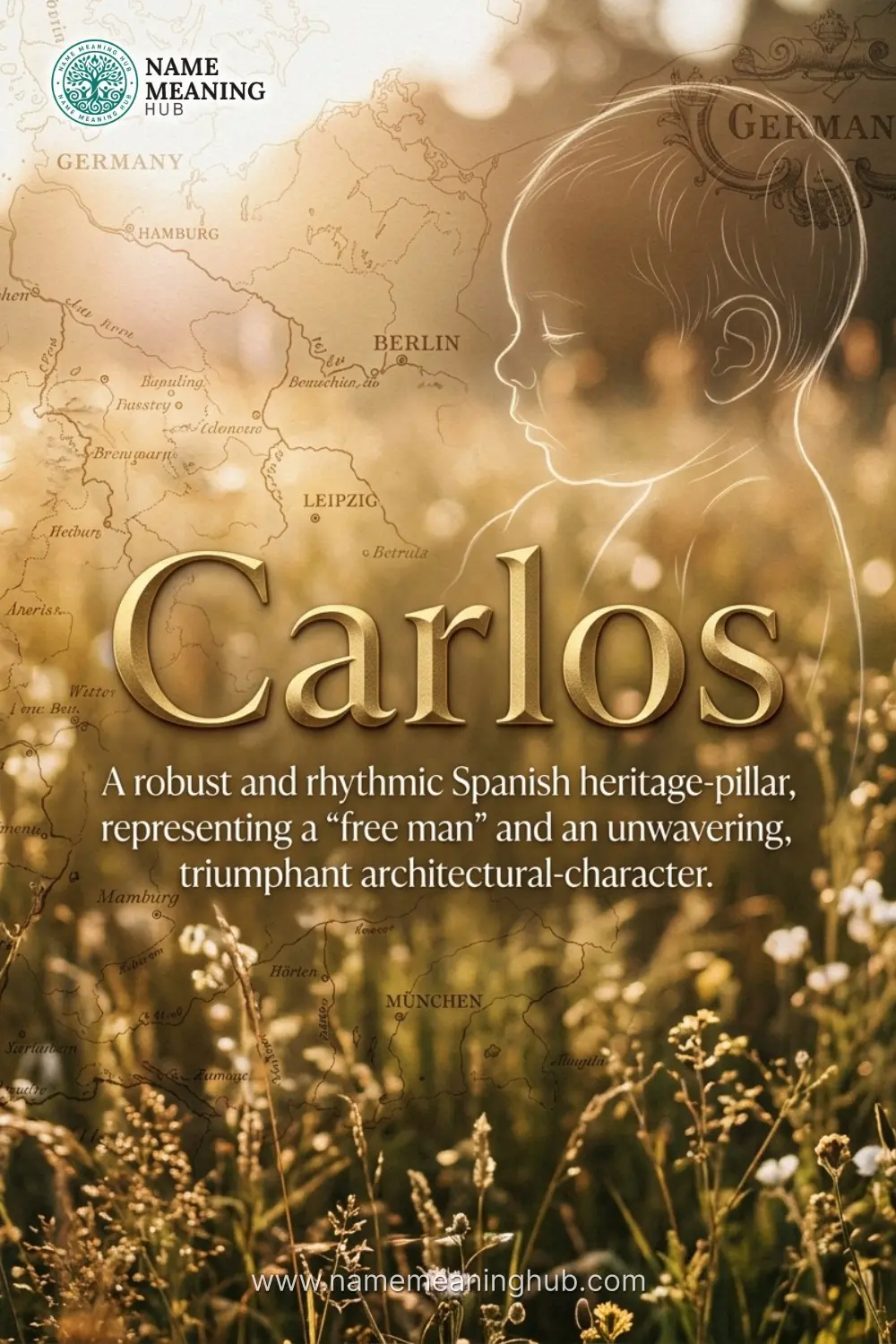
Three practical paths Carlos opens next
Middle names that steady or brighten Carlos
Because Carlos already has a strong public rhythm, middle names can either formalize it or lighten it. One-syllable middles tend to sharpen the profile, while longer or softer middles can underline its warmth. What matters most is not excess flourish but balance with the surname and overall cadence. If you want the full pairing logic behind that contrast, see Carlos middle names.
The nickname life hidden inside Carlos
Carlos offers more nickname range than its compact form first suggests. Some shortenings keep the name sleek and masculine, while others lean familial or playful. The best nickname route depends less on the spelling and more on the circle using it: siblings, teammates, grandparents, or close friends all tend to hear different possibilities. To see how those different moods shorten in real life, explore nicknames for Carlos.
How Carlos changes when spoken aloud
The pronunciation page matters because Carlos carries much of its charm in sound. The American and British forms do not behave exactly the same, and the final syllable is part of what gives the name its warmth. Hearing the name broken down can clarify why it sounds social and self-assured rather than stiff. If you want the full sound pattern behind that rhythm, read how to pronounce Carlos.
Why Carlos remains more than a translation
It would be easy to reduce Carlos to a simple statement: the Spanish form of Charles, meaning “free man.” All of that is true, and none of it is sufficient. The reason Carlos endures is that it does more than translate an old name into another language. It changes the atmosphere of that old name. It takes the inherited dignity of the Charles family and gives it warmth, movement, and public ease. It lets freedom sound human-scaled.
That may be the deepest success of Carlos. Many names with strong meanings become symbolic first and personal second. Carlos remains personal. Its history does not trap it. Its cultural visibility does not exhaust it. Its meaning does not become abstract. Instead, all three reinforce one another. The result is a name that feels rooted, worldly, and usable in the same breath.
For parents, that combination is unusually valuable. Carlos carries a moral idea without moralizing. It carries heritage without becoming narrow. It carries adulthood without skipping tenderness. In a naming culture often torn between the unusual and the overfamiliar, Carlos offers a third route: a name with history, freedom, and social grace all at once.
What Carlos finally says about freedom
In the end, the beauty of Carlos lies in the kind of freedom it imagines. Not freedom as noise, nor freedom as detachment, but freedom as form. A free man, in the deepest sense, is someone who has shape, standing, and room to act. Carlos has always carried that idea within it, and its Spanish cadence gives the idea life rather than abstraction. The name feels open to sunlight, conversation, and movement, but it never loses its backbone.
That is why Carlos continues to speak so clearly. It is a name with enough history to feel serious, enough warmth to feel lived in, and enough simplicity to stay elegant. Its sound is public, its meaning is dignified, and its legacy is still active. For parents seeking a name that joins cultural rootedness to human breadth, Carlos offers one of the oldest and most persuasive promises a name can make: that freedom, worn well, becomes character. And that is why Carlos does not merely survive. Carlos continues to belong.