
How to Pronounce Cam: Syllables, Stress, and Common Tips
The first time Cam appears on a classroom roster, a team sheet, or a clinic intake form, there is usually no long pause. The name is short enough to be read in a glance and familiar enough to be said without rehearsal. It is pronounced KAM, one clean syllable, with the same short vowel sound heard in everyday words like “cat,” “cap,” and “map.”
That simplicity is one of Cam’s great practical strengths. Official data shows Cam ranked No. 1422 for boys and No. 9646 for girls in 2024, so the name is uncommon as a standalone given name but very easy in speech. It has Scottish roots, the meanings “crooked nose; orange fruit,” and a pronunciation that stays stable in both U.S. and U.K. English. Cam may have a layered meaning story, but its sound is wonderfully direct: KAM.
How Cam Is Actually Said in One Clear Beat
| Element | Phonetic Detail | Quick Tip |
|---|---|---|
| Full Pronunciation | KAM | Say it as one short, firm syllable. |
| Syllable Count | 1 syllable | Do not stretch it into two beats. |
| Stress Pattern | Single stressed syllable | The whole name carries the emphasis because there is only one syllable. |
| Opening Sound | Hard K sound | The C is pronounced like K, not like S. |
| Vowel Sound | Short A | The vowel sounds like the A in “cat,” not the A in “came.” |
| Ending Sound | M | Close the name softly through the lips. |
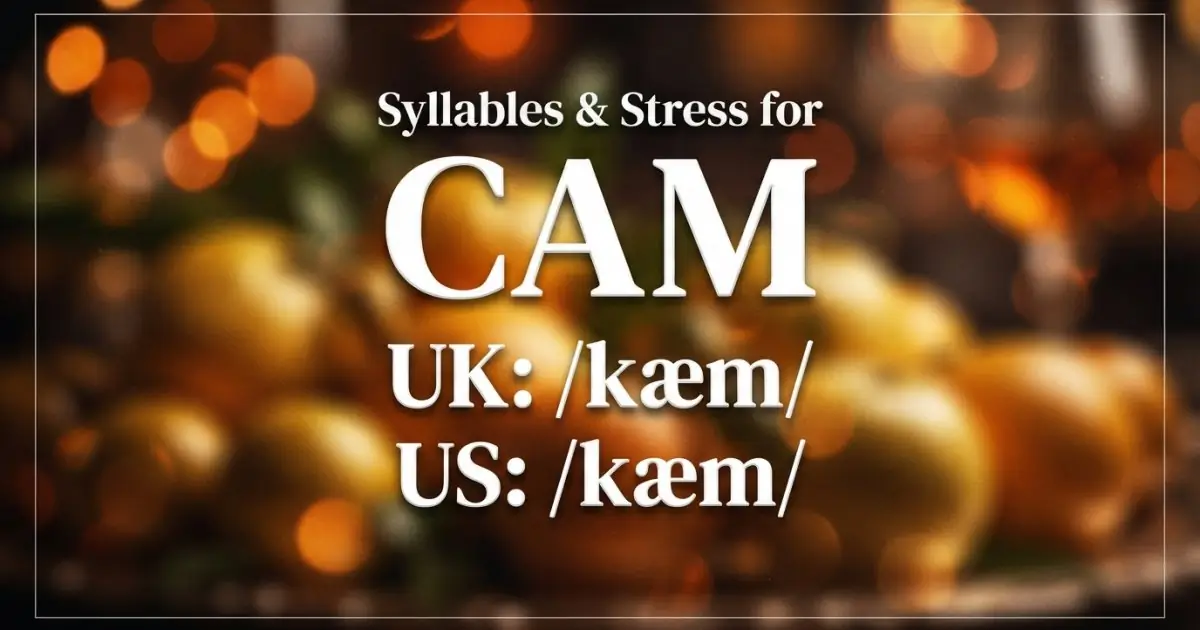
| IPA, U.S. | /kæm/ | The U.S. pronunciation is compact and direct. |
| IPA, U.K. | /kæm/ | The U.K. pronunciation matches the U.S. form. |
Cam Is One Syllable, and That Is the Whole Point
Cam’s pronunciation depends on keeping the name compact. It should not be lengthened, softened into two syllables, or pronounced as if it were a longer formal name. The full sound is KAM. That one-beat structure gives the name its confidence. It is quick enough for daily life, but not so light that it disappears. Pronunciation lands more fully when the name’s roots and history are already in view, so begin with Cam meaning.
The C in Cam is always hard
The opening letter C is pronounced with a hard K sound. This is the same sound heard at the start of “cat,” “cup,” and “coat.” Cam should not begin with an S sound. That mistake is unlikely for most English speakers, but the rule is still useful for clarity: Cam starts like cat.
In linguistic terms, the first sound is a voiceless stop consonant. That simply means the airflow is briefly blocked and released without vocal vibration. The effect is crisp and clean. For such a short name, that firm opening matters. It gives Cam structure from the first moment.
The short A keeps Cam grounded
The vowel in Cam is the short A sound, represented in IPA as /æ/. It is not the long A in “came,” “name,” or “day.” It is closer to the vowel in “map,” “cap,” and “Sam.” This short vowel gives Cam its grounded, casual quality.
That vowel also helps Cam feel friendly rather than formal. A long vowel would change the name’s whole personality. KAM is compact and sturdy; “came” would be a different word entirely. Parents introducing the name can simply say, “Cam, like the first sound in camera but shorter.”
Why Cam Sounds Firm but Still Warm
Cam has only three sounds, but each one does a clear job. The opening K gives the name a decisive start. The short A opens the center. The final M closes the name softly through the lips. Together, those sounds make Cam feel direct without becoming harsh.
The final M softens the edge
The final M is a nasal consonant, meaning the sound resonates through the nose while the lips close. This gives Cam a warmer ending than names that finish with harder sounds like t, k, or p. The name is firm at the start but gentle at the finish.
This is part of why Cam works well as both a standalone name and a nickname-like name. It feels easy to say repeatedly: Cam, come here; Cam is ready; This is Cam. The sound is efficient, but it still has human warmth.
Cam has no hidden accent split
The U.S. and U.K. IPA forms for Cam are the same: /kæm/. That does not mean every speaker’s accent will sound identical, but the basic pronunciation structure does not change. Cam remains one syllable, with a hard K opening, a short A vowel, and an M ending.
This stability is useful for parents who want a name with minimal pronunciation friction. Some names shift noticeably between American and British English. Cam does not require that kind of adjustment. It travels easily across major English accents.
Common Cam Pronunciation Mistakes Are Minor but Worth Noting
Cam is one of the easier names to pronounce, but short names can still be misread when people overthink them. Most issues come from vowel confusion, spelling assumptions, or attempts to treat Cam as a shortened form that must be expanded.
Mistake one: saying it like “came”
The clearest mistake to avoid is pronouncing Cam with a long A, as if it rhymed with “same.” Cam should not sound like came. It should rhyme with Sam. The short A is central to the name’s identity.
Mistake two: adding an extra syllable
Cam should not become Cammy unless someone is intentionally using a nickname. As the full name, Cam has one syllable. The pronunciation is not CAM-ee, KAY-em, or Ca-am. It is simply KAM.
Mistake three: assuming Cam must be short for something
Some people may ask whether Cam is short for a longer name. It can be used that way in other contexts, but Cam also works as a complete given name. Pronunciation does not change when Cam stands alone. The name remains one clear beat.
Cam in Sound Neighbors and Real-Life Practice
Cam sits near other short, crisp names such as Cal, Max, Sam, Kit, and Finn. These names work because they are easy to call aloud and hard to mispronounce. Cam shares that practical strength. It is brief, but it has enough sound to feel complete. Once the sound pattern is clear, some shortenings stop feeling optional and start feeling natural, and the clearest map is in nicknames for Cam.
Sound neighbors that help explain Cam
The easiest comparison is Sam. Cam rhymes with Sam, but begins with a hard K sound. It also shares the short A vowel found in Cal and Max. These neighbors help listeners understand the pronunciation instantly, especially if they have only seen the name written down.
Unlike names with liquid consonants such as r or l, Cam does not flow through the middle. It lands quickly. Unlike names with fricatives such as s, f, or sh, it does not hiss or slide. Its sound is compact: start, vowel, close.
Practice lines for saying Cam naturally
- Cam is here today.
- This is Cam.
- Cam, please come in.
- We saved a seat for Cam.
- Cam Alexander sounds strong and balanced.
- Please welcome Cam.
When practicing, keep the name short and confident. Cam should not be stretched or decorated. Its strength is its simplicity: one syllable, one clean vowel, one soft final consonant.