
How to Say Brooklyn Correctly: A Fast Pronunciation Guide That Helps
The real pronunciation test for Brooklyn does not happen in a dictionary. It happens in places that allow almost no hesitation: the first day of school, a receptionist calling the next appointment, a coach reading a roster, a new friend hearing the name once and deciding whether they can say it back with confidence. That is where Brooklyn proves why it has worked so well as a modern first name. It looks contemporary and place-based, but in actual speech it is compact, clear, and hard to misplace once the stress pattern is understood. The name does not ask for a performance. It asks for a clean hit.
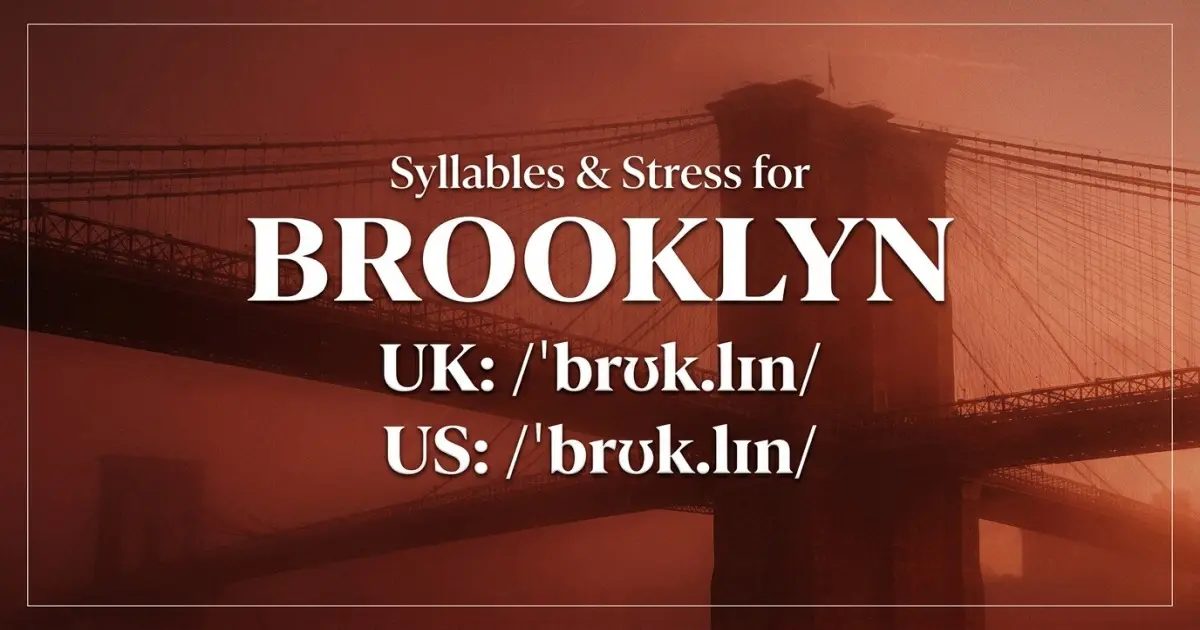
That clean hit comes from the first syllable. Brooklyn is said BROOK-lin, with the stress firmly on Brook. The second syllable is lighter and quicker. Official pronunciation data for this run gives the same IPA in U.S. and U.K. English: /ˈbrʊklɪn/. That consistency matters because it means Brooklyn is one of those names whose practical pronunciation stays stable across major English-speaking settings. There may be small accent differences in vowel color, but the shape does not change. Two syllables. First-syllable stress. Crisp opening, lighter ending.
What Brooklyn is actually asking your mouth to do
| Element | Phonetic Detail | Quick Tip |
|---|---|---|
| Everyday pronunciation | BROOK-lin | Hit the first syllable clearly and let the second move quickly behind it. |
| IPA (US) | /ˈbrʊklɪn/ | The stress mark at the front tells you the opening syllable carries the weight. |
| IPA (UK) | /ˈbrʊklɪn/ | The U.K. target matches the U.S. one here, which makes the name unusually stable across accents. |
| Syllable count | 2 syllables | Think in two beats, not three: Brook / lin. |
| Stress pattern | Primary stress on the first syllable | If the second syllable gets too much emphasis, the name starts sounding off-balance. |
| Ending sound | Short, light -lin | Do not over-stretch the ending into a full -lynn unless that is the family’s deliberate preference. |
Brooklyn works because it is built like a quick, strong phrase
Phonetically, Brooklyn is efficient. The first syllable is dense and self-contained. The second is lighter and supportive. This is one reason the name feels modern and urban in the ear. It does not drift. It strikes. Many successful two-syllable names work like this, especially names that want to sound brisk rather than ornamental. Brooklyn belongs squarely in that category. Pronunciation lands more fully when the name’s roots and history are already in view, so begin with Brooklyn meaning.
The first syllable does almost all the heavy lifting
Brook carries the identity of the name. It contains the initial consonant cluster br, which gives the name momentum right away, followed by the short vowel and the closing k, which makes the syllable feel finished and grounded. This is why Brooklyn sounds firmer than many current names ending in -lyn. The beginning gives it architecture.
It also helps that the sound br is easy for English speakers. There is no awkward cluster, no exotic vowel sequence, and no uncertainty about where the syllable closes. Even people seeing the name for the first time often get the first half right immediately because the opening is so phonetically familiar.
The second syllable should support, not compete
The final -lin is lighter and faster. It should not compete with the opening. In ordinary speech, Brooklyn is not pronounced as though both halves are equally weighted. It is not brook-LYNN in a dramatic, spotlighted way. It is BROOK-lin, where the second syllable acts more like a release than a second peak.
This is one of the reasons the name stays socially easy. A heavily stressed second syllable would make Brooklyn sound more elaborate than it is. The actual pronunciation keeps it lean.
Where people most often get Brooklyn wrong
Because Brooklyn is widely known as both a place-name and a first name, pronunciation errors are usually small rather than catastrophic. But those small shifts still change the feel of the name. Most mistakes come from over-reading the ending or from letting nearby names influence the ear.
The “Brook-LYNN” overemphasis
The most common mistake is making the second syllable too strong and too long, especially because many modern names end in -lynn or -lyn as a highlighted feature. Brooklyn is different. Its second syllable exists, but it is not the star. If a speaker says Brook-LYNN with too much force, the name begins to sound more assembled and less natural.
The fix is simple: keep the second syllable short. You do not need to crush it, but you do need to let the first syllable remain clearly dominant.
The temptation to smooth away the final consonants
Some speakers also soften the ending too much, almost blurring the name into something like Brookin. That usually happens in fast speech or in accents that reduce unstressed syllables strongly. While natural reduction is normal, Brooklyn still needs the l and n to stay audible enough to preserve the name’s shape. Otherwise, the ending loses its clarity.
This is where a small linguistic detail helps. The l in the second syllable is a liquid consonant, which means it helps the sound flow. But because it is followed quickly by n, the name still closes neatly. You want that flow, but not so much that the ending dissolves.
Brooklyn across accents still keeps the same spine
One of the most useful things about Brooklyn is that accent shifts do not usually destabilize it. The exact quality of the vowel in Brook may vary slightly. Some speakers may make the second syllable a touch shorter or lighter. But the core frame stays the same: stressed first syllable, light second syllable, clean consonant edges.
Why U.S. and U.K. English stay aligned here
For this run, the U.S. and U.K. IPA are identical: /ˈbrʊklɪn/. That means the pronunciation target is essentially shared across both major English reference systems. This matters practically. It reduces the chance that the name will need two competing “correct” explanations depending on where the family lives or travels.
That kind of consistency is one reason Brooklyn has traveled so easily from place-name into personal-name usage. Names that remain stable across accents often feel easier to commit to because parents sense, correctly, that the child is less likely to spend years constantly correcting people.
Sound-neighbors that can confuse the ear
Brooklyn sits close to a few neighbors that can nudge pronunciation off course. Brooke may tempt some people to over-soften the ending because they hear the first syllable as a complete separate name. Brooklynn, with the doubled final n, can visually encourage people to stress the second syllable too much. Names like Caitlyn or Ashlyn may also pull speakers toward a more highlighted -lyn ending than Brooklyn naturally wants.
The safest correction is always the same: return to the first beat. Brooklyn is led from the front. The rest of the name follows.
How to practice Brooklyn until it sounds natural
The easiest way to practice Brooklyn is not by over-enunciating it in isolation, but by placing it in real sentences. That reveals whether the stress and pacing feel natural in speech. Since the name is short, practice is more about rhythm than about memorizing complicated vowel symbols. The way the name resolves at the end often decides which short forms feel natural in speech, and that becomes clearer in Brooklyn nicknames.
Three easy practice lines for Brooklyn
Try these aloud:
- “Brooklyn, your table is ready.”
- “This is Brooklyn from third period.”
- “Brooklyn will call you back this afternoon.”
Each one checks something slightly different. The first tests whether the name can be called clearly in public. The second checks classroom rhythm. The third tests adult-speed conversation. If the name feels clumsy, the usual problem is that the ending is being overplayed. Bring the energy back to Brook and let -lin move quickly behind it.
A simple mouth-feel shortcut
If you do not like thinking in IPA, think of Brooklyn as a name that lands first and trails second. Brook lands. lin trails. That is all most speakers need. The first syllable is compact and finished; the second syllable is lighter and quicker. Once that physical feel is in place, Brooklyn usually becomes effortless.
That is the hidden advantage of the name. It looks stylish and place-based, but its pronunciation is remarkably practical. It gives off polish while behaving simply. For everyday life, that is often exactly the right combination.
Brooklyn Stress and Sound FAQ
How do you pronounce Brooklyn in everyday English?
The standard everyday pronunciation is BROOK-lin. The stress belongs on the first syllable.
How many syllables does Brooklyn have?
Brooklyn has two syllables: Brook and lin. Thinking of it as a two-beat name helps keep the rhythm natural.
What is the most common pronunciation mistake with Brooklyn?
The most common mistake is over-stressing the second syllable and turning it into something closer to Brook-LYNN. The correct balance keeps the first syllable dominant.
Do U.S. and U.K. English pronounce Brooklyn differently?
For this pronunciation target, the U.S. and U.K. IPA are the same. Accent color may vary slightly, but the basic structure does not: strong first syllable, lighter second syllable.