
How to Say Blake Correctly: A Clear Guide to Saying It Correctly
The most revealing pronunciation moment for a name like Blake is usually not a formal introduction. It is the split second in a waiting room, at school pickup, or on a team roster when someone sees the name written and decides whether they already know how to say it. Blake looks simple, and in everyday English it usually is simple, but names that seem effortless often work that way because their sound pattern is unusually clean. Blake is one of those names. It is short, direct, and stable, which is why most people say it correctly on first sight.
That said, the very brevity of Blake can tempt some speakers to overthink it. A one-syllable name has nowhere to hide. If the vowel is off or the ending is overdone, the whole name changes shape immediately. Blake is pronounced BLAYK. The vowel is the long a sound heard in day, and the final consonant closes the name firmly without dragging it out. Once that structure is clear, the name becomes exactly what it should be in real life: crisp, confident, and easy to repeat.
What Blake is clarifying every time it is spoken aloud
| Element | Phonetic Detail | Quick Tip |
|---|---|---|
| Everyday Pronunciation | BLAYK | Say it like the word lake with a bl- at the front. |
| IPA (US) | /bleɪk/ | The middle vowel is a long a diphthong, not a short e or flat a. |
| IPA (UK) | /bleɪk/ | The core pronunciation stays effectively the same across major English accents. |
| Syllable Count | 1 syllable | Blake lands in one clean beat, so every sound matters. |
| Primary Stress | Full word stress on the only syllable | Because Blake has one syllable, the name should sound firm and complete, not clipped halfway through. |
| Final Consonant | Clear closing k | Finish the name cleanly, but do not over-punch the ending. |
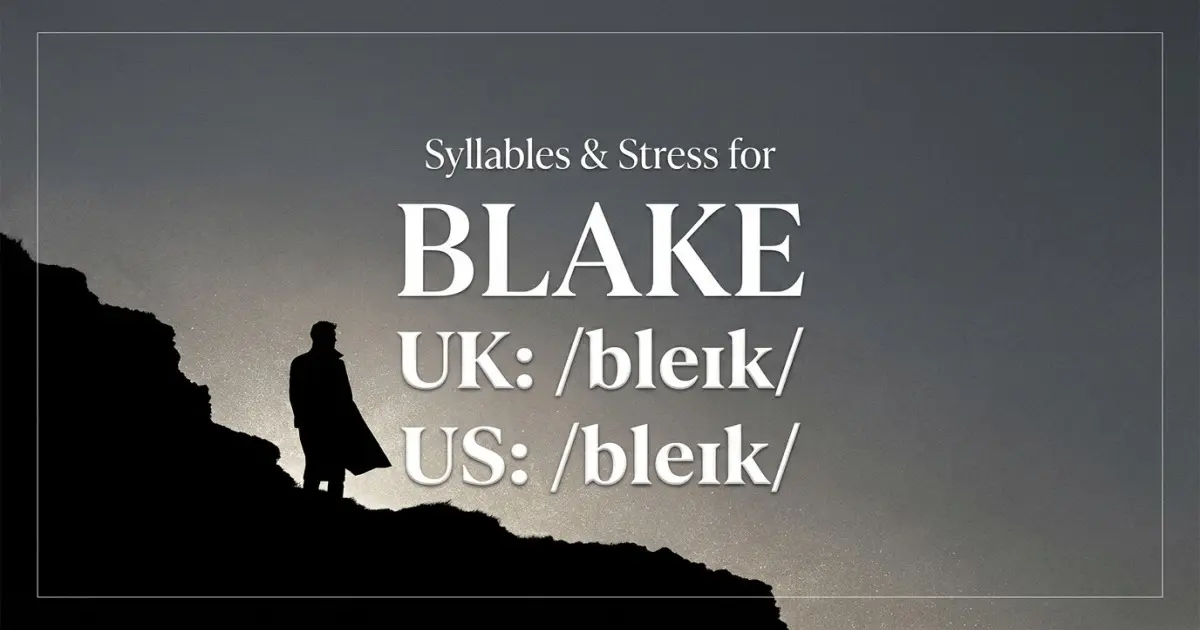
Blake works because the whole name happens in one beat
One-syllable names are often harder to describe than longer names because they leave almost no room for correction after the fact. With a two- or three-syllable name, the stress pattern can rescue the overall pronunciation even if one vowel is imperfect. Blake does not work that way. Everything important happens at once: the opening consonant blend, the long vowel, and the crisp ending. If those parts are aligned, the name sounds natural immediately. If one piece slips, the name can sound unexpectedly off. The sound matters more once you know what the name is meant to carry, which is why the wider frame starts in Blake meaning.
The good news is that Blake is built from extremely familiar English sounds. It begins with the consonant cluster bl, the same opening heard in words like blue, blame, and blank. The l here is a liquid consonant, which simply means it gives the name flow instead of making the opening feel harsh. That is one reason Blake sounds sleek rather than blunt. The consonants are firm, but the liquid l softens the movement into the vowel.
Why the vowel is the real center of Blake
The heart of Blake is the ay sound, written in IPA as /eɪ/. This is the same vowel sound heard in day, play, and say. If that vowel is correct, Blake sounds immediately right. If it shifts toward a short e or a flatter sound, the whole name changes character. Blake should never sound like bleck or black. The long a is what gives the name its brightness and lift. Because the strongest energy lands early, the shorter forms often grow from the opening of the name, and that pattern is easier to see in nicknames for Blake.
Why the final k matters, but not too much
The last sound in Blake is a voiceless stop, the k at the end. This gives the name its crisp finish. But because the name is already only one syllable, the ending should be clean rather than exaggerated. You want the name to land, not snap shut. In natural speech, Blake should feel complete and controlled, not aggressively punched at the end.
Blake in everyday speech sounds smoother than it looks
On the page, Blake can look almost severe because it is so short and angular. In speech, it is actually smoother than many people expect. The liquid l, the open long vowel, and the balanced final consonant make it a much more fluid name than a purely visual reading might suggest. That is why it works so well in daily life. It feels polished without being fussy, and strong without sounding hard.
This is also why Blake crosses settings so easily. It sounds equally plausible in a classroom, at work, on a stage introduction, or in a quiet family conversation. Some names only sound right in one register: formal, playful, or intimate. Blake’s pronunciation is flexible because the sounds themselves are so stable and uncluttered. The name does not need a dramatic shift in tone to move from one setting to another.
How Blake behaves in American and British English
The fact packet gives the same IPA for both American and British English: /bleɪk/. That is useful because it tells us the backbone of the pronunciation does not really change across these major accent systems. In practice, there may be tiny differences in how open or crisp the vowel feels depending on the speaker’s regional accent, but the structure remains the same. Blake still begins with bl-, uses the long a, and closes with k.
That stability is one of the name’s quiet strengths. A name that keeps the same essential shape across accents is easier to carry in international or mixed-dialect settings. Blake does not ask speakers to make awkward adjustments. It already fits comfortably into mainstream English speech on both sides of the Atlantic.
Where people mishear Blake, and how to fix it quickly
Because Blake is so short, the most common pronunciation mistakes are not dramatic. They are tiny shifts in vowel or emphasis that still make the name sound wrong to an attentive ear. Usually, these mistakes happen when someone sees the spelling and overthinks it instead of following the most natural English pattern.
Blake is not Black
This is the most obvious possible mix-up, and it happens because the opening consonants are similar and the name is so short. But the vowel in Blake is completely different. Blake uses the long a sound /eɪ/. Black uses the short a sound /æ/. In real speech, the difference is immediate. A good correction is to compare Blake to lake rather than to any word with a flat a.
Blake is not “Bleck” or “Blek”
Very occasionally, especially when someone is reading too fast or navigating unfamiliar surnames and first names together, the long vowel may get flattened into something closer to bleck. This usually disappears the moment the name is heard correctly once. The fix is easy: slow down just enough to let the ay open fully. Blake should feel bright in the middle, not compressed.
Blake should not be over-enunciated into two beats
Another subtle problem comes when people pronounce the name too carefully, almost as if it were Buh-lake or as if the opening cluster needed extra separation. It does not. Blake is a one-beat name. The bl cluster should flow directly into the vowel. If the name starts sounding as though it has two parts, it has lost the economy that makes it elegant.
How Blake stays memorable with so little phonetic material
One reason Blake works so well is that the sound pattern is efficient. There is no wasted syllable, no decorative ending, and no unstable stress. The name is memorable not because it is elaborate, but because it is exact. Every sound contributes something. The opening gives movement, the long vowel gives brightness, and the ending gives a decisive edge. That tight construction is what makes the pronunciation so satisfying when it is done well.
In practical terms, the easiest way to keep Blake correct is to remember one simple sound neighbor: lake. If you can say lake naturally, you can say Blake naturally. Just add the bl- at the front, keep the vowel open, and let the final k land cleanly.
Practice lines that make Blake sound natural
- “Blake, your table is ready.”
- “Is Blake coming after practice?”
- “Blake sent the file this morning.”
- “Hi, I’m Blake.”
These lines are useful because they place the name inside normal speech instead of isolating it. If Blake feels smooth in a sentence, the pronunciation is probably right.
Why Blake sounds strongest when it stays simple
The best pronunciation advice for Blake is not complicated because the name itself is not complicated. It is a one-syllable English name pronounced BLAYK, with a clear opening blend, a long a vowel, and a crisp closing k. The name succeeds because it does not ask for ornament. Its strength is in precision.
That is why Blake works so well in ordinary life. It sounds quick without sounding rushed, clean without sounding cold, and familiar without sounding generic. Once the long vowel is in place, the rest of the name almost says itself. In the end, Blake is a perfect example of a name whose pronunciation matches its personality: direct, polished, and quietly confident.