
Bianca Name Meaning: Meaning, Associations, and Timeless Style

Bianca is one of those names that seems simple until you listen to what kind of simplicity it actually offers. On paper, its meaning is direct: white. But names built from color words are rarely as plain as they first appear. They carry the old human habit of describing the world before interpreting it, of naming through what is seen before naming through what is hoped for. Bianca belongs to that older tradition, yet it does not sound rustic or literal in modern use. It sounds polished, international, and composed. That is the central tension that gives the name its staying power: Bianca begins as a color and arrives as a social presence.
The Italian origin matters here. Bianca does not feel like a generic “white” name translated flatly into English. It comes with European cadence, theatrical memory, and a three-syllable elegance that turns a basic color into something more refined without making it remote. Official Social Security Administration (SSA) data shows that Bianca ranked No. 460 for girls in the United States in 2024, which places it in an interesting middle zone: familiar enough to be recognized immediately, uncommon enough to keep its edges. It is a name many people know, but not one that has dissolved into background noise. That balance suits Bianca. The name has always worked best when it can seem visible without becoming loud.
Bianca's U.S. popularity rank over time, 1905–2024
Popularity statistics are based on official data from the Social Security Administration baby name records.
Bianca: A Stylish and Singular Italian Classic
Bianca functions as a name with one unmistakable center of gravity, where the girls’ side of the chart provides nearly all of its public visibility and momentum. Its appeal likely stems from a blend of Italian style and long-running literary familiarity, frequently associated with Shakespearean works .
The lack of meaningful crossover usage helps the name maintain a singular and focused public identity. Meaning “white,” its three-syllable melodic rhythm gives it an elegant texture that remains stylish in the modern era.
Bianca, before elegance gets mistaken for decoration
| Key Facts | Information | Quick Insight |
|---|---|---|
| Name | Bianca | The form is graceful but clear, which helps the name feel polished without becoming fragile or overdesigned. |
| Primary origin | Italian | Its Italian origin gives Bianca cultural texture and cadence, turning a simple meaning into a name with style and historical depth. |
| Primary meaning | White | The meaning is visually concrete rather than abstract, which gives the name clarity and immediacy. |
| Pronunciation | bee-AHN-kuh | The name sounds fluent and cosmopolitan, but still easy enough for everyday use in English-speaking settings. |
| IPA | US: /biˈɑːŋkə/; UK: /biˈɑːŋkə/ | The stability across standard US and UK forms helps Bianca travel well without frequent correction. |
| Syllable count | 3 | Three syllables give Bianca movement and softness, helping the name feel complete and refined. |
| Primary gender usage | Female | The name reads distinctly feminine in current use, but in a poised rather than overly delicate way. |
| U.S. girls’ rank (2024) | No. 460 | Official data shows Bianca is recognizable and established, yet still selective enough to feel individual. |

What these facts reveal is that Bianca succeeds through proportion. It has a straightforward meaning but not a blunt sound. It has cultural specificity without being hard to pronounce. It feels feminine without feeling overembellished. That mixture is why the name continues to hold its place. Bianca does not need rarity to create presence. It creates presence through shape, origin, and tonal discipline. If you want to compare Bianca with names from the same heritage, browse names by origin.
Bianca begins with a color, but lives as a tone of clarity
The meaning “white” is the starting point of Bianca, and it should not be blurred into something vaguer simply because modern readers sometimes expect a larger metaphor from a name. Bianca is valuable precisely because it begins with something seen. It belongs to a family of names that arise from the visible world: color, form, texture, light. That makes it feel grounded. Before Bianca becomes literary, fashionable, or graceful, it is descriptive. That descriptive root gives the name an unusual kind of honesty.
Why “white” makes Bianca feel cleaner, not emptier
Color names can sometimes be misunderstood as overly decorative, as though they exist only to create atmosphere. Bianca avoids that trap because “white” is not being used here as ornament alone. In naming history, color words often function as practical descriptors first. They identify. They distinguish. They attach the person to something instantly legible. Bianca therefore carries a kind of visual plainness at its core, and that plainness becomes one of its strengths. The name feels lucid.
That lucidity changes how the name moves socially. Bianca sounds more composed than dreamy. It does not drift. It presents. Even people who never stop to think about the meaning often hear something crisp in it: not severe, but defined. The name’s association with whiteness gives it a visual cleanliness that the sound then translates into social elegance.
How Italian transforms a simple meaning into a finished name
The Italian background is what keeps Bianca from sounding merely literal. The name is the feminine form of an Italian word for white, and that linguistic fact matters because it explains why Bianca feels so natural. It is not a modern invention assembled from stylish syllables. It is an ordinary word that became an enduring given name. That gives it both authenticity and beauty.
Italian naming traditions often produce names that sound musical without becoming airy, and Bianca is a good example. The word itself is straightforward, but the language gives it rhythm, softness, and finish. As a result, Bianca can carry a plain meaning while sounding socially elevated. That is not a contradiction. It is the entire achievement of the name.

How Bianca became one of the most wearable European imports in English
Many names imported from continental European languages either remain strongly marked by their origin or flatten into anglicized familiarity over time. Bianca has done something more interesting. It has remained recognizably Italian while also becoming highly wearable in English-speaking life. That is a difficult balance to achieve. Too much foreignness can make a name feel inaccessible. Too much assimilation can empty it of distinction. Bianca has kept both clarity and character.
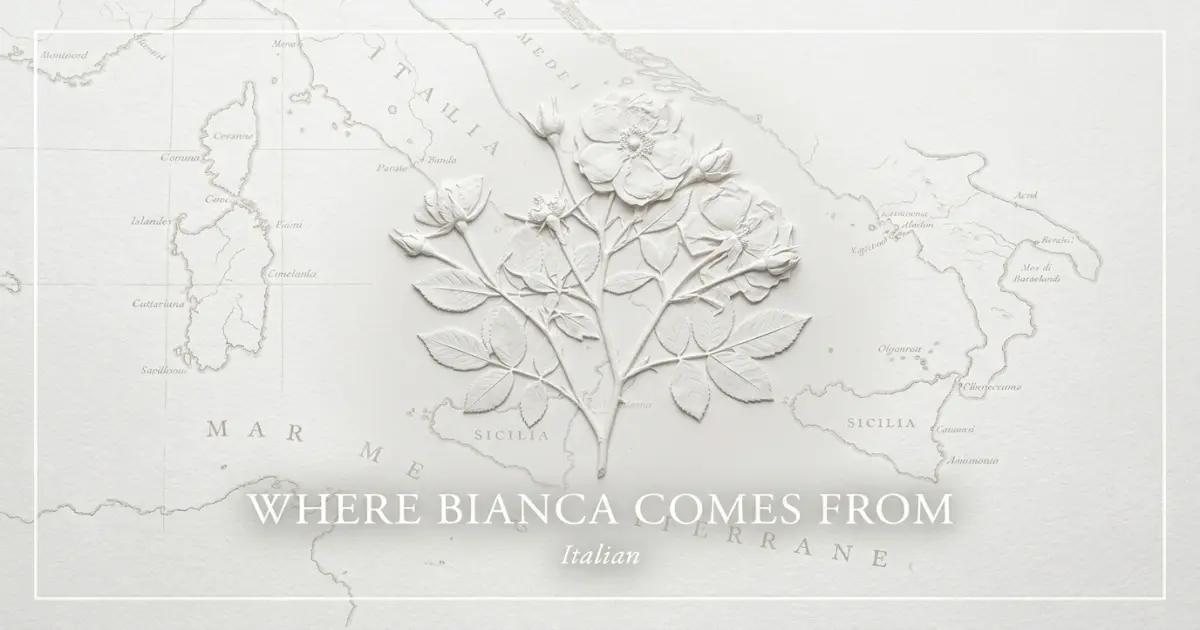
Why Bianca feels international without sounding rootless
One reason is phonetic transparency. English speakers can usually approach Bianca with confidence even if they have never studied Italian. The spelling gives enough guidance, and the stressed second syllable gives the name a memorable internal shape. That ease of pronunciation lowers the barrier to use. At the same time, the bi-AHN-ka rhythm keeps the name from sounding generically Anglophone. Bianca therefore carries an international feeling without becoming vague or placeless.
This is part of why the name works so well across social settings. It can appear elegant in writing, easy in speech, and culturally specific without being socially difficult. Parents often search for that combination and rarely find it. Bianca has been offering it for decades.
Bianca in literary memory helped preserve its poise
Bianca also benefits from literary and dramatic visibility. The name appears in Shakespeare, where it is associated with two very different figures, which is useful because it prevents the name from being trapped in one flat character type. The existence of Bianca in English literary memory gave the name prestige and recognizability long before many modern parents encountered it in baby-name culture. Yet the name never became overused through that route. It gained familiarity without becoming overdetermined.
That kind of literary presence can matter more than rankings. It means the name enters the ear already carrying a hint of culture and historical continuity. Even for people who cannot immediately place those references, the name can feel established in a deeper way than a trend-driven modern invention. Bianca sounds as though it has lived in language for a long time, because it has.
Bianca sounds bright in front and velvety at the center
The sound pattern of Bianca does a great deal of the name’s social work. It begins lightly, opens at the center, and closes with a soft, unstressed ending. This creates a name that feels articulate rather than clipped, feminine rather than fragile, and elegant rather than ornamental. Phonetics matter here because Bianca’s appeal is not only in what it means, but in how the mouth experiences it.
The initial bee sound is quick and bright. It gives the name lift. But the second syllable, AHN, is where the name settles into its real character. That open central vowel gives Bianca body and warmth. Without it, the name might sound too light. With it, Bianca acquires depth. The final -kuh brings the name back down softly, closing the line without harshness.
This is why Bianca feels more mature than some other feminine names with similarly graceful reputations. The name is not built only from light vowels and floral endings. It has an internal anchor. The central stress gives it seriousness. The k sound in the final syllable adds a clean structural edge. Together, these sounds keep the name from floating away into mere prettiness.
There is also a social consequence to that structure. Bianca sounds friendly, but not casual. Distinctive, but not difficult. It can be spoken with affection, authority, or elegance without needing to change form. That is one of the reasons it ages well. A child named Bianca does not sound buried under adult sophistication, and an adult named Bianca does not sound trapped in girlish softness. The sound is flexible enough to support both stages of life.
Bianca in the American record stays visible without becoming ordinary
Official SSA data places Bianca at No. 460 for girls in 2024. That number is revealing because it locates the name in a productive middle territory. Bianca is not obscure. Most people will recognize it, pronounce it, and likely have encountered it before. But it is also not so common that it has become anonymous. The name still retains shape. If you want a wider view beyond Bianca, browse more girls’ names to explore.
This is often the ideal position for a name with strong visual and cultural identity. A highly distinctive name can become tiring if it also carries extreme rarity, because every introduction becomes a small performance of explanation. Bianca avoids that. It is familiar enough to move smoothly through public life, yet uncommon enough to remain memorable in a classroom, workplace, or social circle.
Its position also suggests that Bianca is not purely a nostalgic revival or a trend peak. It continues to circulate without dominating. That kind of longevity often indicates real structural strength. Parents keep returning to the name not because it is suddenly fashionable, but because it remains persuasive when heard afresh. Bianca can still feel newly elegant even after decades of public presence, and that is difficult for a name to achieve.
Bianca belongs to a style family, but keeps her own outline
Modern parents who respond to Bianca are often responding to a broader style family: feminine names with European roots, clear pronunciation, and visual sophistication. Yet Bianca holds her own within that field because it is less elaborate than many of its neighbors. It does not need extra letters, unexpected spellings, or decorative endings to sound elegant. Its meaning is starkly simple, and that simplicity sharpens the whole name.
That is part of Bianca’s distinctiveness. Many elegant names ask to be admired for complexity. Bianca asks to be admired for finish. It is not baroque. It is not frilled. It is controlled. The name has enough texture to feel special, but enough restraint to feel modern. That balance is a recurring reason people continue to choose it.
It also helps that Bianca can sound stylish without seeming tied to a single era. Some names are so linked to one decade of popularity that they carry their timestamp forever. Bianca is more resilient. It can feel a little romantic, a little urban, a little literary, a little international, depending on who is wearing it and what surname it accompanies. That versatility makes the name richer than a single aesthetic label can capture.

The practical questions Bianca naturally opens next
Once parents decide they are serious about Bianca, the next questions usually concern framing rather than viability. The name already works. What remains is deciding how to shape the rest of its everyday life.
Which middle names help Bianca stay elegant without turning ornate?
Because Bianca already carries European grace and a strong internal rhythm, the middle name often determines whether the full combination feels grounded, classic, or more fashion-forward. If you want the full pairing logic behind that contrast, see middle names for Bianca.
Do nicknames make Bianca softer, livelier, or more intimate?
Bianca has a natural nickname field without depending on one. That means its shorter forms can shift the mood of the name more than they change the identity. To see how those different moods shorten in real life, explore nicknames for Bianca.
Is Bianca as easy to pronounce as it sounds in the ear?
Yes, and that ease is part of its long success. A name that looks refined but remains pronounceable often has better staying power than parents first realize. If you want the full sound pattern behind that rhythm, read how to pronounce Bianca.
Why Bianca still feels finished when so many elegant names fray
The strongest thing about Bianca is that it never needed a complicated meaning to become memorable. White is enough. Italian is enough. Three syllables are enough. The name takes those simple materials and turns them into something socially polished, visually clear, and emotionally steady. Bianca is proof that elegance does not always come from abundance. Sometimes it comes from reduction: from one clean color, one language, one well-shaped sound.
That is why Bianca lasts. It begins in the visible world and rises into culture without losing contact with the ground. It carries literary memory without becoming theatrical, femininity without fragility, and style without strain. Official data shows it remains known but not crowded, and that seems exactly right for a name whose whole appeal depends on visibility with restraint. Bianca does not need to shout in order to be seen. Bianca only needs to remain what it has always been: lucid, finished, and unmistakably itself.