
How to Pronounce Bernardo: The Easy Way to Say It Right

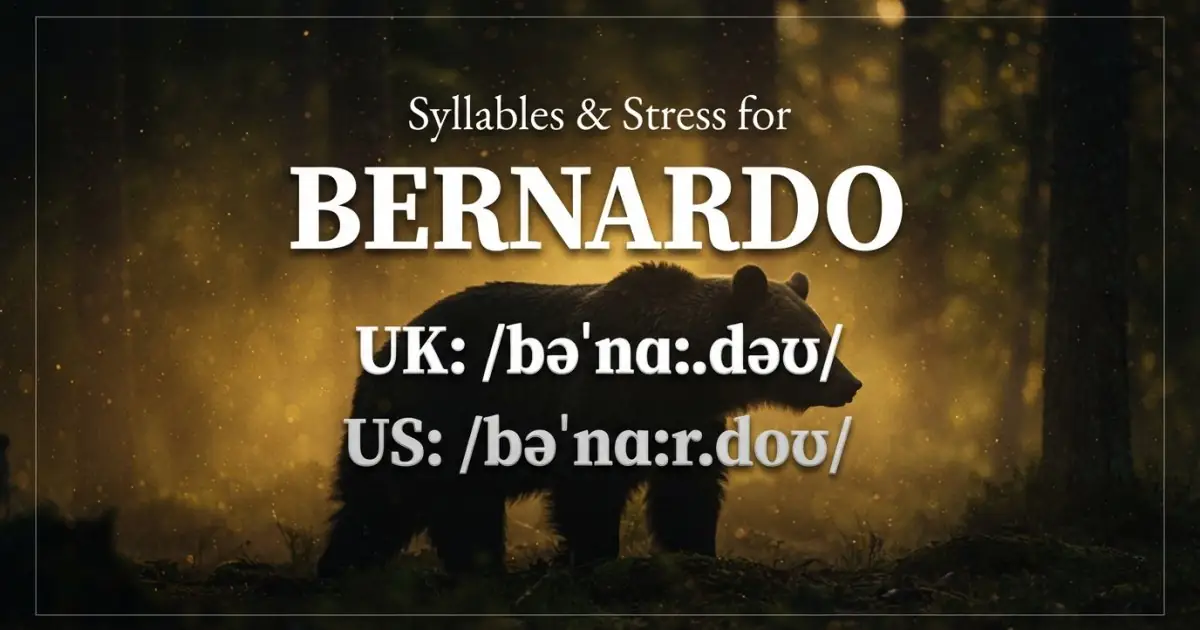
Bernardo is the kind of name that becomes most graceful when its middle syllable is allowed to carry the weight. On a classroom roster, a passport application, a wedding program, or a first introduction in an English-speaking setting, the spelling may look familiar enough that people try to smooth it into BER-nar-do or flatten it into a more English rhythm. The intended pronunciation is ber-NAR-doh, with three syllables and the strongest beat in the center.
That central stress matters because Bernardo means “brave as a bear.” The name should not sound rushed or clipped. It begins lightly, gathers strength in NAR, and then closes with the warm Spanish-style doh ending. Spoken well, Bernardo has both dignity and warmth: ber-NAR-doh, a name with a quiet opening, a strong heart, and a rounded finish.
Bernardo Is Pronounced With Strength at the Center: ber-NAR-doh
| Element | Phonetic Detail | Quick Tip |
|---|---|---|
| Standard pronunciation | ber-NAR-doh | Say it in three parts, with NAR strongest. |
| Syllable count | 3 syllables | Keep all three beats audible: ber + NAR + doh. |
| Stress pattern | Second syllable stressed | The name rises in the middle, not at the beginning. |
| U.S. IPA | /bərˈnɑːrdoʊ/ | The American form keeps the r sound clear in the stressed syllable. |
| U.K. IPA | /bɜːˈnɑːdəʊ/ | The British form may soften or reduce some r coloring, but the middle stress remains. |
| Main correction | Not BER-nar-do or ber-nar-DOH | Put the emphasis on the middle syllable: ber-NAR-doh. |
The Everyday Sound of Bernardo Depends on the NAR Syllable
The easiest way to pronounce Bernardo is to let the name build toward the center. The opening ber should be light, almost like a doorway into the stronger middle. The second syllable, NAR, is the anchor. The final doh closes the name warmly without taking over the rhythm. The sound matters more once you know what the name is meant to carry, which is why the wider frame starts in Bernardo meaning.
In everyday English, Bernardo should sound smooth rather than over-separated. The three parts are useful for learning, but once practiced, the name should move naturally: ber-NAR-doh. The first syllable starts quietly, the second syllable carries the name, and the final syllable gives it a rounded finish.
Why the middle syllable carries Bernardo
The stress falls on the second syllable, so NAR should be the clearest and strongest part of the name. This gives Bernardo its elegant rise. It also keeps the name connected to its Spanish rhythm, where the central emphasis helps the name feel musical rather than flat.
A simple correction is: “It’s ber-NAR-doh, with the stress in the middle.” That one line usually solves the most common pronunciation issue.
Why the final doh should stay warm, not heavy
The final syllable should be pronounced doh, but it should not receive the main stress. If the ending becomes too heavy, the name shifts into ber-nar-DOH, which changes the intended rhythm. The final syllable should feel rounded and clear, not dominant.
This final -o sound is part of Bernardo’s warmth. It gives the name an open finish and helps balance the stronger middle syllable.
Bernardo’s IPA Shows a Three-Syllable Name With Central Stress
The U.S. IPA pronunciation of Bernardo is /bərˈnɑːrdoʊ/, while the U.K. IPA is /bɜːˈnɑːdəʊ/. Both forms show the same essential pattern: three syllables, stress on the second syllable, and a final doh-style ending. The stress mark before the middle syllable confirms that NAR is the strongest beat.
The main accent difference is the treatment of the r sounds and vowels. In many American pronunciations, the r in NAR is more pronounced. In many British pronunciations, the r may be less strongly sounded depending on accent. But the core name remains the same: ber-NAR-doh.
The B sound gives Bernardo a clear beginning
Bernardo begins with B, a voiced stop consonant. In plain terms, that means the name starts with a clear, firm sound, but not a harsh one. The opening gives Bernardo structure before it moves into the stronger middle.
This beginning also makes the name easy to hear in conversation. Even though the first syllable is not stressed, it is still distinct.
The R sounds add texture and maturity
Bernardo contains R sounds that give it richness and motion. In American English, these R sounds may be pronounced more fully. In British English, the R coloring may vary. Either way, the name’s rhythm remains centered on NAR.
The R sound is one reason Bernardo feels more mature than a lighter nickname. It gives the name texture, especially when spoken in full.
Bernardo Is Accessible Across Accents When the Stress Is Right
Bernardo may sound slightly different depending on accent, but the stress pattern should stay steady. The name is not difficult once speakers know where the emphasis belongs. The key is to avoid imposing a first-stressed English pattern. Bernardo is not BER-nar-do. It is ber-NAR-doh.
Official data shows Bernardo ranked 1334 for boys in the United States in 2024, so the name is uncommon but active. Because it is not among the most frequently heard boys’ names, some people may need a quick model. Once heard, the pronunciation is clear and repeatable.
Spanish rhythm and English speech can meet comfortably
Bernardo keeps a Spanish-style warmth through its final -o and central stress. English speakers do not need to overdramatize it to say it respectfully. A clean ber-NAR-doh is enough.
The goal is not to make the name sound theatrical. The goal is to preserve its shape: light opening, strong center, warm ending.
Sound neighbors can influence first guesses
Some speakers may compare Bernardo with Bernard, Leonardo, Fernando, or Ricardo. Bernard may lead to a more English, first-heavy rhythm. Leonardo and Fernando may help speakers recognize the three-syllable or four-syllable Spanish-style flow. Bernardo sits closest to the pattern ber-NAR-doh: three syllables, middle stress, final -o. The way the name resolves at the end often decides which short forms feel natural in speech, and that becomes clearer in Bernardo nicknames.
Common Bernardo Pronunciation Mistakes Usually Come From Stress Shifts
Bernardo is readable, but its rhythm can be misread when people rely on English stress habits. Most mistakes involve placing the emphasis too early, too late, or reducing the final vowel too much.
Mistake 1: Saying “BER-nar-do”
This places the stress on the first syllable. The intended pronunciation places the strongest beat in the middle: ber-NAR-doh.
Mistake 2: Saying “ber-nar-DOH”
This overemphasizes the final syllable. The final doh should be clear and warm, but the main stress belongs on NAR.
Mistake 3: Flattening the final vowel
The name should end with a rounded doh sound. Avoid making the final syllable disappear into a dull or swallowed ending.
Mistake 4: Treating Bernardo exactly like Bernard
Bernardo and Bernard are related in style and sound, but Bernardo has a fuller Spanish rhythm. Keep all three syllables and let the middle syllable lead.
Practice Lines Help Bernardo Sound Smooth and Confident
The best way to practice Bernardo is to speak the name slowly once, then let it flow. The middle syllable should be strongest, but the name should not feel chopped apart. It should sound warm, mature, and natural.
Slow practice for first-time speakers
- Bernardo.
- ber-NAR-doh.
- Bernardo is here.
- This is Bernardo.
- We named him Bernardo.
Everyday conversation practice
- Hi, Bernardo, it is nice to meet you.
- Bernardo has a three-syllable name.
- Bernardo is pronounced ber-NAR-doh.
- The stress is on the middle syllable.
- Bernardo will be joining the group today.
Gentle correction practice
- It is pronounced ber-NAR-doh.
- The middle syllable is strongest.
- It has three syllables: ber, NAR, and doh.
- The ending is doh, but it is not the stressed syllable.
- The name should rise in the middle.