
How to Say Bernard Correctly: A Simple Pronunciation Guide
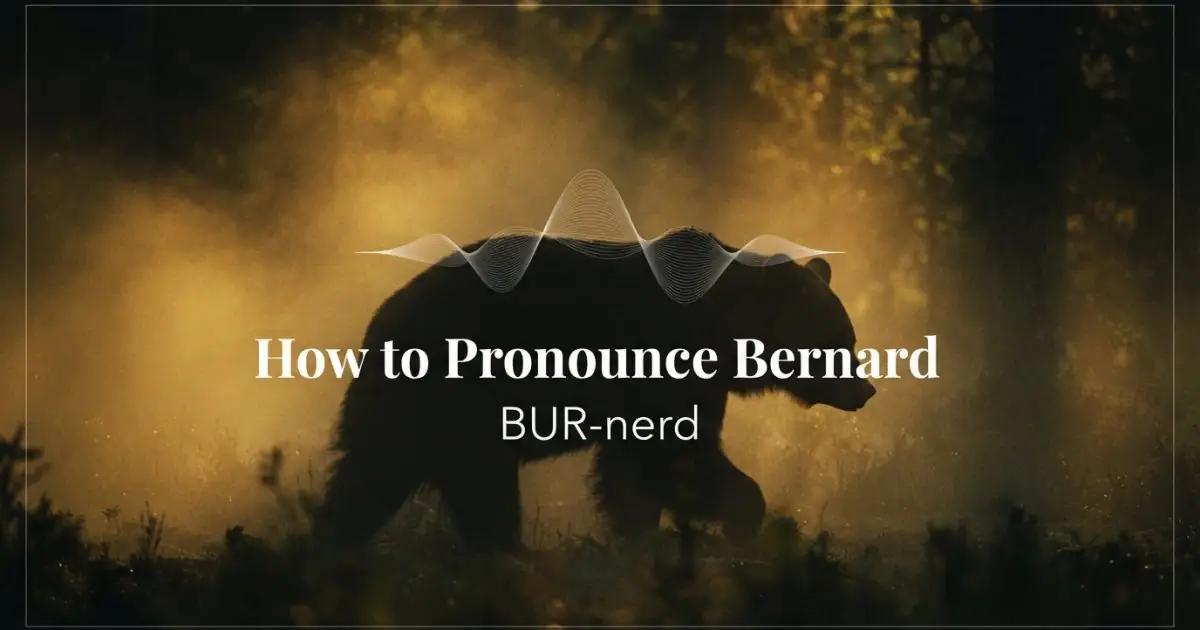
Imagine an emcee reading a graduation program: Benjamin, Bennett, Bernard. In the United States, the final name usually rises toward its second syllable, landing with a full formal sound: ber-NARD. But in a British classroom or family setting, the same spelling may sound much softer and more front-weighted, closer to BER-nəd. Bernard is one of those classic names whose pronunciation changes noticeably depending on accent.
That accent difference gives Bernard a more interesting spoken life than many two-syllable names. Its German origin and meaning, “brave as a bear,” give it an old-world strength, but its pronunciation can shift from emphatic and formal to compact and gentle. For American use, the clearest guide is ber-NARD, with the stress on the second syllable. For U.K. use, the common form is closer to BER-nəd, with the stress at the front.
How Bernard is actually said when accent changes the shape
| Element | Phonetic Detail | Quick Tip |
|---|---|---|
| Primary U.S. pronunciation | ber-NARD | In American English, give the second syllable the stronger stress. |
| Primary U.K. pronunciation | BER-nəd | In British English, the first syllable is usually stronger and the ending is softer. |
| U.S. IPA | /bərˈnɑːrd/ | The stress mark before NARD shows that the second syllable carries the weight. |
| U.K. IPA | /ˈbɜːnəd/ | The stress mark before BER shows that the first syllable carries the weight. |
| Syllable count | 2 syllables | Whether U.S. or U.K., keep Bernard to two beats. |
| Opening sound | /b/ | Begin with a clear “b” sound, as in “bear” or “book.” |
| Ending sound | U.S. /rd/; U.K. softer /d/ after an unstressed vowel | American speech usually keeps the final R clearer; British speech often softens it. |
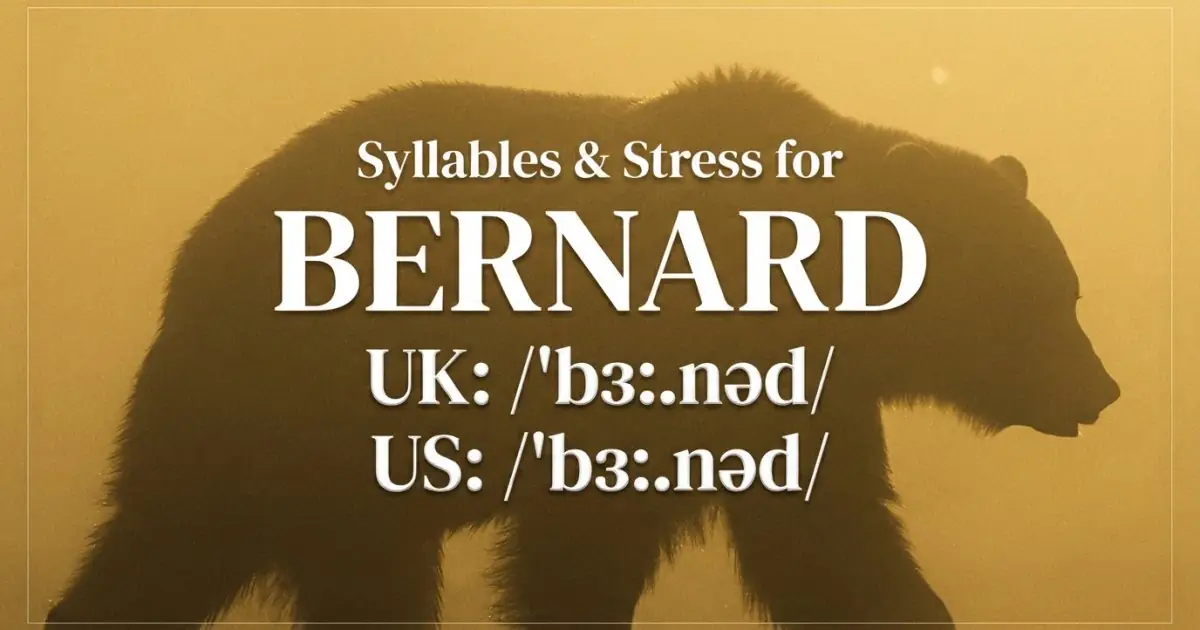
Bernard has two syllables, but the stress changes by region
Bernard is always a two-syllable name in standard English use, but the name’s personality changes with stress. In American English, ber-NARD rises toward the second syllable. In British English, BER-nəd usually begins with the stronger beat and lets the ending fall away. This is not a mistake in either direction; it is a genuine accent-based difference. The sound matters more once you know what the name is meant to carry, which is why the wider frame starts in Bernard meaning.
The American Bernard lands on NARD
In the U.S. pronunciation /bərˈnɑːrd/, the first syllable is light: “ber.” The second syllable carries the emphasis: NARD. The vowel in NARD is broad and open, and the “r” is usually pronounced clearly. That makes the name sound formal, weighty, and somewhat grand.
A simple American guide is: “ber-NARD, like a soft beginning followed by a strong finish.” The name should not sound like BERN-erd in this pronunciation. The energy belongs at the end.
The British Bernard begins with BER
In the U.K. pronunciation /ˈbɜːnəd/, the name is front-stressed: BER-nəd. The first syllable is fuller, and the second syllable becomes lighter. In many British accents, the “r” after the vowel is not pronounced the way it usually is in American English, so the name can sound smoother and more compact.
This pronunciation can feel gentler and more understated. The name still has two syllables, but it does not build dramatically toward the end. Instead, it starts firmly and then relaxes.
Why Bernard sounds different in American and British English
The difference comes from two main features: stress placement and the treatment of the letter R. American English is often rhotic, meaning speakers usually pronounce “r” sounds after vowels. Many British accents are non-rhotic, meaning the “r” after a vowel may be softened or not pronounced unless another vowel follows. Bernard contains exactly the kind of R sound that makes this difference noticeable.
The R changes the feel of Bernard
In American English, the final part of Bernard includes a clearer R sound before the final D. This makes NARD feel heavier and more pronounced. The name has a strong finish, almost like a formal surname or old family name.
In British English, the R in the first syllable may color the vowel rather than sound like a distinct consonant, and the ending becomes softer. That is why the U.K. form can feel closer to BER-nəd. The name becomes less emphatic, even though the spelling is unchanged.
The unstressed syllable becomes lighter
English often weakens unstressed syllables. In the American pronunciation, the first syllable “ber” is lighter because the stress is on NARD. In the British pronunciation, the final syllable becomes lighter because the stress is on BER. This kind of reduction is normal in English speech.
For parents, the practical lesson is simple: choose the pronunciation that fits the language community where the child will hear the name most. In the U.S., ber-NARD will usually feel natural. In the U.K., BER-nəd may be expected.
Common mistakes that change Bernard too much
Bernard is familiar, but its regional variation can make people second-guess it. Most mistakes come from mixing the American and British patterns or overpronouncing letters that would normally be lighter in speech.
Do not flatten Bernard into equal stress
Bernard should not sound like BER-NARD with both syllables equally heavy. English names usually prefer one main stress. In American English, emphasize the second syllable: ber-NARD. In British English, emphasize the first: BER-nəd.
Equal stress can make the name sound stiff or unnatural. A clear stress pattern keeps the name smooth.
Do not turn the U.S. ending into “nerd”
In American pronunciation, Bernard ends with NARD, not “nerd.” The vowel is broader and more open than the vowel in “bird” or “word.” A useful guide is to think of the final syllable as close to “nard,” with a clear R and final D.
This distinction matters because Bernard’s American form has a dignified final syllable. Making it too tight can change the mood of the name.
Do not add extra syllables
Bernard has two syllables. It should not become ber-NAH-ard or BER-nuh-erd. Even when the R is pronounced clearly, the name stays compact. The full shape is two beats, not three.
A good practice method is to clap it: ber / NARD for U.S. pronunciation, or BER / nəd for U.K. pronunciation.
Sound neighbors that help explain Bernard
Bernard sits near several vintage names that change subtly by accent, such as Leonard, Howard, and Frederick. It also shares nickname territory with Bernie, Bern, and Bear, but the full-name pronunciation has its own formal shape. The way the name resolves at the end often decides which short forms feel natural in speech, and that becomes clearer in Bernard nicknames.
Names that help place Bernard
In American English, Bernard’s final stress gives it a rhythm somewhat like Gerard, though the opening and vowels are different. The name starts lightly and finishes firmly. In British English, Bernard sits closer in rhythm to names like Leonard, where the first syllable often carries more weight and the ending softens.
These comparisons help explain why Bernard may sound different from one speaker to another without being mispronounced. The name has an accepted accent range.
Nicknames avoid most pronunciation confusion
Nicknames such as Bernie, Bern, and Bear are much simpler across accents. Bernie is usually BER-nee, Bern is one syllable, and Bear follows the ordinary word. Families who love Bernard but want an easier casual form often find that these nicknames solve the everyday pronunciation gap.
The full name can remain formal and accent-sensitive, while the nickname becomes warm and simple.
Practice lines for saying Bernard naturally
Because Bernard has two major English pronunciation patterns, practice should match the version being used. The goal is not to erase regional difference, but to keep each version natural.
American English practice
- Bernard is pronounced ber-NARD.
- This is Bernard.
- Bernard is on the list.
- Can Bernard join the group?
- Bernard James has a steady, formal rhythm.
British English practice
- Bernard is pronounced BER-nəd.
- This is Bernard.
- Bernard is arriving soon.
- We saved a seat for Bernard.
- Bernard Henry sounds gentle and traditional.
For the American form, let the name rise toward NARD. For the British form, start firmly on BER and let the ending relax. In both versions, keep the name to two syllables.