
How to Pronounce Bailey: Where the Emphasis Goes and How It Sounds
The clearest place to hear how Bailey is pronounced is not in a dictionary entry but in a real social moment: a teacher glancing down at the attendance sheet, a nurse calling the next patient, or a coach calling across a field. Bailey is one of those names that most English speakers recognize immediately, which is why it often gets pronounced correctly on the first try. But that ease can also make people sloppy. Short familiar names are often rushed, and when Bailey is rushed, it can lose the clean two-part rhythm that gives it its warmth.
That rhythm matters more than it first appears. Bailey is not a flat, casual sound tossed off in one breath. It has shape. The opening syllable carries the energy, and the second syllable softens the landing. Spoken naturally, the name sounds bright, friendly, and open: BAY-lee. Once that pattern is clear, the name becomes almost effortless to say. The trick is not complexity. The trick is keeping the first syllable strong and the second syllable light.
How Bailey is actually said when everyday speech gets it right
| Element | Phonetic Detail | Quick Tip |
|---|---|---|
| Standard pronunciation | BAY-lee | Give the first syllable the main stress, then let the second syllable finish the name lightly. |
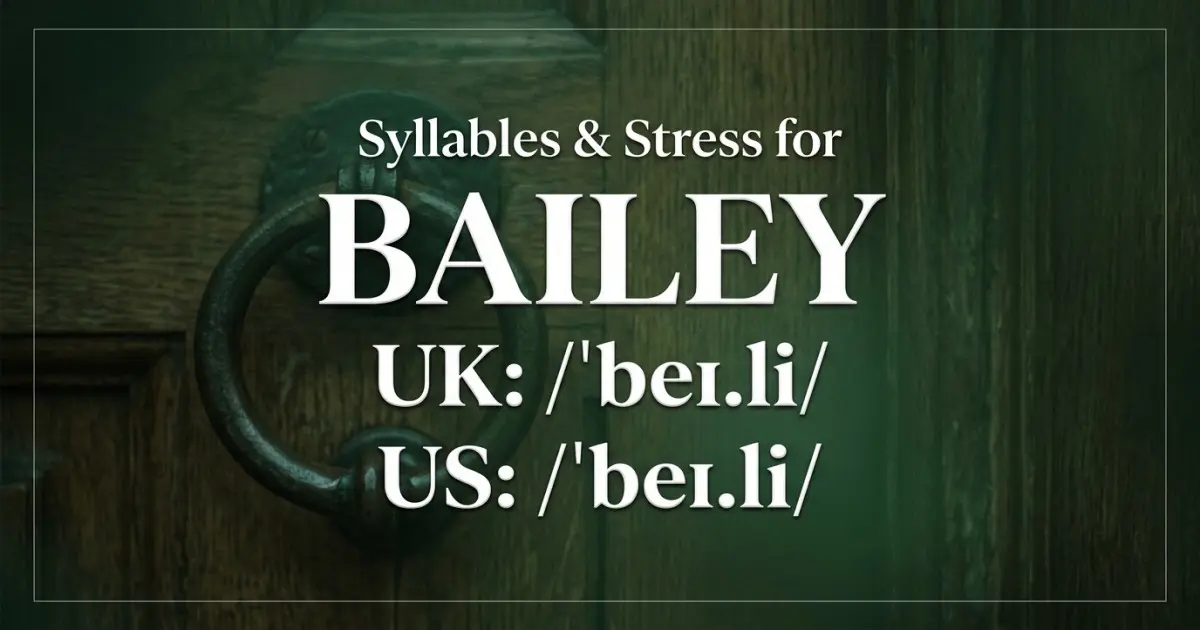
| IPA (US) | /ˈbeɪli/ | The stress mark shows that the name’s weight belongs on the opening syllable. |
| IPA (UK) | /ˈbeɪli/ | The US and UK forms are effectively the same, which makes Bailey unusually stable across accents. |
| Syllable count | 2 syllables | Think of the name in two clear beats: Bay / lee. |
| Stress pattern | Primary stress on the first syllable | If the name starts strongly and ends softly, it will usually sound natural. |
| Opening sound | Initial /b/ plus the diphthong /eɪ/ | Start with a clean b, then use the same vowel sound heard in “day” or “say.” |
| Ending sound | Final /li/ sound | Finish with a light lee, not with a heavy or overdrawn ending. |
Bailey works because one syllable leads and the other relaxes
The first half of Bailey carries the name’s confidence
The opening syllable, Bay, is where the name finds its shape. It begins with /b/, a voiced stop consonant, which means the sound starts with a neat closure and release. That helps Bailey sound friendly but defined. It does not drift into the air. It arrives clearly. Then the vowel opens into /eɪ/, the same moving sound heard in words like “day” and “rain.” That bright opening is one reason Bailey sounds socially easy and upbeat. Before focusing only on syllables and stress, it helps to step back into the fuller frame of Bailey meaning.
Because the stress falls here, the first syllable should be allowed to carry the name. If it is underplayed, Bailey can sound flattened. If it is overdone, the name can become choppy. The best version is simple: a clear opening with enough weight to guide the ear into the second syllable.
The ending of Bailey keeps the name from sounding hard
The second syllable, lee, is lighter and less forceful, but it is not an afterthought. It softens the whole name. Without it, Bailey would collapse toward Bay. With it, the name feels friendlier, more rounded, and more obviously complete. This is why Bailey often sounds more approachable than some other surname-style names. The ending does a great deal of emotional work. The way the name resolves at the end often decides which short forms feel natural in speech, and that becomes clearer in Bailey nicknames.
This final syllable should stay crisp but easy. It does not need heavy emphasis. In fact, too much emphasis on the ending can make the name feel awkwardly segmented. Bailey sounds best when the second syllable completes the name rather than competes with it.
Why Bailey stays remarkably stable across accents
American and British English use the same core pronunciation
The supplied IPA is the same in both American and British English: /ˈbeɪli/. That is helpful because some familiar names can shift significantly across accents. Bailey usually does not. The stress remains on the first syllable, the opening vowel stays the same bright /eɪ/ sound, and the ending remains a light lee. For everyday use, that makes Bailey easy to carry across English-speaking settings.
This stability is part of the name’s appeal. A name can feel relaxed and modern without becoming slippery. Bailey sounds very close to itself whether it is spoken in American or British English, and that consistency helps it remain socially easy.
What may vary slightly anyway
Even when the IPA stays the same, real voices still color names differently. Some speakers may clip the second syllable a little faster. Others may make the opening vowel slightly broader or brighter. But these are small texture differences, not real pronunciation changes. The overall shape of Bailey remains intact.
In practical terms, this means that people are likely to recognize and reproduce the pronunciation easily once they have heard it once. Bailey does not demand much correction in ordinary life, which is one reason it has worn so well as a widely used unisex name.
Where Bailey is most likely to be mispronounced or misheard
The most common issue is not error but flattening
Because Bailey looks familiar, the most common problem is not a dramatic mispronunciation. It is carelessness. Some speakers flatten the name so that both syllables receive nearly equal emphasis, or they rush through it until the second syllable almost disappears. When that happens, Bailey loses some of its brightness and polish.
The correction is simple: let Bay lead and let lee follow. The name should feel like a two-step movement, not a blur.
Why Bailey should not sound like Bay-Lee with equal weight
Another subtle mistake is overseparating the syllables. People trying to be very careful sometimes pronounce the name too deliberately, as if each syllable deserves the same stress. That can make Bailey sound mechanical. The name is structured, but it is still conversational. It should flow.
The most natural spoken version places the emphasis clearly at the beginning and then lets the name taper. That is what gives Bailey its ease.
Sound-neighbors can create quick confusion
Bailey sits near other familiar English names and words such as Bay, Baylee, or names like Hailey and Riley that share a similar second syllable. That can occasionally create a momentary spelling-based hesitation. But phonetically, Bailey is straightforward. The first syllable rhymes with “day,” and the second rhymes with “lee.” Once that framework is heard, the name locks into place.
How Bailey sounds beside nearby names
One useful way to hear Bailey correctly is to compare it with neighboring names. It shares the same bright opening vowel as Baylee and similar flowing ease with names like Hailey or Riley, but Bailey begins more firmly because of the initial b. Compared with Bay, Bailey is gentler because it has the added final syllable. Compared with Blake, it is softer and more social. Compared with Riley, it feels a little more grounded because the first syllable lands more clearly and the name’s historical roots subtly color how people hear it.
These comparisons matter because Bailey’s pronunciation is not difficult, but it does sit in a sound-family of familiar modern names. Hearing what makes Bailey itself distinct helps keep the name crisp instead of generic.
How to practice Bailey until it feels effortless
Use two clean beats, then smooth them together
The easiest practice method is to say the name in two parts: Bay / lee. Let the first syllable sound like “day” with a b in front of it. Let the second syllable be a quick, bright lee. Once both parts are clear, connect them in one easy line rather than speaking them like separate units.
Practice lines that sound like ordinary life
- “This is Bailey.”
- “Bailey is here.”
- “Have you met Bailey?”
- “Bailey will join us in a minute.”
- “I’m looking for Bailey Carter.”
Speaking the name inside full sentences helps because names are almost always learned in context. Bailey tends to sound especially natural once it is placed in ordinary conversation rather than isolated for inspection.
The quickest self-check
If you want one fast pronunciation check, ask three questions. Does the first syllable rhyme with “day”? Is the first syllable clearly the stronger one? Does the second syllable end lightly as lee? If the answer is yes, the pronunciation is almost certainly right.