
How to Say Ayla Correctly: A Simple Pronunciation Guide

Ayla is the kind of name that often looks easier than it is only because it is short. A teacher sees it on a class list, a receptionist reads it from a clipboard, a relative sees it on a birth announcement, and for a split second there is that familiar modern-name hesitation: is it as straightforward as it looks, or is there a hidden vowel sound waiting to trip the speaker? Then someone says it clearly aloud, and the uncertainty usually disappears. The name lands in two clean beats, open and bright, and suddenly it feels exactly as graceful as it looked on the page.
That real-life moment matters because Ayla succeeds through clarity. The everyday pronunciation is AY-luh. The first syllable carries the stress. The second releases softly. Nothing about the name needs to be overperformed, stretched, or made more exotic than it is. Its beauty comes from how easily it moves: bright opening, gentle finish. That simplicity is one of the reasons Ayla has traveled so well in modern English-speaking life. It feels elegant without becoming fragile and distinctive without becoming difficult.
What Ayla pronunciation is really clarifying
| Element | Phonetic Detail | Quick Tip |
|---|---|---|
| Everyday pronunciation | AY-luh | Say it in two smooth beats, with the first syllable clearly stronger than the second. |
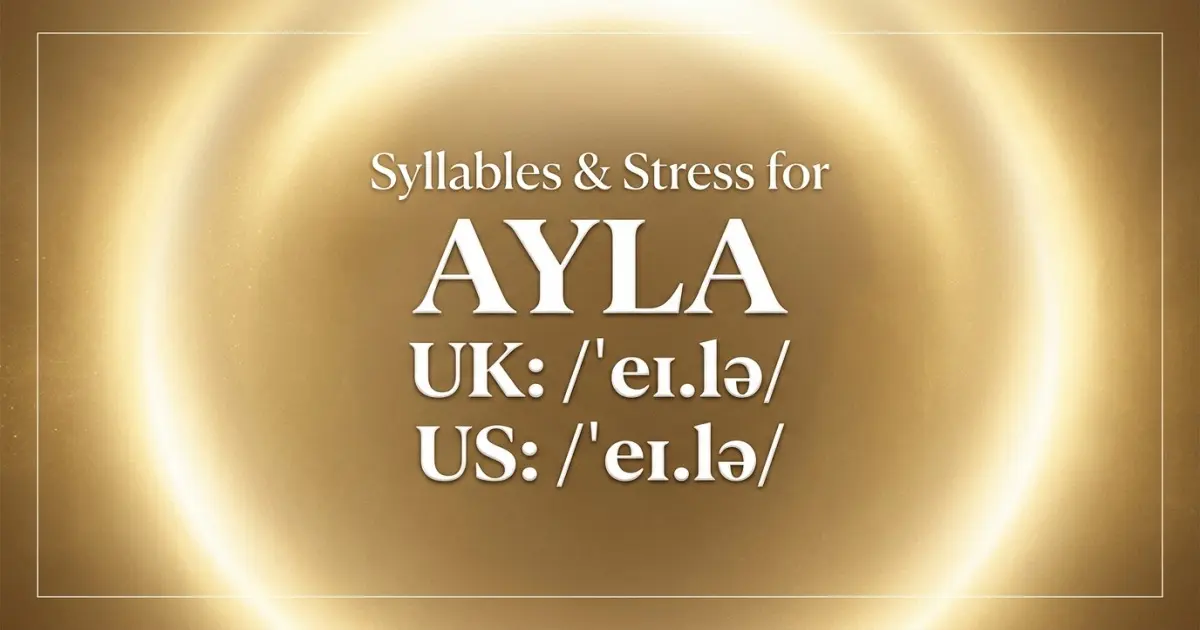
| IPA (US) | /ˈeɪlə/ | The stress mark shows that the name begins with its strongest sound. |
| IPA (UK) | /ˈeɪlə/ | The standard British form keeps the same rhythm and vowel pattern as the American one. |
| Syllable count | 2 syllables | Ayla works because it stays compact and musical, not because it sounds elaborate. |
| Primary stress | First syllable | If the stress shifts away from AY, the name loses the clean lift that makes it sound natural. |
| Ending texture | Soft schwa-like -luh | The ending should relax rather than punch. Keep it warm, not sharp. |
| Sound profile | Open vowel followed by liquid consonant and soft release | The name feels graceful because it opens brightly and closes gently. |
How Ayla sounds in everyday speech
Ayla works so well in English because its structure is very easy for the mouth to follow. The name begins with the bright long a sound in AY. That opening immediately gives the name lift and visibility. Then comes the l, a liquid consonant that helps the name move smoothly rather than abruptly. Finally, the soft -uh close lets the name settle without sounding clipped. The whole effect is clean and open. Before focusing only on syllables and stress, it helps to step back into the fuller frame of Ayla meaning.
Why the first syllable gives Ayla its identity
The strongest beat in Ayla is the first syllable. That is where the name gets its brightness. If the opening is clear, most listeners understand the name immediately. This is one reason Ayla feels more stable than some other short modern names with multiple possible readings. The name is not meant to drift or hide its emphasis. It announces its rhythm right away.
That first stressed syllable also explains why Ayla feels more vivid than names that begin more softly. The opening vowel sounds lifted and clear, which helps the name sound light without sounding weak.
Why the second syllable should stay soft
The second syllable matters because it humanizes the name. Without it, Ayla would sound abrupt. With it, the name becomes warm and socially easy. The key is that the second syllable should not compete with the first. It is a landing, not a second spotlight. When speakers overemphasize the ending, the name can sound choppier than it should.
In everyday use, the best version is smooth and conversational: AY-luh, not AY-LAH with equal weight on both parts, and not a clipped one-beat version that rushes the ending away.
Ayla in IPA, accent, and English-language use
The fact packet gives the same IPA for U.S. and U.K. English: /ˈeɪlə/. That is useful because it tells parents something practical right away. Ayla is one of those names that stays remarkably stable across major English-speaking accents. The first syllable remains stressed, the vowel stays bright, and the ending remains soft.
Ayla changes very little across major accents
Some names shift meaningfully between American and British speech. Ayla usually does not. Accent may color the exact texture of the vowel very slightly, but the structure stays the same. Most speakers in either setting will say the name in a recognizably similar way. That is an advantage for a short name, because short names have less room to absorb variation without sounding different.
This stability is one reason Ayla feels so usable. Parents do not usually have to choose between multiple competing common pronunciations. The name travels well because its rhythm is so clear.
Why Ayla sounds modern without sounding trendy in the mouth
Ayla belongs to a broad group of contemporary names that are short, vowel-rich, and easy to say. But phonetically it has more shape than some of its neighbors. The liquid l gives it flow, and the soft ending prevents the first syllable from sounding too stark. That is why Ayla sounds graceful rather than minimal in a severe way.
Linguistically, it is a very efficient name. Socially, that efficiency becomes elegance. The name sounds polished not because it is ornate, but because every sound in it contributes something necessary.
Where people usually get Ayla wrong
Ayla is not a difficult name, but it is a name people sometimes second-guess because its spelling can invite overthinking. Most pronunciation mistakes come from uncertainty about the first vowel or from giving too much weight to the second syllable.
Flattening the first syllable weakens Ayla first
The most common issue is reducing the opening so that it loses the clear AY sound. That first syllable should feel bright and lifted. If it becomes duller or less distinct, the name loses the clean line that makes it so appealing.
Overstressing the second syllable changes the whole mood
Another common mistake is making the ending too strong. The second syllable should be audible, but it should not dominate. When speakers hit both syllables with equal force, Ayla starts to sound harder and less fluid than intended.
Trying to make Ayla more exotic than it needs to be
Because the name has an international feel and a beautiful meaning, some speakers may instinctively over-style it, as if elegance requires more vocal flourish. In reality, Ayla works best when spoken naturally. Its beauty is already built into its shape. It does not need extra performance to sound special.
Ayla beside its sound neighbors
It helps to hear Ayla next to a few nearby names. Isla shares the same modern appeal and similar brevity, but it begins more softly and ends with a more open feel. Layla has a richer, more obviously lyrical double-syllable pattern. Kayla is more direct and slightly more familiar in American ears because of its strong consonant start. Ava is even shorter and smoother, but lacks Ayla’s liquid middle and gentle drop at the end. Once the sound pattern is clear, some shortenings stop feeling optional and start feeling natural, and the clearest map is in Ayla nicknames.
What makes Ayla distinct is the combination of brightness and softness. It opens cleanly, but it does not end abruptly. That balance is exactly what gives it its elegant, contemporary ease.
How to practice Ayla until it feels natural
The easiest way to settle Ayla into the mouth is to use it in the kinds of phrases where names actually live. Names become natural not through isolated repetition, but through use in greetings, introductions, and full-name combinations.
Three useful practice lines for Ayla
Ayla is here.
Ayla Claire Morgan.
Hello, Ayla.
These are helpful because they test the name in greeting, in a full-name line, and in direct address. If the first syllable still leads and the second still lands softly in all three, the pronunciation is settled.
The easiest memory cue for Ayla
If you want one practical guide, keep this: AY-luh. Bright beginning, soft ending. That simple pattern is what makes Ayla sound elegant, clear, and easy to carry in everyday life.