
How to Pronounce Avani: The Easy Way to Say It Right
The real pronunciation test for Avani usually happens in an ordinary place: a teacher reading a class list on the first day, a receptionist calling a patient from the waiting room, a barista glancing at a cup label and taking one quick guess. Avani is the kind of name that can invite a brief visual pause in that moment, not because it is difficult, but because English speakers are still mapping its sound before they hear it. Then someone says it once—uh-VAH-nee—and the hesitation often disappears. That is one of the name’s practical strengths. It may look new to some readers, but it settles quickly in the ear.
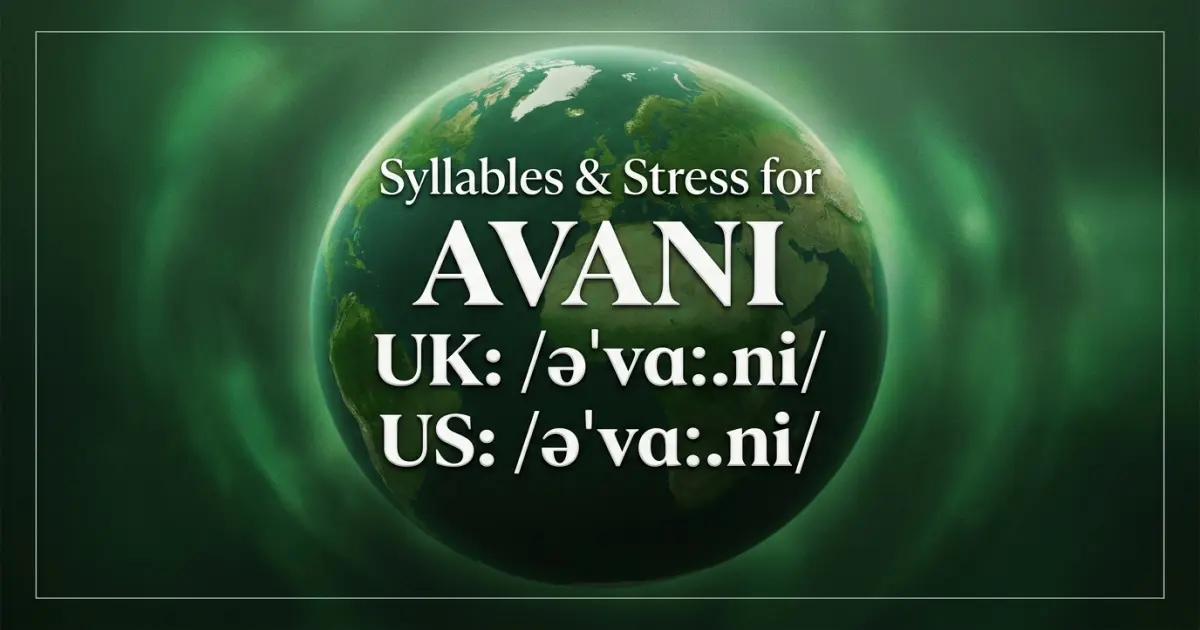
In everyday use, Avani is pronounced uh-VAH-nee, with the stress falling clearly on the middle syllable. Official phonetic notation gives the same pattern in both American and British English: /əˈvɑːni/. That stability matters. It means Avani is not a name that changes shape dramatically from one English-speaking setting to another. Once the central stress is understood, the name becomes surprisingly easy to say, remember, and repeat. For a name with Sanskrit roots and a meaning as large as “earth,” that spoken ease is part of what makes it feel so wearable in modern life.
How Avani is actually meant to sound in everyday speech
| Element | Phonetic Detail | Quick Tip |
|---|---|---|
| Everyday pronunciation | uh-VAH-nee | Say it in three beats, with the middle syllable clearly receiving the stress. |
| IPA (US) | /əˈvɑːni/ | The opening syllable is soft and light, almost like the first sound in “about.” |
| IPA (UK) | /əˈvɑːni/ | British English keeps essentially the same rhythm and vowel pattern as American English. |
| Syllable count | 3 syllables | Think of it as uh + VAH + nee, not as a two-syllable compression. |
| Stress pattern | Middle syllable stressed | If the first syllable gets the main emphasis, the name quickly starts sounding off-balance. |
| Opening sound | /ə/ | Keep the first syllable light; it should introduce the name, not dominate it. |
| Middle vowel | /ɑː/ | The central vowel is broad and warm, like “ah,” and it gives the name its core resonance. |
| Ending sound | /ni/ | The final syllable should be clear and bright, rhyming with “knee.” |
Avani works because the middle syllable carries the name
Why the stress belongs in the center
The most important thing to hear in Avani is where the weight falls. It does not land at the beginning, which is what many English speakers instinctively expect in a three-syllable name. It lands in the middle: uh-VAH-nee. That middle stress is what gives the name its poise. Without it, Avani can sound flattened, rushed, or anglicized in a way that loses some of its grace. Before focusing only on syllables and stress, it helps to step back into the fuller frame of Avani meaning.
Middle-stressed names often feel more fluid in English than strongly front-loaded names. Avani benefits from that. The opening syllable remains light, the center opens fully, and the final syllable finishes the line clearly. This creates a kind of gentle rise-and-release pattern. The name does not strike the ear. It unfolds.
The first syllable should stay modest
The opening uh matters precisely because it is not supposed to dominate. It is a schwa, the neutral vowel sound that appears in many unstressed English syllables. In plain terms, it is the soft, quick sound heard at the start of words like “about” or “ago.” That opening gives Avani a graceful entrance. It should not be over-pronounced into something hard or fully weighted.
When speakers give the first syllable too much emphasis, the name starts sounding less like Avani and more like a different name with similar letters. Keeping that first beat light is one of the easiest ways to make the whole name sound correct.
Where people misread Avani and why the fixes are usually simple
The most common issue is misplaced stress
Avani is not usually mispronounced because the sounds are hard. It is more often misread because English-speaking readers may place the stress in the wrong spot on first sight. They may be tempted toward something like AV-uh-nee or even a flatter reading that treats all three syllables as equally weighted. Once that happens, the name can lose its internal elegance.
The fix, however, is very straightforward: move the emphasis to the middle. One calm spoken model—uh-VAH-nee—is often enough. Because the name is so rhythmic once heard correctly, it tends to stay learned.
Why the “vah” sound matters more than people think
The central syllable is the heart of the name. It carries the broad ah vowel represented in IPA as /ɑː/. That vowel gives Avani warmth and space. If speakers narrow it too much, the name can sound clipped or less natural. If they overcomplicate it, the name can sound theatrical. The goal is neither. The best version keeps the middle open, warm, and steady.
This is especially important because the name’s meaning is “earth.” While pronunciation should never be forced into symbolism, there is a nice natural fit here: the broad middle vowel gives the name a grounded center. It is part of why the spoken form feels calm rather than sharp.
Visual hesitation is normal with a globally rooted name
Names like Avani sometimes produce a tiny first-glance hesitation because they are not built from the most familiar English stress templates. That should not be mistaken for true pronunciation difficulty. In everyday life, the hesitation is usually brief. Once people hear the name once or twice, the pattern becomes intuitive. Avani is teachable in a way that some more consonant-heavy names are not. Its sounds are open and familiar even when the exact stress is new.
That is good news for parents. The name may occasionally require an initial spoken model, but it does not usually require repeated correction. That is a very manageable kind of pronunciation profile.
Avani across accents stays remarkably stable
American and British English are closely aligned here
One of the practical advantages of Avani is that the common American and British phonetic renderings are the same: /əˈvɑːni/. Accent will always color a vowel slightly, and some speakers may produce a somewhat broader or tighter middle sound depending on region. But the overall structure does not change much. The opening remains light, the middle remains stressed, and the ending stays bright.
This makes Avani more internationally usable than some parents might assume. A name with Sanskrit roots could easily have generated multiple strong English variants. Avani largely avoids that. It keeps one stable shape and lets accents simply shade the edges.
Sound neighbors can help, but only to a point
It can help to compare Avani to other names with open vowels and three-syllable movement, but only carefully. It shares some broad sonic ease with names like Amaya, Elani, or Imani in the sense that all rely on internal vowel flow rather than dense consonant clusters. But Avani differs because its stress is so clearly central and because its first syllable is intentionally light. That difference is exactly why the name feels both graceful and grounded. Once the sound pattern is clear, some shortenings stop feeling optional and start feeling natural, and the clearest map is in Avani nicknames.
There are also no liquid consonants such as l or r in the middle to soften or redirect the flow. Avani moves almost entirely through vowels and a light central v, which gives it an especially open texture. That openness is part of the reason it sounds gentle without becoming vague.
How to practice Avani until it feels completely natural
Use short real-life phrases
The fastest way to internalize a name is to hear it inside normal sentences rather than in isolation. That is especially useful with Avani, since the stress pattern becomes clearer in running speech. A few short lines usually do the work:
“This is Avani.”
“Avani is here.”
“Can you help Avani?”
“I’m looking for Avani.”
These simple phrases let the middle stress emerge naturally. They also help parents hear whether the first syllable is staying light enough and whether the final -nee is landing cleanly.
The best quick reminder for new listeners
If someone needs a rapid pronunciation cue, the simplest guide is still the best one: uh-VAH-nee. It does not require technical knowledge, and it communicates the one thing that matters most—the location of the stress. Once that is in place, the rest of the name usually follows naturally.
That is the real pronunciation story of Avani. It is a name that may ask for a first spoken model, but not for constant explanation. Its sound is stable, the stress pattern is graceful once learned, and the vowels make it easier to carry than many people expect at first sight. Avani may look refined and culturally deep, but in speech it is one of those names that becomes natural surprisingly quickly.
How to Say Avani: FAQ
How do you pronounce Avani in everyday English?
Avani is pronounced uh-VAH-nee, with the stress clearly on the middle syllable.
What is the most common pronunciation mistake with Avani?
The most common issue is placing too much stress on the first syllable. Avani sounds most natural when the opening stays light and the middle syllable carries the emphasis.
Is Avani pronounced differently in American and British English?
In most cases, no major difference appears. The common phonetic notation is the same in both, and the overall rhythm stays very similar.
Why does Avani sometimes look harder to say than it really is?
Because English readers may not immediately expect the middle stress when they first see the letters. Once they hear the name spoken correctly, however, the pattern is usually easy to remember.