
How to Pronounce Aurora: Quick Tips for Clearer Pronunciation
The pronunciation of Aurora often becomes real in a very ordinary scene: a teacher pausing at a class list on the first morning of school, a nurse calling a patient from the waiting room, or a barista looking down at the cup and realizing that this is not a name you can toss off carelessly if you want it to sound right. That small hesitation is part of the name’s identity. Aurora is beautiful on the page, but it is also one of those names whose beauty lives in motion. The rolling r sounds, the open vowels, and the soft finish all ask the mouth to do a little work. When that work is done well, the name sounds luminous. When it is rushed, it can knot itself.
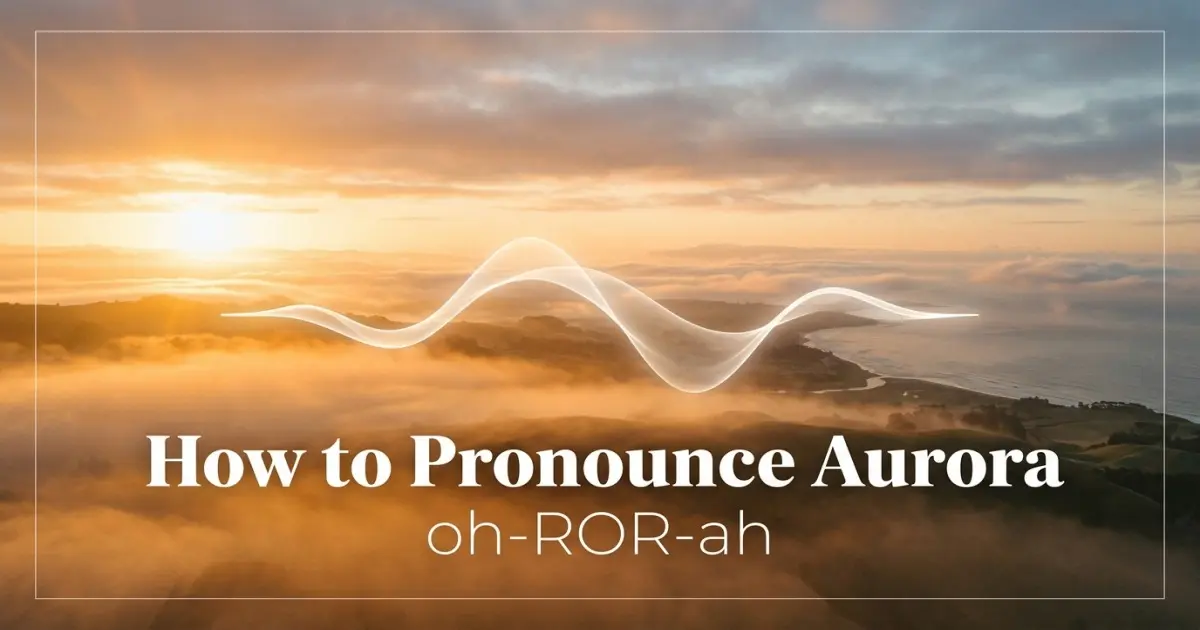
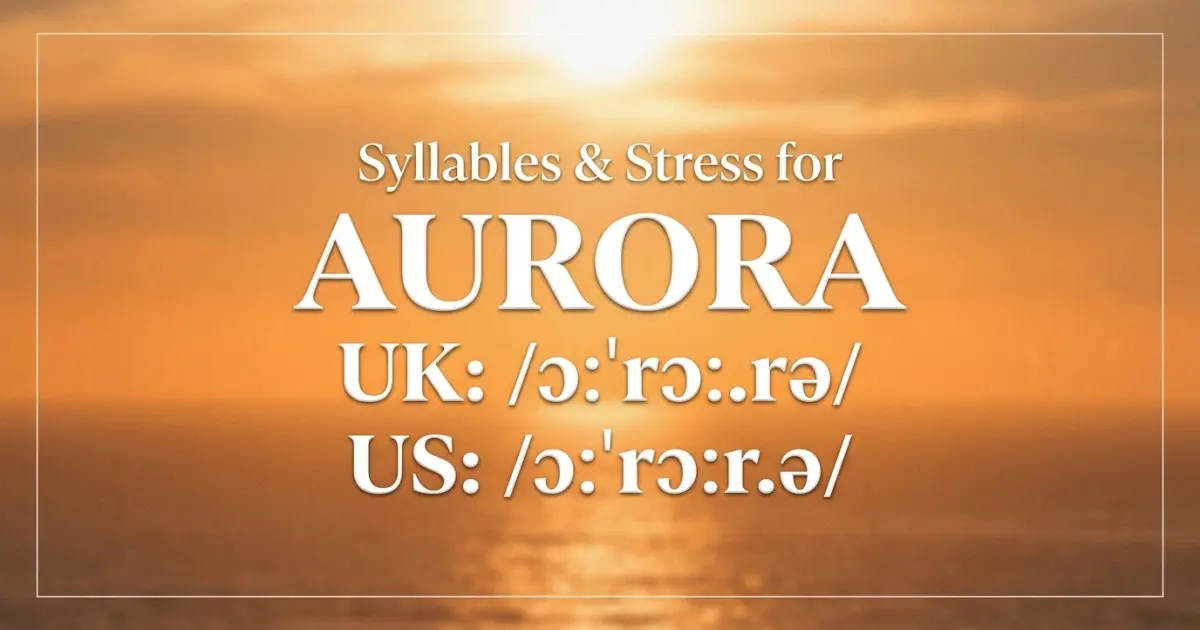
In everyday English, the intended pronunciation here is ah-ROR-uh. The supplied IPA for both American and British English is /əˈrɔːrə/, which tells you something important immediately: the core pattern is stable. The stress belongs on the middle syllable, not the first and not the last. That middle stress is what gives Aurora its lift. Without it, the name loses its sense of unfolding. With it, the whole word opens the way dawn itself does: gently at first, then fully.
How Aurora is actually meant to move through the mouth
| Element | Phonetic Detail | Quick Tip |
|---|---|---|
| Everyday pronunciation | ah-ROR-uh | Let the middle syllable carry the name, then release softly into the final uh. |
| IPA (US) | /əˈrɔːrə/ | The opening is a light schwa sound, and the stress mark shows the second syllable is the anchor. |
| IPA (UK) | /əˈrɔːrə/ | In the supplied form, British and American English follow the same broad pronunciation pattern. |
| Syllable count | 3 syllables | Think of the rhythm as soft start, strong center, soft landing. |
| Stress pattern | ah-ROR-uh | If all three syllables get equal weight, the name becomes clumsy very quickly. |
| Core sound challenge | Repeated r sounds | Do not force each r separately. Let them flow as part of one connected movement. |
Aurora depends on the middle syllable more than many parents expect
Why the stress belongs on ROR
The most important thing about Aurora is that the name lives in its center. In ah-ROR-uh, the middle syllable is where the name takes shape. The opening syllable is intentionally light. It does not announce itself with force. It merely sets the name in motion. The final syllable is also light, functioning more like an echo than a second point of emphasis. That leaves ROR as the true center of gravity. The sound matters more once you know what the name is meant to carry, which is why the wider frame starts in Aurora meaning.
This matters because many pronunciation problems happen when speakers try to give every syllable equal importance. That does not work well here. Aurora is not a staircase of three evenly matched sounds. It is a wave. The middle rises. The rest supports it. Once that is understood, the name becomes much easier to say naturally.
What the repeated r-sounds are doing
One reason Aurora feels so atmospheric is that it uses the r sound repeatedly. In accessible linguistic terms, r is a kind of liquid consonant. Liquid consonants tend to make words feel flowing rather than chopped. That is perfect for a name meaning dawn. The sound does not strike sharply the way a k or t would. It rolls. It glides.
But that same beauty is also the source of the name’s difficulty. Too much effort on each r makes the name sound tangled. Too little effort makes it sound blurred. The best pronunciation treats the repeated r sounds as connected parts of one movement rather than as separate hurdles to clear.
Why the opening and ending should stay lighter
The first and last syllables in Aurora should not disappear, but they also should not compete with the center. The opening ah is best thought of as a soft lead-in. The final uh is best treated as a release. If either of those gets too much weight, the name can become heavy and lose the flowing feel that makes it beautiful in the first place. When the stress sits in the center, the nickname logic often follows that same center of gravity, which is why Aurora nicknames is the natural next step.
That is why Aurora often sounds best when it is spoken with confidence rather than with over-caution. Over-caution makes speakers over-articulate every part. The name does not want that. It wants shape, not stiffness.
Aurora in American and British English sounds more similar than different
What the matching IPA in US and UK speech suggests
The supplied IPA is the same in both American and British English: /əˈrɔːrə/. That tells you that the broad pronunciation target remains stable across major English-speaking accents. The name still begins with a light unstressed sound. The stress still lands in the middle. The final syllable still softens. This stability is useful because it means Aurora is not one of those names whose identity shifts dramatically from country to country.
That does not mean every speaker will sound identical. Real speech always has variation. Some people will make the opening lighter. Some will round the middle vowel more fully. Some will make the final syllable shorter. But those are shades of delivery, not competing pronunciations. The architecture of the name holds.
How accent may change texture without changing structure
In real life, some speakers may produce a slightly stronger or softer r, and some may make the vowel in ROR feel either broader or slightly tighter. None of that changes the essential shape of Aurora. The most important thing is still the same: a light beginning, a stressed middle, and a soft finish.
This is helpful for parents because it means the name remains recognizable even when different relatives or teachers say it in slightly different ways. The melody may vary, but the line itself stays intact.
Where Aurora gets mispronounced, and why the errors are so predictable
Misstep one: flattening all three syllables
The most common problem with Aurora is not a dramatic wrong version. It is a flattening of the rhythm. When speakers give all three syllables equal weight, the name can sound cumbersome, almost like it is tripping over itself. That usually happens when someone is being too careful and tries to pronounce every part with the same force.
The solution is to remember that ROR is the center. The opening and ending are there to frame it, not rival it. Once the middle syllable is allowed to take over, the whole name becomes smoother immediately.
Misstep two: swallowing the final syllable
The opposite problem can also happen. Because the name’s middle is so strong, some speakers rush the ending and almost lose the final uh. That makes the name sound more abrupt than intended. Aurora should end softly, but it should still end clearly. The final syllable is part of the glow of the name. If it disappears completely, the name loses some of its atmosphere.
This is especially worth noting because people sometimes assume a lyrical name should be rushed in a single sweep. But Aurora is not a blur. It is a three-part movement with a distinct soft landing.
Misstep three: overworking the r-sounds
The repeated r sounds tempt some speakers into over-pronouncing the name, especially if they know it can be tricky. But forcing every r separately often makes the whole name sound more tangled, not less. Aurora is one of those names where too much precision can actually reduce elegance.
A better strategy is to think less about “hitting every letter” and more about allowing the name to travel. That usually produces a cleaner result than rigid articulation does.
Aurora sounds best in ordinary sentences, not in isolated rehearsal
Practice lines that make the rhythm feel natural
The easiest way to settle Aurora into the mouth is to place it where names actually live:
“Aurora, your table is ready.”
“This is Aurora from the office.”
“Can Aurora come to the front desk?”
In each case, the name should move with one light entrance, one clear stressed center, and one soft finish. If it sounds too sharp, the speaker is probably overworking the consonants. If it sounds too mushy, the middle syllable may not be carrying enough weight. Real speech helps balance those tendencies better than isolated repetition often does.
A quick memory cue for Aurora
If someone needs one easy reminder, it is this: start soft, rise on ROR, then relax. That captures the essence of the name. Aurora does not need to be forced into correctness. It needs to be allowed into motion.
That, in the end, is why the pronunciation suits the meaning so well. A name meaning dawn should not sound static. It should sound like something opening. Aurora does. When the rhythm is right, the name feels less like a label and more like light coming across the horizon.